

The Ultimate Guide to Electrical Safety Standards
Did you know that using a multimeter or clamp meter without following electrical safety standards can lead to fatal electric shocks or severe fires in just seconds? Improper use of electrical testing equipment can contribute to serious workplace hazards, many of which are entirely preventable.
Choosing a safe multimeter is not just about buying a precise tool — it is a critical decision to protect human lives, industrial equipment, and infrastructure. Brands like Megger, Fluke, Hioki, and Kyoritsu comply with international standards such as IEC 61010 and safety CAT ratings.
In this guide, you’ll learn about key concepts such as CAT categories (CAT II, CAT III, CAT IV), IP ratings, and overvoltage protection, along with a practical checklist for selecting safe measuring tools.
Electrical Hazards When Using Measuring Equipment
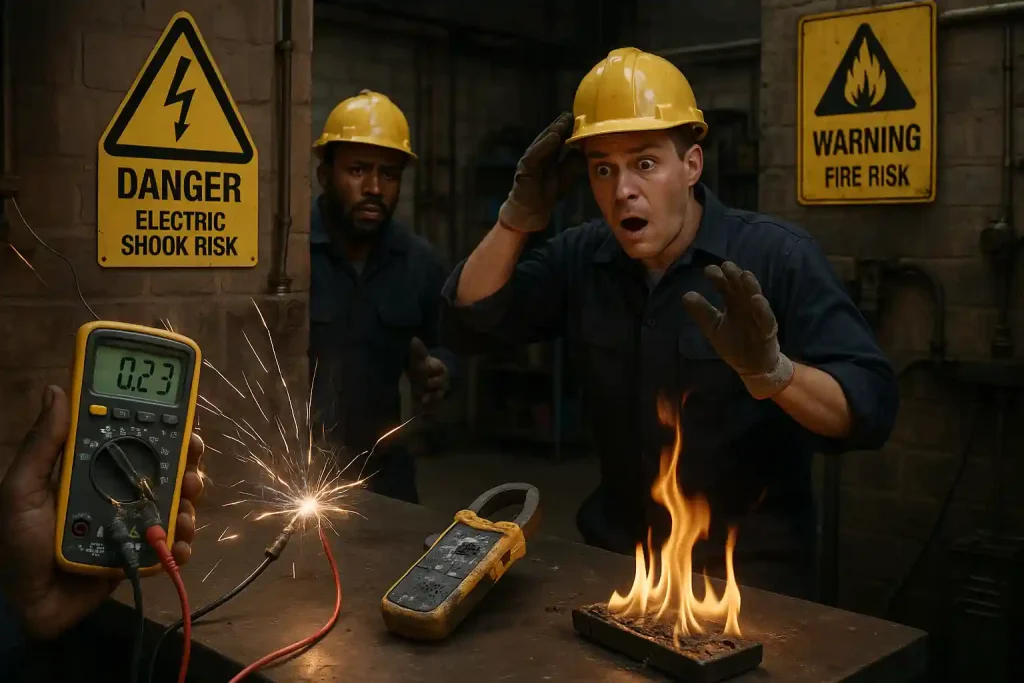
- Electric Shock Hazard: Electric shock is one of the most serious threats when working with testing and measuring equipment. Even low voltages can be dangerous. Using a device with an inappropriate safety rating can allow excessive current to flow through the operator’s body.
- Damage to the Device: Connecting the device to a voltage or current source beyond its rated capacity can result in the burning of circuit boards, fuses, and sensors.
- Fire and Explosion: Incorrect connections, fuse failure, or the ingress of conductive dust can create sparks, leading to fire or explosion, especially in industrial environments.
Overview of Global Safety Standards
Global safety standards define the required characteristics a device must have in terms of design, insulation, voltage withstand capability, mechanical protection, and resistance to environmental conditions.
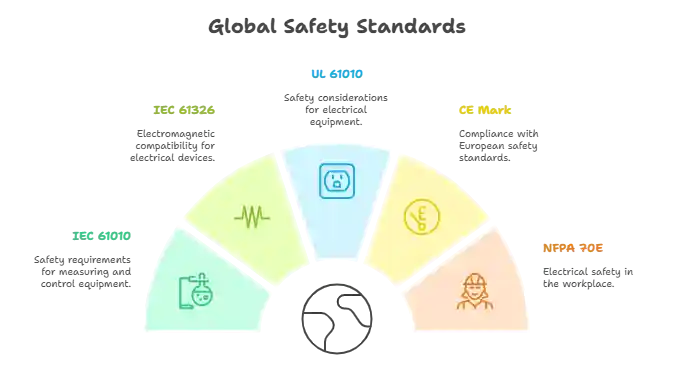
Some of the most well-known standards include:
- IEC 61010: Specifies electrical and mechanical safety requirements for measuring equipment. CAT ratings (CAT I to CAT IV) are defined here.
- IEC 61326: Covers electromagnetic compatibility (EMC) requirements to prevent measurement errors.
- UL 61010: The U.S. standard for electrical measuring tool safety, certified by Underwriters Laboratories.
- CE Mark: European conformity mark indicating compliance with EU safety, health, and environmental standards.
- NFPA 70E: Workplace electrical safety standard in the USA for hazard assessment and PPE requirements.
| Standard / Mark | Issuing Body | Scope | Relevance to Multimeter Safety |
|---|---|---|---|
| IEC 61010 | IEC | Electrical & mechanical safety; CAT ratings | Defines voltage safety levels, insulation, and shock protection |
| IEC 61326 | IEC | Electromagnetic compatibility (EMC) | Prevents errors under electromagnetic interference |
| UL 61010 | UL (USA) | Safety per U.S. regulations | Required for sale and compliance in the U.S. market |
| CE Mark | European Union | Safety & environmental protection | Authorization for the European market |
| NFPA 70E | NFPA (USA) | Electrical safety at work; PPE | Reduces shock and arc-flash risk in facilities |
Voltage Safety Categories (CAT Ratings)
CAT ratings define how safely a multimeter or clamp meter can handle transient overvoltages and surges at different points in an electrical system.
Reference: Advanced Energy. (n.d.). Application Note 603: Understanding the CAT ratings on a voltmeter.

What is CAT (Category) in Electrical Safety?
CAT (Category) is a safety classification (defined in IEC 61010) that indicates the transient energy a tester can withstand at specific locations in the power distribution chain.
- It’s about surge energy and impulse withstand, not measurement accuracy.
- Always consider both the CAT level and the voltage rating printed on your instrument and test leads.
Reference: DigiKey. (2020). What are multimeter CAT (category) safety ratings?
CAT Rating Chart
The measurement load is categorized into four distinct levels based on its type.
| Rating | Typical Location | Common Examples | Practical Guidance |
|---|---|---|---|
| CAT I | Internal, low-energy circuits | Signal boards, bench electronics, adapter outputs | Not suitable for mains power connections |
| CAT II | Load side / receptacle level | Household outlets, portable appliances, office gear | Not sufficient for building distribution panels |
| CAT III | Building distribution | Switchboards, distribution panels, fixed wiring, motors | Standard for most commercial and facility maintenance |
| CAT IV | Service entrance / outdoors | Utility meters, service feeders, outdoor lines | Highest protection against high-energy transients |
What Is the Difference Between CAT III and CAT IV?
The main differences between CAT III and CAT IV safety ratings lie in their measurement location, transient energy withstand capability, and specific applications:
- Measurement Location: CAT III covers distribution inside the building (e.g., sub-panels, branch circuits, and fixed equipment). CAT IV covers the origin of the installation (e.g., utility meters, service entrance, and outdoor overhead/underground lines).
- Transient Surge Energy: CAT IV instruments are engineered to safely withstand much higher energy transients and voltage spikes than CAT III equipment.
- Typical Applications:
- CAT III: Distribution panels, switchboards, busbars, junction boxes, and hard-wired industrial machinery.
- CAT IV: Electric utility meters, primary service disconnects, incoming service feeders, and outdoor conductors.
- Downward Compatibility: A CAT IV rated tool can generally be used in CAT III and CAT II locations (provided the operating voltage and accessory ratings match the task). However, CAT III tools must never be used in CAT IV environments.
CAT III 1000V vs CAT IV 600V – which is safer for you?
Choosing between these depends on where you measure and the voltage level present:
| Scenario | Recommended Choice | Reason |
|---|---|---|
| Measuring service entrance or outdoor feeder up to 600V | CAT IV 600V | Higher transient surge risk requires CAT IV protection |
| Measuring inside distribution panel up to 1000V | CAT III 1000V | Indoor panel requires higher continuous working voltage |
| Mixed or uncertain environments | CAT IV 600V (or higher) | Select the tool matching the highest foreseeable risk |
How to Read CAT Markings on Your Meter and Test Leads
Electrical test instruments and leads feature markings such as CAT III 600V or CAT II 1000V. To properly interpret these ratings:
- First Part (CAT Level): Identifies the installation category (location in the electrical network) where the meter can safely withstand transient voltage spikes.
- Second Part (Voltage Rating): Specifies the maximum continuous working voltage (to ground) allowed for that specific category.
Common Examples Explained:
- CAT III 600V: Safe for indoor distribution panel work up to 600V.
- CAT II 1000V: Safe for receptacle-level and appliance measurements up to 1000V.
- Dual-Rated (CAT III 600V / CAT II 1000V): In higher-risk environments (CAT III), the maximum safe working voltage is restricted to 600V, while in lower-transient locations (CAT II), it supports measurements up to 1000V.
Safety Note: Always ensure that both your multimeter and your test probes/leads carry ratings that match or exceed the category and voltage of the circuit being tested.
How to Choose the Right CAT Rating

To select the appropriate CAT rating for your test equipment, evaluate your working environment, location in the electrical distribution system, and expected transient risks:
- CAT I: Best for low-energy, protected electronic circuits, signal boards, and battery-operated equipment.
- CAT II: Suitable for single-phase receptacle-connected loads, home appliances, portable power tools, and office equipment.
- CAT III: The standard choice for commercial and industrial facility distribution, including three-phase switchgear, circuit breaker panels, motors, and fixed industrial wiring.
- CAT IV: Essential for the origin of the installation, such as utility power meters, outdoor overhead/underground lines, and primary service entrance equipment where transient overvoltage risks are highest.
Selection Tip: Always verify that both the multimeter and your test probes/leads carry ratings that match or exceed the category and voltage of the circuit being tested.
Environmental Protection Standards (IP Ratings)
If you’ve ever searched for an easy IP rating chart, the official IP rating standard (IEC 60529), or a plain-English guide to IP ratings meaning, this section breaks it all down so you can choose the right multimeter, clamp meter, or thermometer for tough environments.
Reference: APEM. (2023). Understanding IP rating: Protect your HMIs from dust and water.
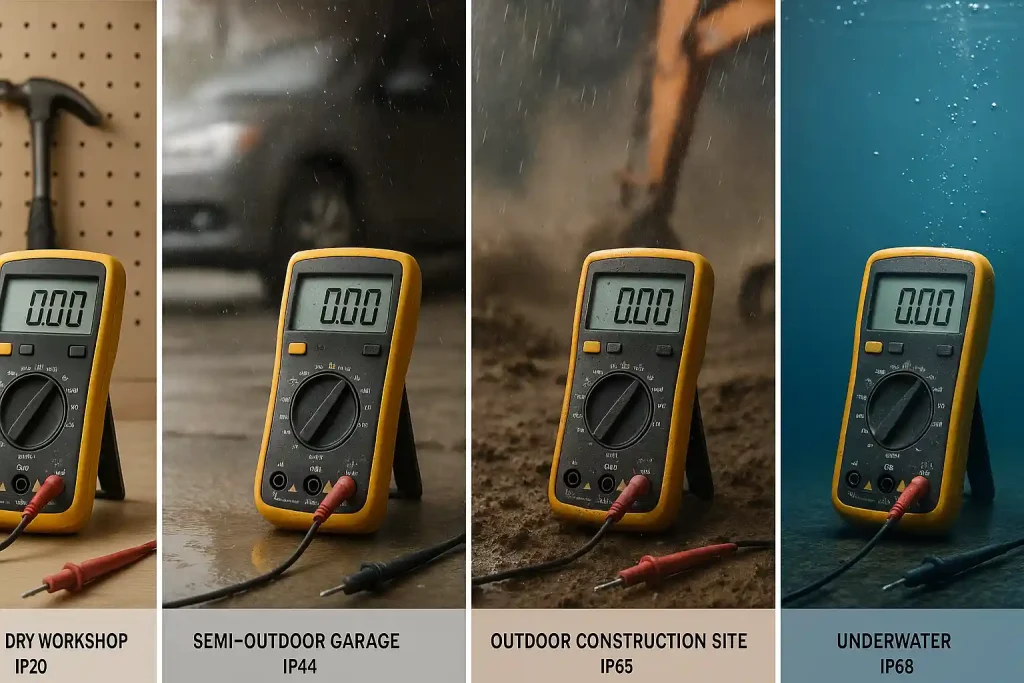
What are the different types of IP ratings?
IP ratings (Ingress Protection ratings) classify the level of protection an electrical enclosure or test instrument offers against the intrusion of solid objects, dust, and liquids. Defined under the IEC 60529 international standard, an IP code typically consists of two digits (e.g., IPXY):
- First Digit (X) – Solids & Dust: Measures protection against physical contact and the ingress of solid foreign objects (ranging from 0 to 6).
- Second Digit (Y) – Liquids & Moisture: Measures protection against harmful ingress of water, from light dripping to continuous immersion under pressure (ranging from 0 to 9K).
Here is a breakdown of the standard IP rating classification levels:
How the IP Code is Structured
The code is written as IPXY:
- X (First digit, 0–6): Protection against solid objects and dust.
- Y (Second digit, 0–9K): Protection against water and moisture.
Example: IP54 offers limited dust protection and resistance to water splashes from any direction.
IP Rating Chart (Full Breakdown for First and Second Digits)
First Digit (X): Solids & Dust Protection
| Digit (X) | Protection Level & Object Size |
|---|---|
| 0 | No protection against contact or entry of objects. |
| 1 | Protected against solid objects > 50 mm (e.g., accidental back-of-hand touch). |
| 2 | Protected against solid objects > 12.5 mm (e.g., fingers or similar objects). |
| 3 | Protected against solid objects > 2.5 mm (e.g., tools, thick wires). |
| 4 | Protected against solid objects > 1 mm (e.g., most wires, slender screws, small debris). |
| 5 | Dust-Protected: Ingress of dust is not entirely prevented, but it cannot enter in sufficient quantity to interfere with safe operation. |
| 6 | Dust-Tight: Complete protection against dust ingress (vacuum seal level). |
Second Digit (Y): Moisture & Liquid Protection
| Digit (Y) | Protection Level & Water Exposure |
|---|---|
| 0 | No water protection. |
| 1 | Protected against vertically dripping water. |
| 2 | Protected against vertically dripping water when enclosure is tilted up to 15°. |
| 3 | Protected against direct spraying water up to 60° from vertical. |
| 4 | Splash-Proof: Protected against water splashing from any direction. |
| 5 | Water Jets: Protected against low-pressure water jets (6.3 mm nozzle) from any angle. |
| 6 | Powerful Water Jets: Protected against strong water jets (12.5 mm nozzle) and heavy seas. |
| 7 | Temporary Immersion: Protected against submersion in water up to 1 meter depth for 30 minutes. |
| 8 | Continuous Immersion: Protected against continuous submersion under specified depth and pressure conditions. |
| 9 | Protected against close-range, high-pressure, high-temperature washdowns. |
| 9K | Steam-Jet Washdown (ISO 20653): Extreme protection against high-pressure, high-temperature water/steam cleaning. |
Common Industrial IP Ratings Explained
- IP40: Solid debris protection only; no liquid resistance. Suitable for clean, climate-controlled indoor laboratories and classrooms.
- IP54: Limited dust ingress + splash-water resistance. Recommended for general industrial maintenance and damp plant floors.
- IP67: Dust-tight + submersible (1m). Ideal for outdoor utility work, severe weather, muddy environments, and heavy rain.
- IP69 / IP69K: Withstands high-pressure, high-temperature cleaning; typical for hygienic or chemical washdown zones.
Quick IP Rating Selection Guide
- IP40: Clean, dry indoor laboratories and workshops.
- IP54: Dusty environments with light water splash resistance.
- IP67: Dust-tight and resistant to temporary water immersion (ideal for outdoor field work).
- IP69 / IP69K: High-pressure, high-temperature washdown areas.
Other Safety Parameters
When selecting and using electrical measuring instruments, besides CAT ratings and IP ratings, several other critical safety parameters help prevent hazards, protect technicians, and extend equipment operating life:
HRC Fuses (High Rupturing Capacity Fuses)
HRC fuses are vital safety components engineered with sand-filled ceramic bodies capable of extinguishing massive fault currents in milliseconds. Unlike standard automotive or glass fuses, HRC fuses safely isolate high energy arcs without violently exploding under catastrophic short-circuit conditions.
Always replace blown fuses exclusively with manufacturer-specified HRC fuses matching the exact voltage and breaking-capacity rating.
Double Insulation Design
Double insulation incorporates two independent, redundant insulation barriers between hazardous live parts and external user-accessible surfaces. This design eliminates shock hazards even if primary insulation degrades due to wear or moisture ingress.
In professional test instruments—especially CAT III and CAT IV multimeters—double insulation ensures technician protection against hazardous transient flashover.
Overvoltage Transient Protection
High-quality meters incorporate metal-oxide varistors (MOVs), spark gaps, and PTC thermistors to absorb and divert transient voltage spikes resulting from lightning strikes, grid switching, or inductive motor shutoffs before reaching sensitive internal circuits.
Ensure that your instrument incorporates verified overvoltage suppression capable of withstanding the transient peak voltages mandated by IEC 61010.
Input Alert (Lead Error Warning)
Modern industrial multimeters include an audible and visual Input Alert that triggers whenever test leads are plugged into current (A/mA) jacks while the selector dial remains on Voltage. This prevents dangerous dead short-circuits across energized buses.
Special Standards for Hazardous & Explosive Environments
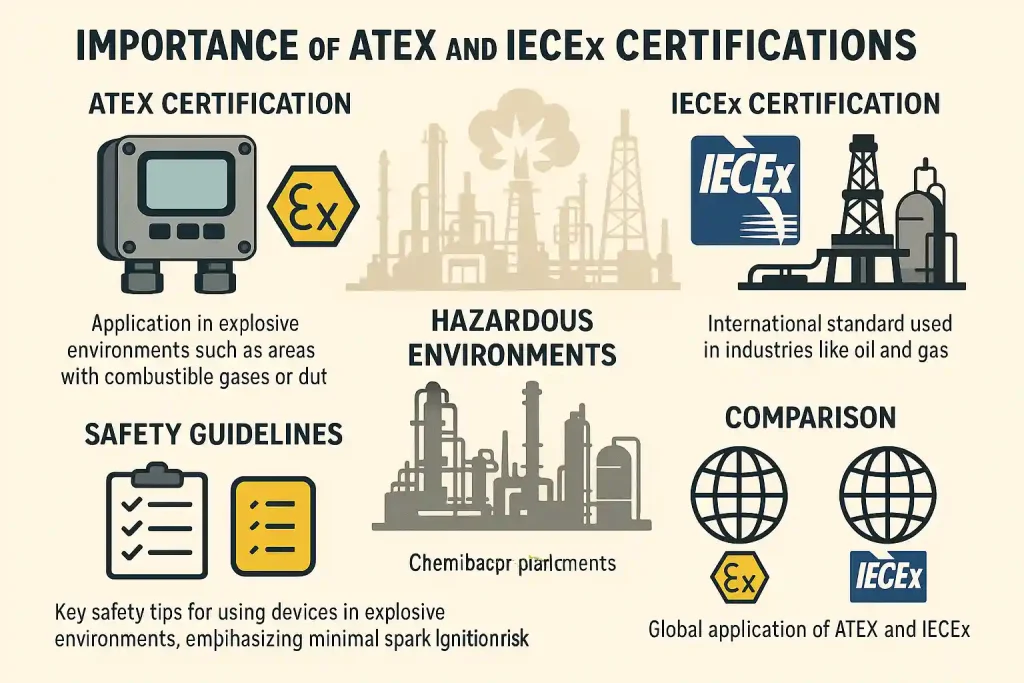
Testing in volatile atmosphere environments requires specialized intrinsic-safety approvals to eliminate any possibility of ignition sparks or excessive thermal surface temperatures.
ATEX for Explosive Environments
ATEX (Atmosphères Explosibles) is the European Union directive governing equipment used in potentially explosive gas, vapor, or combustible dust atmospheres. Certified intrinsically safe devices are engineered so internal electrical energy cannot ignite surrounding hazards.
Reference: European Commission directive on Equipment for Potentially Explosive Atmospheres (ATEX).
IECEx Global Certification
IECEx provides international verification for hazardous-location equipment across global markets including the Middle East, Americas, and Asia-Pacific energy corridors.
Reference: IECEx System for Explosive Atmospheres.
Third-Party Certifications: UL, TÜV, CSA, and CE
Self-declared markings can be misleading. Always ensure your test equipment carries independent, third-party NRTL (Nationally Recognized Testing Laboratory) stamps such as UL, TÜV, or CSA alongside the mandatory CE conformity mark.
Safety Inspection & Maintenance Checklist for Test Tools
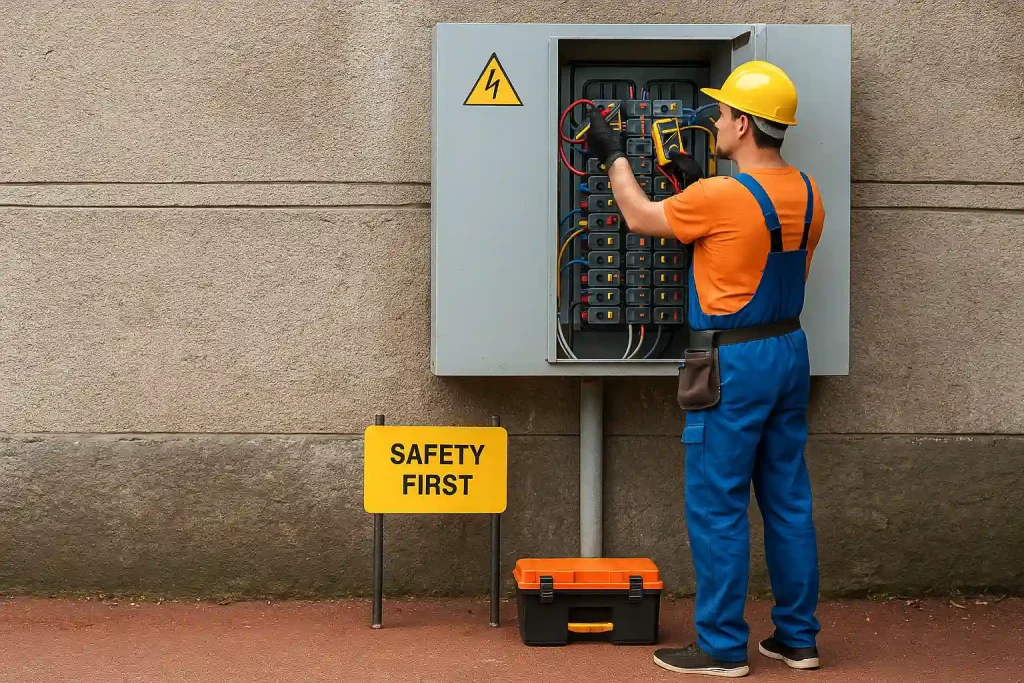
Even premium rated tools require regular verification to maintain their protective integrity over time.
Pre-Use Inspection Routine
- Housing & Casing: Inspect for stress fractures, cracked display lenses, chemical discoloration, or port warping.
- Test Leads & Probes: Check for nicked, melted, or brittle lead insulation. Ensure probe tips are clean and shrouds are firmly fitted.
- Fuse Continuity: Use the meter’s internal continuity test to confirm current-range fuses are intact before measuring loads.
Maintaining Category (CAT) Integrity
- Avoid Unauthorized Repairs: Opening calibrated housings without certified ESD/resealing protocol compromises creepage and clearance distances.
- OEM Parts Only: Never replace HRC ceramic fuses with fast-blow glass fuses or jumper wires.
- Keep Input Terminals Clean: Conductive dust buildup inside probe jacks can foster internal arcing under high voltage.

Maintaining Ingress Protection (IP) Sealing
- Inspect Gaskets: Verify battery-door elastomeric seals and O-rings are clean and uncompressed after cell replacement.
- Gentle Decontamination: Clean exterior cases using a damp microfiber cloth; avoid harsh aromatic solvents or total submersion unless explicitly rated IP68.
Recommended Calibration & Dielectric Test Intervals
- Severe Industrial / Utility Fieldwork: Recalibrate and perform insulation dielectric breakdown checks every 6 months.
- Standard Bench / HVAC Operations: Verify annually (12-month interval).
Complementary International Regulatory Standards
| Standard / Mark | Regulatory Focus | Significance for Field Technicians |
|---|---|---|
| UL (Underwriters Laboratories) | Product safety testing and certification for the US market. | Confirms adherence to strict electrical safety standards for use in North America. |
| CE (Conformité Européenne) | EU’s health, safety, and environmental protection conformity. | Mandatory for sale in the European Economic Area; ensures compliance with EU directives. |
| RoHS (Restriction of Hazardous Substances) | Limits toxic materials (lead, mercury, cadmium, etc.) in electronics. | Guarantees environmental responsibility and reduced health risks from device components. |
| EMC (Electromagnetic Compatibility) | Ensures devices do not interfere with each other electromagnetically. | Crucial in industrial settings to prevent operational disruptions caused by electromagnetic interference (EMI). |
| CSA (Canadian Standards Association) | Safety and performance certification primarily for Canada. | Equivalent to UL for the Canadian market, ensuring product safety compliance. |
| TÜV | Independent safety and quality testing, prominent in Germany/Europe. | A respected mark indicating rigorous third-party safety assessment. |
| Standard | Purpose | Application in Measuring Equipment |
|---|---|---|
| ISO 9001 | Quality Management System | Ensures a stable and controlled manufacturing process |
| ISO 14001 | Environmental Management | Reduces the environmental impact of production |
| CSA (Canada Standards Association) | Safety and Performance | Similar to UL but for the Canadian market |
| TÜV | Safety and Quality Testing | Popular in the German and European markets |
Why These Certifications Matter:
- Global Market Access: Facilitates international sales and distribution.
- Enhanced User Trust: Builds confidence in product safety and reliability.
- Regulatory Compliance: Avoids legal penalties and product recalls.
- Quality Assurance: Demonstrates commitment to high manufacturing standards.
In summary, selecting the right multimeter involves a holistic approach. Understanding and verifying CAT ratings, IP ratings, HRC fuse capabilities, and international certifications like UL, CE, and RoHS is paramount. Regular maintenance and safety checks further ensure that your equipment remains a reliable and safe partner in any electrical task, preventing costly incidents and extending operational life.
What are CAT Ratings?
CAT ratings define the safety of electrical testing equipment based on its ability to handle transient overvoltages in different electrical environments, ranging from CAT I for low-energy circuits to CAT IV for high-voltage service lines.
What are Multimeter CAT (Category) Safety Ratings?
Multimeter CAT ratings indicate the device's ability to safely measure voltages in various environments, ensuring protection against electrical surges and transient voltages. These ratings range from CAT I (low-voltage circuits) to CAT IV (high-voltage systems).
What is the IEC standard for IP rating?
The IEC 60529 standard defines the IP (Ingress Protection) rating, which indicates how well an electrical device is protected against dust and water intrusion.
What is IP rating in safety?
IP rating determines the level of protection against solid objects (like dust) and liquids (like water). A higher IP rating means better protection, making the device safer for use in harsh environments.
What is IP rating in EV?
In Electric Vehicles (EVs), an IP rating ensures that electrical components like battery packs and charging ports are protected against environmental elements such as water and dust, ensuring safe operation in various conditions.
What are the different types of IP ratings?
IP ratings are defined by two digits:
The first digit (0-6) indicates protection against solids.
The second digit (0-9) indicates protection against liquids.
Examples: IP54 (dust protected and water splash resistant), IP67 (dust-tight and waterproof up to 1 meter).
What is the difference between IP65, IP66, IP67, and IP68?
IP65: Dustproof and resistant to water jets.
IP66: More resistant to strong water jets.
IP67: Dust-tight and resistant to immersion in water (up to 1 meter for 30 minutes).
IP68: Dust-tight and resistant to continuous immersion in water beyond 1 meter.
What are the four main types of IP?
The four main IP ratings:
IP40: Protects against dust larger than 1mm.
IP54: Dust protected and water splash resistant.
IP67: Dust-tight and resistant to immersion in water.
IP69K: Dust-tight and resistant to high-pressure water jets.
Is IP54 better than IP44?
Yes, IP54 offers better dust protection than IP44. Both are similar in water resistance, but IP54 is better for environments with dust exposure.
Need compliant test equipment? MME supplies Megger insulation and electrical safety testers in the UAE as the official Megger distributor in Dubai and the GCC.
 Bench Multimeters