


When it comes to precision and accuracy in electrical measurements, the tools you use can make a significant difference. For professionals in the field, choosing the right calibrator can be crucial. The Fluke 705 and the Fluke 707 are two dynamic options that have garnered attention for their reliability and functionality. But which one stands out for your specific needs? In this comprehensive comparison, we’ll delve into the features, benefits, and ideal scenarios for each. Whether you’re an engineer, technician, or simply someone keen on understanding these tools better, read on to find out which calibrator might be your best fit.
Key Features Comparison Fluke 705 vs 707
Let’s start by comparing the key features of Fluke 705 vs 707 in a detailed table. This will help you quickly identify the differences and decide which model suits your needs better.
| Feature | Fluke 705 | Fluke 707 |
|---|---|---|
| Accuracy | ±0.02% + 2 LSD | ±0.015% + 2 LSD |
| Measurement Range | 0 to 24 mA (0.001 mA resolution) | 0 to 24 mA (0.001 mA resolution) |
| Sourcing Range | 0 to 20 or 4 to 20 mA | 0 to 20 or 4 to 20 mA |
| Load Drive Capacity | 1000 ohms at 24 mA | 1200 ohms at 24 mA |
| Display | Large, clear display | Backlit display for low-light conditions |
| User Interface | Push button for settings | Quick Click dial for faster adjustments |
| Battery Life | 18 hours at 12 mA | 18 hours at 12 mA |
| Advanced Features | Ramp and Step Ramp | Span Check, Ramp, Step Ramp |
| Price | More affordable | Higher cost with more features |
| Datasheet | View Fluke 705 Datasheet | View Fluke 707 Datasheet |
Detailed Breakdown of Fluke 705 vs 707 Differences
When comparing two professional loop calibrators like the Fluke 705 and Fluke 707, it’s important to go beyond the basics. While both tools serve similar functions, the subtle distinctions in accuracy, usability, interface design, and advanced features can significantly impact your workflow—especially in demanding industrial environments. In the following sections, we’ll explore each of these key categories to give you a detailed and practical understanding of how these two calibrators differ, and more importantly, which one is the right fit for your applications.1
Accuracy Comparison Fluke 705 vs 707
-
Fluke 705: Provides ±0.02% accuracy, which is perfect for most general industrial calibration tasks. This level of accuracy is sufficient for routine measurements.
-
Fluke 707: Offers ±0.015% accuracy, making it ideal for applications requiring high precision and attention to detail.
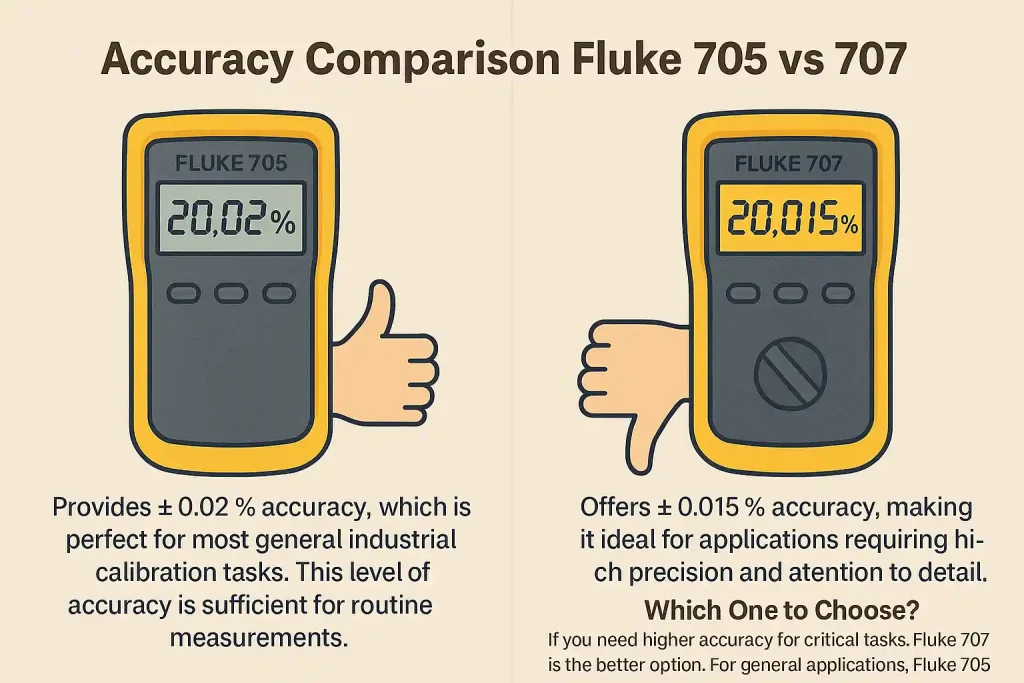
Which One to Choose?
If you need higher accuracy for critical tasks, Fluke 707 is the better option. For general applications, Fluke 705 will suffice.
Measurement and Sourcing Range Fluke 705 vs 707
Both the Fluke 705 and Fluke 707 feature a 0 to 24 mA range with 0.001 mA resolution, which is suitable for most current loop applications. However, the Fluke 707 provides better overall precision, especially at the lower and higher ends of the range.

Which One to Choose?
If you are working in environments requiring fine-tuned precision, Fluke 707 is the superior choice. However, for day-to-day calibration tasks, Fluke 705 provides solid performance.
Load Drive Capacity Fluke 705 vs 707
-
Fluke 705: Capable of driving 1000 ohms at 24 mA, which is suitable for most common industrial applications.
-
Fluke 707: Can drive 1200 ohms at 24 mA, making it more suitable for applications involving higher resistance loads.
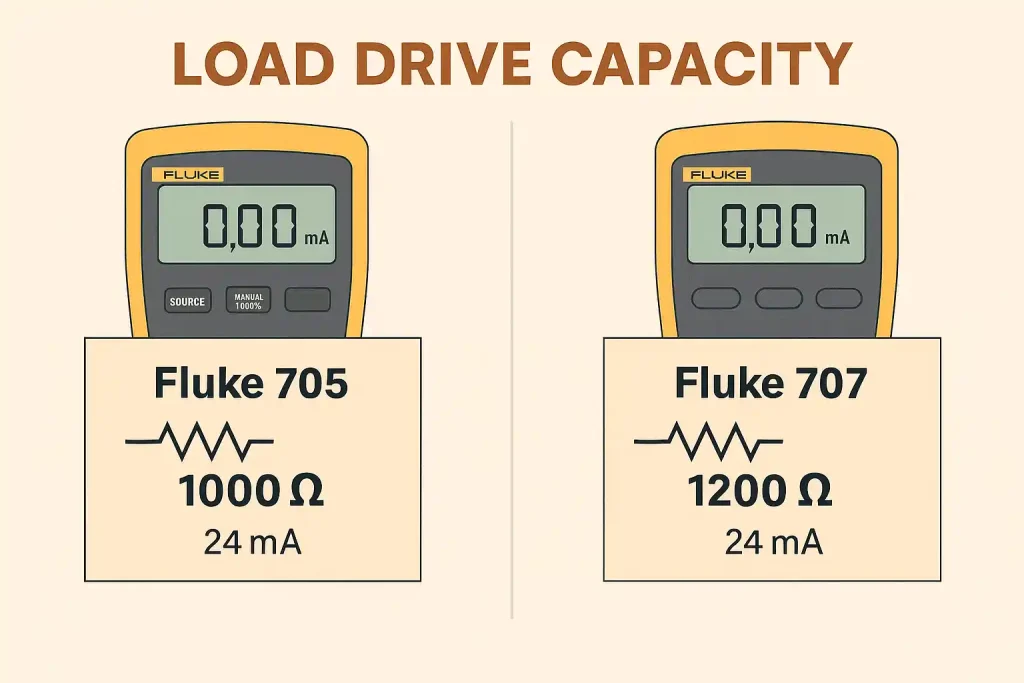
Which One to Choose?
If you’re working with systems requiring higher load resistance, Fluke 707 is the better choice due to its superior load drive capacity.
Display Comparison Fluke 705 vs 707
-
Fluke 705: Offers a large, clear digital display. However, it lacks a backlight, making it less readable in low-light conditions.
-
Fluke 707: Features a backlit display, which makes it much easier to read in low-light environments.
Which One to Choose?
If you work in low-light conditions frequently, Fluke 707 with its backlit display is the ideal choice.
User Interface Speed Fluke 705 vs 707
-
Fluke 705: Uses push buttons for adjustments.
-
Fluke 707: Features a Quick Click dial, which allows for faster and more precise adjustments, especially when working with complex setups.
Which One to Choose?
For those who need quick adjustments during calibration, the Fluke 707 with its Quick Click dial offers a more efficient user experience.
Advanced Features Fluke 705 vs 707
-
Fluke 705: Offers basic Ramp and Step Ramp functions, which are suitable for standard calibration tasks.
-
Fluke 707: Includes advanced features such as Span Check, along with Ramp and Step Ramp, providing more precise calibration.
Which One to Choose?
If you require advanced calibration features, the Fluke 707 is the better choice with its added functionality.
Price Comparison Fluke 705 vs 707
-
Fluke 705: Priced more affordably, making it a great option for professionals who need a reliable calibrator without the extra cost of advanced features.
-
Fluke 707: Priced higher due to its additional features and higher precision, but it provides great value for industries requiring advanced functionality.
Which One to Choose?
If budget is important and you don’t need advanced features, the Fluke 705 provides excellent value. However, for those needing higher accuracy and more advanced features, the Fluke 707 justifies the higher price.
Conclusion Fluke 705 vs 707 – Which One Should You Choose?

Both Fluke 705 and Fluke 707 are excellent loop calibrators, but your choice depends on your specific needs:
-
If you’re looking for a reliable, cost-effective calibrator for general calibration tasks, Fluke 705 is a great option.
-
If you need higher precision, advanced features, or better usability in low-light environments, Fluke 707 is the superior choice.
Confused between models?Click here and let us help you choose smarter

- Fluke Corporation. (n.d.). Fluke 705 and Fluke 707 loop calibrators. Retrieved August 2, 2025[↩]





د.إ0.00 (excl.VAT)
(4 reviews)


د.إ0.00 (excl.VAT)
(5 reviews)


 Bench Multimeters