

5 kV vs 10 kV vs 15 kV Insulation Resistance Tester: How to Choose the Right Test Voltage
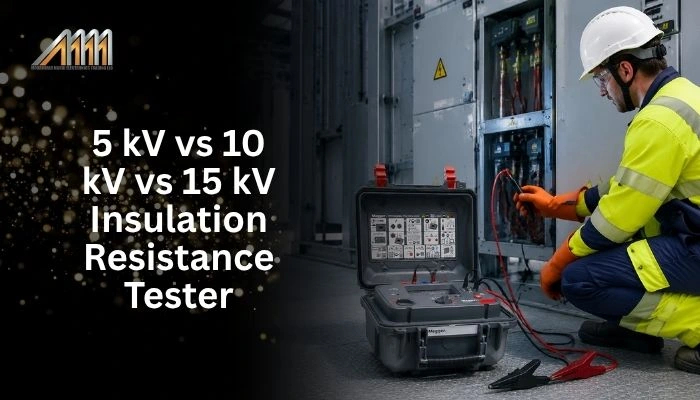
A comprehensive technical guide for electrical maintenance engineers, commissioning experts, and procurement teams evaluating high-voltage insulation diagnostics.
Executive Summary
Selecting between a 5 kV, 10 kV, or 15 kV insulation resistance tester is not simply a matter of “higher voltage is better.” Test voltage selection depends on asset operating ratings, international testing standards (IEEE, IEC, NETA), asset capacitance, and diagnostic requirements. This guide breaks down exact voltage thresholds, application criteria, and model capabilities.
1. Introduction: Understanding High-Voltage Insulation Testing
In industrial power systems, insulation failure is the leading cause of electrical equipment breakdown. High-voltage Insulation Resistance (IR) diagnostic testing allows engineers to identify dielectric degradation, moisture ingress, contamination, and mechanical voids before catastrophic failure occurs.
When selecting portable high-voltage diagnostic equipment, engineers often face a key decision: Should you invest in a 5 kV, 10 kV, or 15 kV insulation tester?
A common misconception in the field is that purchasing a higher-voltage unit automatically covers all testing needs. However, applying an improper test voltage can damage equipment, yield unreliable dielectric readings, or violate manufacturer warranties.
Golden Rule of Insulation Diagnostics: Test voltage must be selected strictly according to the equipment manufacturer’s instructions and applicable IEEE/IEC standards—not simply because a higher-voltage tester provides a higher resistance reading.
2. Quick Comparison: 5 kV, 10 kV, and 15 kV Testing Capabilities
Before examining individual voltage classes in detail, the table below provides a quick reference breakdown for field applications and target user groups:
| Test Voltage | Typical Applications | Target Users & Field Scope |
|---|---|---|
| 5 kV | Medium-voltage (MV) motors, generators, MV switchgear, distribution transformers, MV power cables (up to 5 kV rating). | Plant maintenance teams, general electrical contractors, facility engineers. |
| 10 kV | High-voltage (HV) cables, large power transformers, power plant generators, transmission substations, predictive maintenance diagnostics. | Utility companies, heavy industrial complexes, commissioning engineers. |
| 15 kV | Critical high-voltage assets (>15 kV rated), extra-large power transformers, long transmission cables, primary utility substations. | Specialized HV diagnostic services, national utility grids, critical infrastructure specialists. |
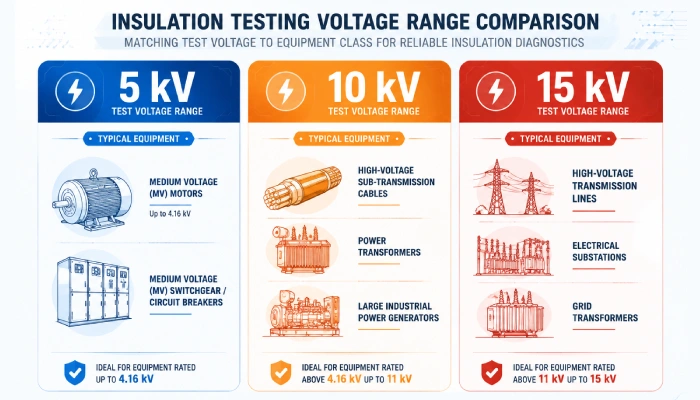
*Note: The applications listed above represent standard industry field guidelines. Always cross-reference specific equipment standards before applying DC test voltages.
3. When Should You Choose a 5 kV Insulation Tester?
A 5 kV insulation resistance tester is the industry benchmark for general industrial maintenance and medium-voltage electrical asset management. According to IEEE 43-2000 (R2013) standards for rotating machinery rated between 2,400 V and 4,160 V, a 2,500 V to 5,000 V DC test is standard practice.
Primary Applications:
- Industrial Electric Motors & Generators: Rated up to 4.16 kV or 6.6 kV winding insulation.
- Medium-Voltage Switchgear: Busbars, circuit breakers, and disconnect switches.
- Distribution Transformers: Primary and secondary winding diagnostics.
- Medium-Voltage Power Cables: Feeder cables rated up to 5 kV operating voltage.
- Routine Preventive Maintenance: Periodic spot-reading (IR) and Polarization Index (PI) testing.
Key Advantages of 5 kV Units:
- Portability & Ergonomics: Generally lighter weight and more compact for field work.
- Cost-Effective: Lower initial purchase price compared to 10 kV/15 kV diagnostic sets.
- Standard Maintenance Fit: Meets >80% of routine industrial manufacturing plant requirements.
Featured 5 kV Instruments: Industry standards include the Megger MIT515/2 (entry-level maintenance) and Megger MIT525/2 (advanced diagnostic set with memory and ramp testing).

7% off
Megger MIT515/2 5 kV Insulation Resistance Tester
Original price was: د.إ15,999.00.د.إ14,800.00Current price is: د.إ14,800.00. (excl.VAT)
The Megger MIT515/2 is the advanced 5 kV insulation resistance tester measuring up to 15 TΩ, adding a colour display, RE>Act and PIp diagnostics, s...
More info
Megger MIT525/2 5 kV Insulation Resistance Tester
د.إ15,900.00 (excl.VAT)
The Megger MIT525/2 is the advanced 5 kV insulation resistance tester measuring up to 15 TΩ, with a colour display, RE>Act and PIp diagnostics, sel...
More info4. When Should You Choose a 10 kV Insulation Tester?
As equipment operating voltages increase above 4.16 kV into the 12 kV, 13.8 kV, or 24 kV classes, a 5 kV test voltage may no longer adequately stress the insulation system to reveal micro-cracks, moisture channels, or void treeing.
Primary Applications:
- High-Voltage Cables: 15 kV to 35 kV class shielded power cables.
- Large Power Transformers: Substation step-up and distribution power transformers.
- High-Voltage Utility Generators: Turbine generators in power plants rated above 6.9 kV.
- Electrical Substations: Main buswork, insulators, and oil/gas-insulated breakers.
- Commissioning & Acceptance Testing: Baseline characterization for new equipment installations (NETA World standards).
A 10 kV tester is widely considered the most versatile all-in-one professional unit for service providers, high-voltage testing companies, and utility engineers who work across both medium and high-voltage assets.
Featured 10 kV Instruments: Key instruments in this category include the Megger MIT1015 and Megger MIT1025/2, offering resistance measurement capabilities up to 20 TΩ.

17% off
Megger MIT1015 10 kV Insulation Resistance Tester
Original price was: د.إ19,046.00.د.إ15,800.00Current price is: د.إ15,800.00. (excl.VAT)
The Megger MIT1015 is a 10 kV digital insulation resistance tester and megohmmeter measuring up to 20 TΩ, with selectable 500 V–10 kV test voltages, c...
More info
9% off
Megger MIT1025/2 10 kV Insulation Resistance Tester
Original price was: د.إ23,500.00.د.إ21,500.00Current price is: د.إ21,500.00. (excl.VAT)
The Megger MIT1025/2 is the advanced 10 kV insulation resistance tester measuring up to 20 TΩ, adding a colour display, RE>Act and PIp diagnostics,...
More info5. When Should You Choose a 15 kV Insulation Tester?
The 15 kV voltage class represents the top tier of portable DC insulation testing. IEEE 95-2002 guidelines for high-voltage machinery recommend testing voltages up to 200% to 250% of the rated AC line-to-line voltage during diagnostic insulation checks.
Primary Applications:
- Critical Utility Power Transformers: 138 kV, 230 kV, and 500 kV grid transformers.
- Long High-Voltage Transmission Cables: Where high capacitive charging currents require superior power output.
- Large Utility Turbo-Generators: High-capacity generating units requiring high test current output to charge large windings quickly.
- Specialized Substation Diagnostics: Evaluating advanced dielectric absorption parameters on critical infrastructure.
Important Technical Note: A 15 kV tester is not intended to replace a 5 kV or 10 kV unit by simply dialing down the voltage unless specified by procedure. It is built for extra-high voltage assets. When testing at 15 kV DC, extreme safety precautions, proper guard terminal wiring, and operator certification are mandatory.
Featured 15 kV Instruments: The Megger MIT1525 / MIT1525/2 sets the industry standard, offering resistance measurements up to 30 TΩ and up to 6 mA short-circuit charging current.

11% off
Megger MIT1525/2 15 kV Insulation Resistance Tester
Original price was: د.إ28,999.00.د.إ25,800.00Current price is: د.إ25,800.00. (excl.VAT)
The Megger MIT1525/2 is the flagship 15 kV insulation resistance tester measuring up to 30 TΩ, with a colour display, RE>Act and PIp diagnostics, s...
More info6. In-Depth Feature Comparison Matrix
Selecting the proper unit involves evaluating operational requirements against hardware capabilities:
| Evaluation Criteria | 5 kV Tester | 10 kV Tester | 15 kV Tester |
|---|---|---|---|
| Target Asset Class | Medium Voltage (up to 4.16 kV) | HV Cables / Substation Assets | Critical Grid Infrastructure (>15 kV) |
| Typical Max Resistance | Up to 10 TΩ | Up to 20 TΩ | Up to 30 TΩ |
| Noise Immunity | 3 mA to 4 mA typical | 3 mA to 6 mA high noise filter | Enhanced noise rejection (up to 8 mA) |
| Large Transformer Fit | Limited (Distribution size) | High (Transmission size) | Optimal (Main Generating Sets) |
| Capacitive Asset Charging | Standard speed | Fast charging capability | Ultra-fast charging capability |
| Capital Investment | |||
| Large Transformer Fit | Limited (Distribution size) | High (Transmission size) | Optimal (Main Generating Sets) |
| Capacitive Asset Charging | Standard speed | Fast charging capability | Ultra-fast charging capability |
| Capital Investment | Moderate | Moderate-to-High | Premium / Specialized |
| Skill Level Required | Standard Technician |
“Never increase the test voltage beyond the level prescribed by the equipment manufacturer or applicable IEEE/NETA standard unless performing a structured, controlled step-voltage diagnostic test.” |
8. Key Specifications to Evaluate Before Purchasing
While output voltage (5 kV, 10 kV, 15 kV) is crucial, high-voltage testing performance relies on several additional specifications:
A. Insulation Resistance Range (Teraohms – TΩ)
Ensure the instrument offers high resistance range capabilities. Modern insulation diagnostic instruments should measure up to 10 TΩ for 5 kV units, 20 TΩ for 10 kV units, and up to 30 TΩ for 15 kV units to allow trend analysis on new, high-grade insulation systems.
B. Diagnostic Test Modes
Professional predictive maintenance requires more than a simple resistance reading. Look for built-in diagnostic test routines:
- Polarization Index (PI) & Dielectric Absorption Ratio (DAR): Identifies moisture contamination and dirty insulation.
- Step Voltage (SV) Test: Detects physical cracks and localized physical PurchasingWhile output voltage (5 kV, 10 kV, 15 kV) is crucial, high-voltage testing performance relies on several additional specifications:
A. Insulation Resistance Range (Teraohms – TΩ)
Ensure the instrument offers high resistance range capabilities. Modern insulation diagnostic instruments should measure up to 10 TΩ for 5 kV units, 20 TΩ for 10 kV units, and up to 30 TΩ for 15 kV units to allow trend analysis on new, high-grade insulation systems.
B. Diagnostic Test Modes
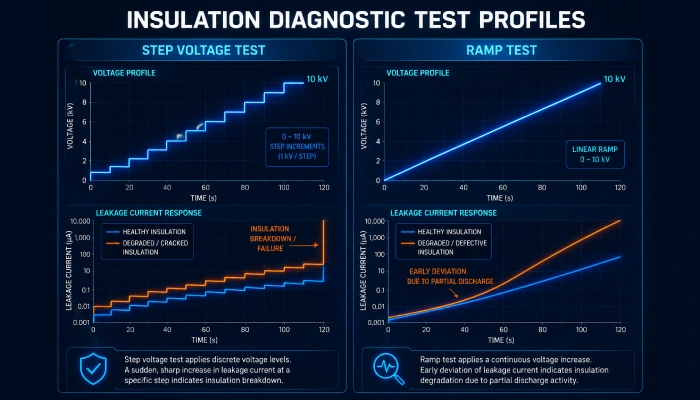
Professional predictive maintenance requires more than a simple resistance reading. Look for built-in diagnostic test routines:
- Polarization Index (PI) & Dielectric Absorption Ratio (DAR): Identifies moisture contamination and dirty insulation.
- Step Voltage (SV) Test: Detects physical cracks and localized physical insulation damage.
- Dielectric Discharge (DD) Test: Reveals stored capacitive charge dissipation and layer degradation in multi-layer insulation.
- Ramp Test: Gradually increases voltage to detect subtle insulation breakdown without causing sudden failure.
C. Short-Circuit Current & Capacitive Charging
When testing long cables or large power transformers, high electrical capacitance takes significant time to charge. Instruments with a higher short-circuit current output (e.g., 3 mA to 6 mA) charge capacitive loads faster, reaching stabilized test voltages rapidly.
D. Guard Terminal Performance & Noise Immunity
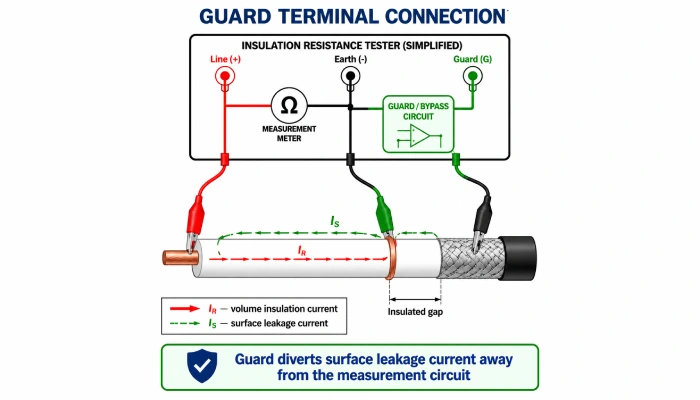
- In energized: 1px solid #cbd5e0; border-radius: 8px; padding: 25px; margin: 20px 0;”>
-
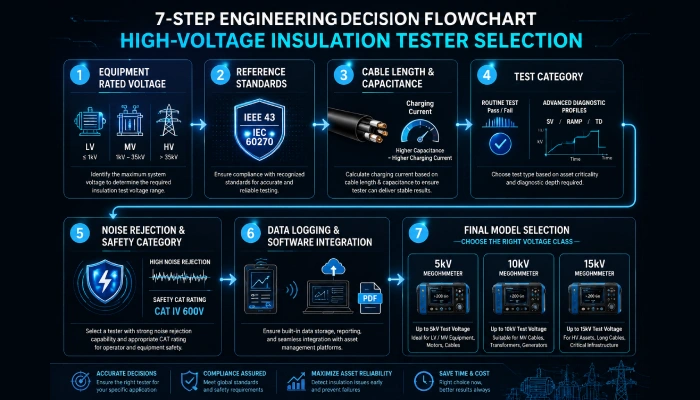
- Step 1: Identify Asset Operating Voltages: Note the nominal AC operating voltage of the motors, cables, or transformers in your facility.
- Step 2: Consult Standards: Check mandatory standards (IEEE 43, IEEE 95, NETA MTS/ATS, or IEC 60502) for required test voltages.
- Step 3: Define Test Purpose: Determine if tests are for routine maintenance, fault troubleshooting, or new installation commissioning.
- Step 4: Check Diagnostic Requirements: Verify if your procedures require advanced profiles like Step Voltage (SV), Dielectric Discharge (DD), or Ramp testing.
- Step 5: Evaluate Asset Capacitance: Determine if you are testing long power cables or large windings that demand higher short-circuit charging current (3 mA – 6 mA).
- Step 6: Assess Safety & Environmental Factors: Select instruments rated to appropriate CAT safety categories (CAT IV 600V / CAT IV 1000V) with strong noise rejection.
- Step 7: Choose the Ideal Voltage Class: Select 5 kV for standard plant maintenance, 10 kV for comprehensive industrial/utility work, or 15 kV for high-voltage transmission & grid assets.
9. Recommended Megger Insulation Resistance Testers
As authorized technical distributors, we recommend selecting from the industry-leading Megger MIT Series based on your technical scope:
| Model | Max Test Voltage | Max Resistance | Best Suited Applications |
|---|---|---|---|
| Megger MIT515 | 5 kV | 10 TΩ | Routine industrial maintenance, motors, switchgear, IR & PI tests. |
| Megger MIT525 | 5 kV | 10 TΩ | Advanced 5 kV diagnostic testing (Step Voltage, DD, memory, USB download). |
| Megger MIT1015 | 10 kV | 20 TΩ | Industrial & power system testing, HV power cables, switchgear. |
| Megger MIT1025 | 10 kV | 20 TΩ | Advanced 10 kV diagnostics for utilities, transformers, and power plants. |
| Megger MIT1525 | 15 kV | 30 TΩ | Critical high-voltage grid assets, power transformers, major generating units. |
11. Final Verdict: Matching Test Voltage to Asset Integrity
Selecting the right high-voltage insulation tester is fundamentally an engineering decision governed by asset voltage class, compliance standards (IEEE/IEC/NETA), and diagnostic depth—not simply purchasing the highest voltage available:
- Select 5 kV (Megger MIT515/2 / MIT525/2): Best for industrial manufacturing facilities, medium-voltage motors, plant feeders, and standard routine PM inspections up to 4.16 kV.
- Select 10 kV (Megger MIT1015 / MIT1025/2): The definitive all-rounder for electrical contractors, commissioning service teams, 15 kV–35 kV cables, and substation power transformers.
- Select 15 kV (Megger MIT1525/2): Crucial for critical transmission infrastructure, utility-scale turbo-generators, long capacitive cables, and assets operating above 15 kV where rapid charging and maximum noise rejection are paramount.



 Bench Multimeters