

When a critical transmitter drops offline, the control room doesn’t care about technical details—they want the process running now. But for the instrumentation team on the ground, fixing the issue quickly depends entirely on what’s in their toolbelt.
For decades, troubleshooting a 4–20 mA loop meant hauling a heavy 24V power supply, multimeter, and basic terminal into the plant. Today, as facilities upgrade to smart infrastructure, plant managers are asking: Can we cut maintenance time in half?
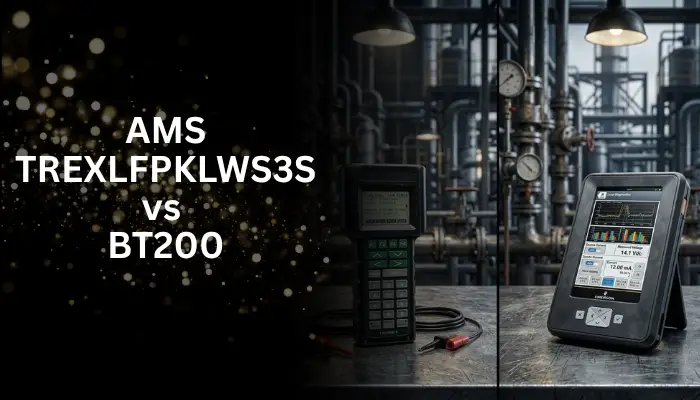
This brings us to the most critical hardware decision in process automation: AMS Trex vs BT200. Should you stick with Yokogawa’s legendary BT200 terminal, or is Emerson’s touchscreen AMS Trex truly the best HART communicator on the market? This guide breaks down hard specs, field performance, and real-world ROI to help you decide.
Why the AMS Trex vs BT200 Debate Matters for Plant Reliability
Comparing the AMS Trex vs BT200 isn’t just about screen size or battery life—it’s a clash of two maintenance philosophies:
- BT200: Built for basic ranging and tag changes on legacy BRAIN protocol devices
- AMS Trex: Designed for predictive diagnostics, partial stroke tests, and advanced loop analysis on modern smart instruments
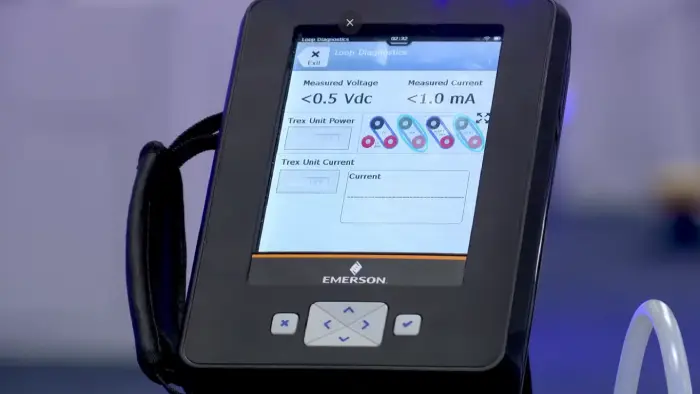
To determine the best HART communicator, we must evaluate how these devices handle 4–20 mA loops, Device Description (DD) files, and intrinsically safe (IS) environments.
Yokogawa BT200 Review: The Legacy Standard
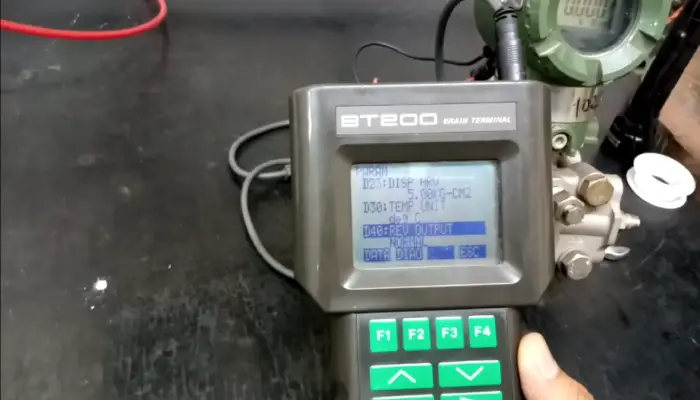
The Yokogawa BT200 (Brain Terminal) is a legend in instrumentation. If your facility was built in the 1990s and runs Yokogawa’s proprietary BRAIN protocol, the BT200 was the only tool for the job.
Where the BT200 Succeeded
- ✓ Tactile Keypad: Thick rubber buttons work flawlessly with heavy PPE gloves
- ✓ Extreme Durability: Built like a tank—survives multi-story drops
- ✓ Lightweight: 510g (N00 model) / 700g (P00 model) clips easily to toolbelts
Where the BT200 Fails Today
- ✗ Zero Loop Power: Requires separate 24V power supply—you can’t test unpowered transmitters in the field
- ✗ No Diagnostics: The LCD dot matrix (21 × 8 lines) can’t display graphs, valve signatures, or diagnostic trees
- ✗ Obsolete Architecture: No HART support; sourcing DD files for modern devices is nearly impossible
⚠️ Critical Limitation: The BT200 is BRAIN protocol only—it cannot communicate with HART or FOUNDATION Fieldbus devices at all.
Emerson AMS Trex: Why It’s the Best HART Communicator
Designed from technician feedback, the Emerson AMS Trex isn’t just a configurator—it’s a ruggedized mobile diagnostic workstation.
Why the AMS Trex Dominates
🔋 On-Board Loop Power
This is the game-changer. The Device Communicator Plus module powers the loop directly from the handset. Pull an unpowered transmitter from the warehouse, configure it with the Trex, and install it—no power supply needed.
📱 High-Resolution Touchscreen
5.7-inch (14.5 cm) color VGA resistive touchscreen (640 × 480 pixels) displays full diagnostic charts and responds perfectly to gloved fingers.
💾 Massive Processing Power
800 MHz ARM Cortex A8 processor, 512 MB DDR3 RAM, and 2 GB NAND + 32 GB extended flash memory store thousands of DD files and load them instantly.
⚡ All-Day Battery
Rechargeable Lithium-Ion module delivers 8+ hours of typical use; fully recharges in 3–4 hours (vs. BT200’s disposable AA batteries).
AMS Trex vs BT200: Complete Specifications Comparison
Here’s exactly how the AMS Trex vs BT200 stack up with hard data:
| Specification | Yokogawa BT200 | Emerson AMS Trex |
|---|---|---|
| Supported Protocols | BRAIN Only | HART + FOUNDATION Fieldbus |
| Display Interface | LCD dot matrix (21 × 8 lines) | 5.7″ Color VGA Touchscreen (640 × 480) |
| Device Weight | 510g (N00) / 700g (P00) | 1,330g (2.9 lbs) |
| Internal Memory | Flash ROM (Minimal) | 2 GB NAND + 32 GB Flash |
| Power Source | 5× AA Alkaline/Ni-MH | Rechargeable Li-Ion Module |
| Provides Loop Power? | ❌ No | ✅ Yes (167Ω / 250Ω) |
| Valve Diagnostics | ❌ No | ✅ Yes (ValveLink Mobile) |
| Data Connectivity | Printer Interface (P00 only) | Wi-Fi, USB, Bluetooth |
| Battery Runtime | ~20 hours (disposable AAs) | 8+ hours (rechargeable) |
Field Performance: Where the Trex Wins in Real-World Use
The true winner of the AMS Trex vs BT200 matchup is decided in the field, not on paper.
1. Eliminating the 250Ω Resistor Setup
The BT200 is BRAIN-only—it cannot establish HART communication at all. Even for its native BRAIN protocol on bench setups, you must manually wire a 250Ω resistor in series with your 24V supply.
The AMS Trex handles this internally. One tap on the touchscreen engages the internal resistor and powers the loop. This alone saves 10–15 minutes per instrument during loop checks.
2. Advanced ValveLink Mobile Integration
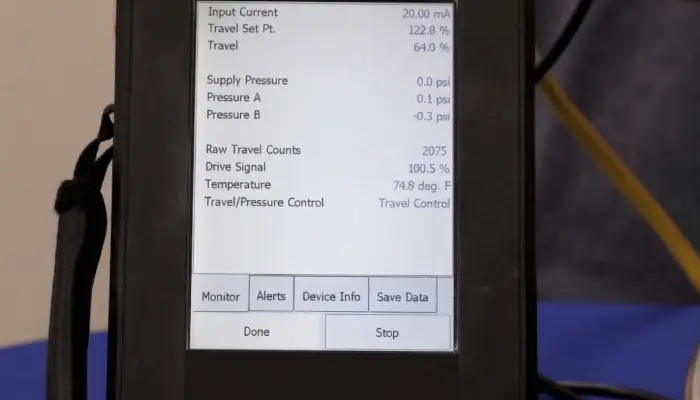
Control valves are your most critical mechanical assets. The BT200 can only read basic variables. The AMS Trex, using ValveLink Mobile, lets you:
- Perform partial stroke tests at the valve
- View full-color valve signature graphs
- Identify friction or seating issues without calling an engineer with a laptop
3. Automated Wi-Fi Synchronization
When you finish a calibration shift with the BT200, data is trapped on the device. The AMS Trex leverages Wi-Fi to automatically sync all configurations, audit logs, and timestamped changes directly to your AMS Device Manager database the moment you enter network range.
Final Verdict: Which Should You Choose?
Keep the BT200 If:
- Your plant runs exclusively on 30-year-old BRAIN protocol devices
- You have zero HART or FOUNDATION Fieldbus instruments
- You need the lightest possible device (510g vs 1,330g)
✅ Choose the AMS Trex If:
- You use modern smart instruments (HART/FF)
- You value predictive maintenance
- You want to eliminate external power supplies
- You need valve diagnostics in the field
- You want to prevent unplanned downtime
Bottom Line: The Emerson AMS Trex is unquestionably the best HART communicator you can invest in for modern plants.
While it weighs more (1,330g vs 510g) and has a higher initial cost, the ROI is massive. By eliminating external loop power supplies, ending the hunt for 250Ω resistors, and providing instant graphical diagnostics, the Trex pays for itself by preventing just one hour of unplanned downtime.
Available AMS Trex Models
🏆 Full-Featured Model (Recommended)
Emerson AMS Trex Device Communicator – HART + FOUNDATION Fieldbus Support
- Complete protocol support (HART & FF)
- ValveLink Mobile integration
- Wi-Fi, USB, Bluetooth connectivity
- Internal loop power with 167Ω / 250Ω resistor control
⚙️ HART-Only Model
AMS Trex HART Communicator (LHPKLWS3S) – HART Protocol Only
- HART protocol support
- Internal loop power
- Ideal for HART-only installations
- Lower cost alternative
💡 Need Help Choosing? If your facility uses any FOUNDATION Fieldbus devices or plans to upgrade in the future, choose the full-featured model. For HART-only environments, the LHPKLWS3S model offers excellent value.
Ready to Upgrade Your Instrumentation Toolkit?
Stop carrying external power supplies. Start diagnosing smarter.







د.إ0.00 (excl.VAT)
(5 reviews)

د.إ0.00 (excl.VAT)
(4 reviews)



 Bench Multimeters