

Don’t Get Scammed: How to Detect Repainted Cars with a Paint Thickness Gauge?

Buying a used car in a bustling market like Dubai can be exhilarating, but it comes with significant risks. A vehicle might look flawless under the showroom lights, glistening with a fresh coat of wax, but underneath that shiny exterior could hide a history of major accidents, structural damage, and thick layers of body filler.
Hidden repairs not only compromise the safety of the vehicle but can also depreciate its true value by thousands of Dirhams. How do professional car dealers and inspectors spot these issues instantly? They use a “secret weapon” that you can own too.
In this guide by MME, we will teach you how to use a Paint Thickness Gauge to reveal the hidden history of any vehicle and ensure you never overpay for an accident-damaged car.
What is a Paint Thickness Gauge and Why Do You Need It?
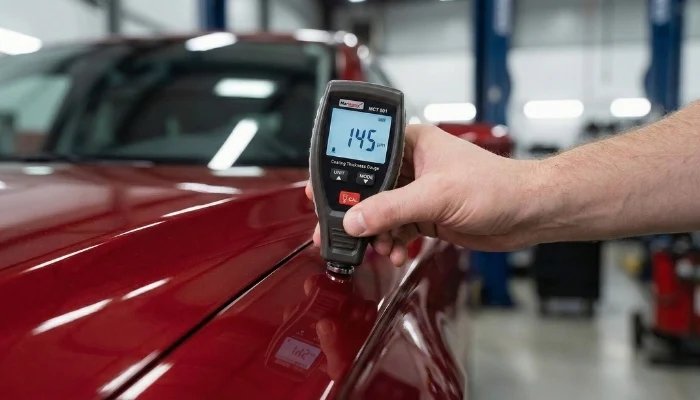
A Paint Thickness Gauge—also frequently searched for by users as a paint thickness meter or a digital car paint thickness tester—is a precision instrument used to measure the depth of the coating on a substrate.
While known technically in industrial sectors as a coating thickness gauge for checking pipelines and steel structures, in the automotive world, it is the ultimate tool for non-destructive testing of vehicle bodywork. It measures the total thickness of paint, primer, and any underlying filler right down to the metal, usually in Microns (µm) or Mils.
The Dubai Used Car Market Reality
The UAE has a massive turnover of vehicles. Unfortunately, some unscrupulous sellers may attempt to pass off badly damaged cars as “accident-free” after cheap cosmetic repairs. Without a gauge, you are relying solely on your eyes, which can easily be deceived by a good polishing job.
Equipping yourself with a reliable gauge allows you to:
-
Identify hidden body filler (putty) used to cover dents.
-
Detect resprayed panels, indicating previous damage or scratches.
-
Negotiate with confidence, backed by hard data.
Pro Tip: Don’t rely on guesswork. Ensure you have the right tool for the job. Explore our range of professional Paint & Coating Thickness Gauges available in Dubai to find the perfect model for car inspection.
Decoding the Data: How to Read the Numbers (Microns)
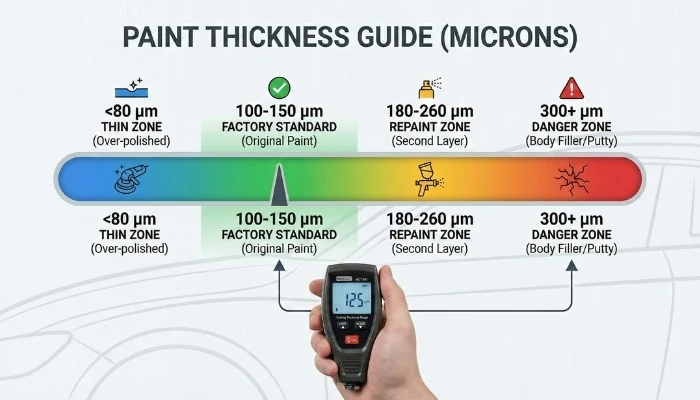
The most common question we get is: “What is the normal paint thickness on a car?
While factory standards vary slightly between manufacturers (e.g., Japanese vs. German cars), there are general rules of thumb that apply to most modern vehicles found in the UAE.
-
The Factory Standard (100 – 150 µm / 4 – 6 mils): This is the safe zone. Readings consistently in this range across the vehicle usually indicate original, factory-applied paint.
-
The Repaint Zone (180 – 260 µm): Readings in this range suggest a second layer of paint has been applied over the original coat. This doesn’t always mean a major accident; it could be a cosmetic respray for scratches or sun fading. However, it warrants further investigation.
-
The Danger Zone – Body Filler (300+ µm): If your paint thickness meter jumps to 300, 500, or even 1000+ microns, you have found body filler (putty). This indicates significant bodywork where dents or crash damage have been filled in before painting. Be extremely cautious.
-
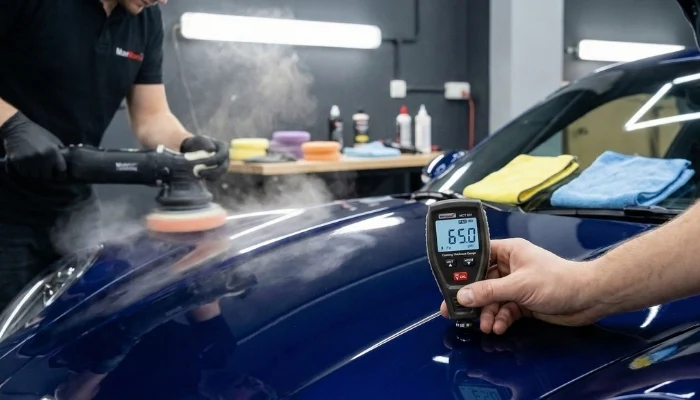
The Thin Zone (Below 80 µm): Very low readings often mean the car has been aggressively polished or compounded multiple times, thinning the clear coat.
Step-by-Step: How to Inspect a Car Like a Pro
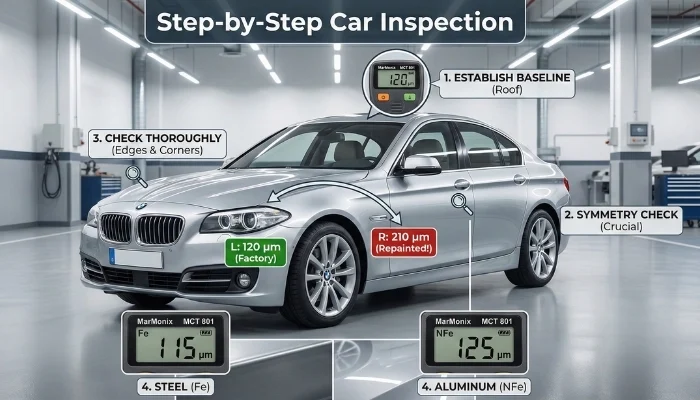
Using a car paint thickness tester effectively requires a systematic approach. Follow these steps during your next inspection:
1. Establish a Baseline
Start on the vehicle’s roof. The roof is statistically the least likely panel to be damaged or repainted. Take several readings here to establish the baseline “factory thickness” for that specific car (e.g., an average of 120 µm).
2. The Symmetry Check (Crucial Step)
Compare panels on opposite sides of the car. If the driver’s side front fender reads 120 µm, the passenger side front fender should be very close to that number. A significant difference (e.g., one side is 120 µm and the other is 210 µm) is a massive red flag that one side has been repaired.
3. Check Every Panel Thoroughly
Don’t just take one reading per panel. Check the center, corners, and edges of every door, hood, and trunk lid. Often, poor repairs are blended on the edges of panels.
4. Understand the Material: Ferrous vs. Non-Ferrous
Modern luxury cars common in Dubai (like Audi, BMW, or high-end SUVs) often use aluminum (Non-Ferrous / NFe) parts like hoods or fenders to save weight, combined with standard steel (Ferrous / Fe) bodies.
Ensure the gauge you use can automatically detect the substrate. Quality dual-probe gauges will display “Fe” for steel and “NFe” for aluminum, ensuring accurate readings regardless of the material.
Conclusion: Invest Before You Buy
Purchasing a vehicle is a major financial decision. A small investment in a quality diagnostic tool can save you from buying a hidden liability. Whether you are a professional car dealer needing a rugged daily tool, or a private buyer looking for peace of mind, MME has the right solution.
As a leading coating thickness gauge supplier in Dubai and UAE, we offer high-precision instruments backed by warranty and support.
What is the normal paint thickness on a car in microns
For most factory-original vehicles, the paint thickness typically falls between 100 to 150 microns (4 to 6 mils). Readings consistently within this range usually indicate original paint. However, luxury brands may vary, so always compare the reading with the vehicle's roof as a baseline.
How can I tell if a car has been repainted using a gauge
If your paint thickness meter shows readings significantly higher than the baseline (e.g., over 200 microns), it often indicates a secondary layer of paint (repainting). Extremely high readings (above 300-400 microns) suggest the presence of body filler (putty) used to repair dents from an accident.
Does a paint thickness tester work on aluminum (luxury) cars
Yes, but you need the right device. Standard gauges measure steel (Ferrous/Fe), but many modern cars in Dubai (like Audi or Range Rover) use aluminum panels. At MME, we supply Dual-Probe Coating Thickness Gauges (Fe/NFe) that automatically detect and measure both steel and aluminum surfaces.
What does a reading below 80 microns mean
A reading significantly below the factory standard (e.g., 60-80 microns) typically indicates that the clear coat has been thinned down due to aggressive polishing or compounding. While not an accident indicator, it means the paint has less protection against the harsh UAE sun.





 Bench Multimeters