

Fluke 568 vs Fluke 561

Quick Comparison Table: Fluke 568 vs Fluke 561
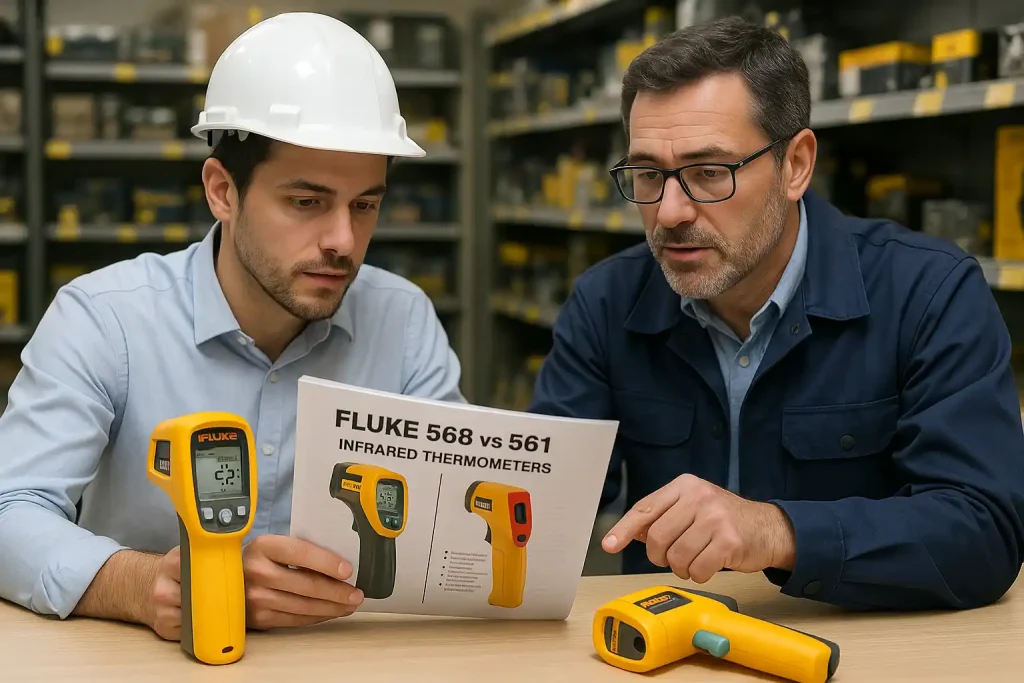
Here’s the quick side-by-side comparison table that highlights the most important technical and practical differences between the Fluke 561 and Fluke 568.
| Specification | Fluke 561 | Fluke 568 |
|---|---|---|
| Temperature Range (IR) | –40 °C to 550 °C (–40 °F to 1022 °F) | –40 °C to 800 °C (–40 °F to 1472 °F) |
| Accuracy | ±1 % of reading or ±1 °C (whichever greater) above 0 °C; below 0 °C: ±1 °C + 0.1 °C/°C | < 0 °C: ±1 °C + 0.1 °C per °C; above 0 °C: ±1 % or ±1 °C (whichever greater) |
| Distance-to-Spot Ratio (D:S) | 12:1 | 50:1 |
| Emissivity Adjustment | Manual, 3 preset levels (Low 0.3, Med 0.7, High 0.95) | Digital adjustable (0.10–1.00) + built-in material table |
| Display & Interface | Basic LCD with Scan/Hold, MIN/MAX/DIF, backlight | 98×96 pixel dot-matrix, soft-key menus, two-level backlight |
| Data Logging & Connectivity | None | Stores 99 points with date/time, USB & FlukeView® connectivity |
| Alarms | None specified | Audible + two-color visual alarms |
| Thermocouple (Type-K) Input | Yes, mini-connector + included flexible pipe probe | Yes, bead Type-K included |
| Weight | ~340 g (12 oz) | ~1 kg |
| Battery Life | ~12 h (laser/backlight on) | ~12 h (laser/backlight on), ~100 h off |
| Operating Temp Range | 0 °C to 50 °C | 0 °C to 50 °C |

Infrared Temperature Range of Fluke 568 and Fluke 561
The infrared temperature range refers to the span of surface temperatures an IR thermometer can measure without physical contact by detecting the infrared radiation naturally emitted from objects. This specification is crucial because it directly affects accuracy, safety, and application versatility. A wider range enables professionals to work confidently in diverse environments—from refrigeration systems to industrial furnaces—while maintaining precise and reliable readings.
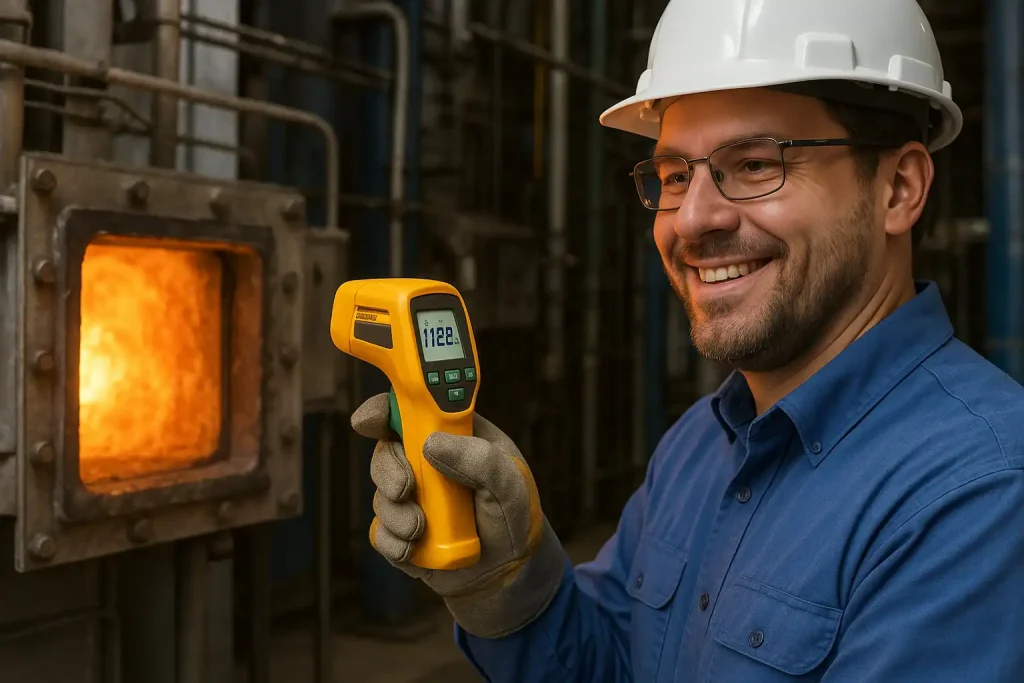
To compare the temperature ranges of the Fluke 568 and Fluke 561:
- The Fluke 561 offers an infrared range of –40 °C to 550 °C, making it suitable for HVAC, electrical, refrigeration, and mid-temperature industrial work. It is optimized for environments where temperatures remain below extreme heat thresholds and is the best choice for technicians who need portability, quick setup, and an adequate range for most service tasks.2
- The Fluke 568 extends this range to –40 °C to 800 °C, providing 250 °C more measurement capacity than the 561. This makes it ideal for heavy industry, metallurgy, kiln inspections, and other high-heat applications. Its broader range allows professionals working in extreme heat environments to perform accurate, safe, and long-distance temperature measurements.
Infrared Accuracy in Fluke 561 and Fluke 568
Infrared accuracy refers to the maximum potential difference between the actual surface temperature and the reading displayed by the infrared thermometer, provided that the measurement is taken within the device’s supported temperature range. This specification is one of the core performance indicators of any IR thermometer, showing how reliable and trustworthy the readings are. Several factors can influence infrared accuracy, including the quality of calibration, correct adjustment of emissivity based on the surface material, the physical characteristics of the target (such as reflectivity or texture), and environmental conditions like humidity, dust, and ambient temperature. This parameter is especially critical in sensitive industrial applications, safety systems, and quality control, where even a one or two-degree deviation can impact decisions, safety, and final product quality.
This specification is one of the most important parameters when deciding which infrared thermometer to choose or purchase, and below we compare these two models in terms of infrared accuracy:
Fluke 561
- Above 0°C: ±1% of reading or ±1°C (whichever is greater)
- Below 0°C: ±1°C + 0.1°C for each degree below zero
- Suitable for HVAC service, electrical maintenance, and general-purpose tasks where temperatures are moderate and standard accuracy is sufficient.
Fluke 568
- Above 0°C: ±1% of reading or ±1°C (whichever is greater)
- Below 0°C: ±(2°F + 0.1°/°C or °F)
- Maintains accuracy at high temperatures up to approximately 800°C, making it ideal for heavy industry, metallurgy, kilns, and industrial processes requiring precise measurements under extreme conditions.3
Accuracy and Calibration Between Fluke 568 and Fluke 561
Both models deliver ±1% accuracy, but Fluke 568 retains precision at higher ranges (up to 800 °C), crucial for steel manufacturing and glass production.
Pair your thermometer with a Fluke blackbody calibration source annually to maintain accuracy.
Distance-to-Spot Ratio (D:S) in Fluke 561 vs Fluke 568
The Distance-to-Spot Ratio (D:S) indicates how large an area the infrared thermometer measures in relation to the distance from the target. In simple terms, the higher the D:S ratio, the smaller the measurement spot at a given distance—allowing for more precise readings without having to be close to the surface. This specification directly affects both measurement accuracy and user safety, especially in high-temperature or hazardous environments.
For example, a D:S ratio of 12:1 means that at a distance of 12 units (inches, centimeters, or meters), the device measures a circular spot with a diameter of 1 unit. A D:S ratio of 50:1, on the other hand, can measure a spot of the same size from over four times farther away. This makes a high D:S ratio essential for industrial applications where proximity is unsafe or impractical.
This specification is one of the key parameters when deciding which infrared thermometer to choose, and here’s how the Fluke 561 and Fluke 568 compare in terms of D:S ratio:
Fluke 561
- D:S Ratio: 12:1
- Best suited for close-range measurements where the user can safely access the target area.
- Ideal for HVAC, electrical panels, and medium-distance industrial checks where the measured spot size is not a critical limitation.
Fluke 568
- D:S Ratio: 50:1
- Allows accurate measurement from significantly greater distances.
- Perfect for high-temperature equipment, moving machinery, or inaccessible surfaces where close contact is unsafe.
Emissivity and Spectral Response in Fluke 561 and Fluke 568
Emissivity represents the ability of a surface to emit infrared energy, and correct adjustment of this setting is essential for accurate temperature measurements. Spectral response indicates the infrared wavelength range that the thermometer’s sensor can detect; both models operate in the 8–14 μm range, ideal for most industrial and commercial applications.
This specification is one of the most important factors when selecting an infrared thermometer, especially if you work with a variety of surface types. Here’s how the two models compare:
Fluke 561
- Emissivity: Three preset levels (0.3, 0.7, 0.95) for common materials
- Spectral response: 8–14 μm
- Quick to set but less precise for non-standard or reflective surfaces.
Fluke 568
- Emissivity: Fully adjustable from 0.10 to 1.00 in 0.01 increments, plus a built-in material table
- Spectral response: 8–14 μm
- Allows fine-tuning for unusual surfaces such as shiny metals, ceramics, and plastics.
Fluke 561 is sufficient for quick work on common materials, while Fluke 568 offers superior flexibility and precision for diverse or challenging surfaces.
Display, User Interface & Usability in Fluke 561 and Fluke 568
A clear and functional display with intuitive controls can greatly improve workflow efficiency.
Fluke 561
- Simple backlit LCD
- Basic buttons, straightforward operation
- Ideal for quick, no-fuss use in the field.
Fluke 568
- High-resolution dot-matrix display with two-level backlight
- Soft-key menus for intuitive navigation
- Allows easy adjustment of advanced settings and review of stored data.
Fluke 561 is best for fast, straightforward tasks; Fluke 568 suits users who need advanced control and data review capabilities.
Data Logging, Connectivity & Software in Fluke 561 and Fluke 568
Being able to store and transfer readings is crucial for quality control, compliance, and trend analysis.
Fluke 561
- No internal data logging or PC connectivity
- Readings must be recorded manually.
Fluke 568
- Internal memory for 99 readings with date/time stamps
- USB connection and FlukeView software for exporting and analyzing data
- Suitable for professional reporting and audit requirements.
Fluke 561 is fine for simple spot checks, while Fluke 568 is ideal for applications that require record-keeping and data analysis.
Power, Battery Life & Environmental Specs in Fluke 561 and Fluke 568
Power source, battery life, and operating temperature range are critical factors that directly impact the reliability and usability of an infrared thermometer in various work environments. These specifications determine how long the device can operate without replacing or recharging the battery and under what environmental conditions it will maintain stable performance.
Fluke 561
- Power: 9V battery
- Battery life: Approximately 12 hours with laser and backlight on
- Operating temperature: 0°C to 50°C
- While the 9V battery is reliable, it is less common than AA batteries and can be harder to source in certain environments.
Fluke 568
- Power: AA batteries
- Battery life: Approximately 12 hours with laser/backlight on; up to 100 hours in power-saving mode
- Operating temperature: 0°C to 50°C
- AA batteries are widely available, making it easy to find replacements even in remote locations.
Both models are designed for field use and industrial conditions, but the Fluke 568 offers greater flexibility and reliability for long-term work thanks to its longer standby battery life and the use of more common battery types.
Response Time in Fluke 561 and Fluke 568
Response time indicates how quickly the device can capture and display a temperature reading after being aimed at the target. This factor is crucial for applications requiring fast measurements, such as production lines or servicing equipment in operation.
- Fluke 561: Approximately 500 ms
- Fluke 568: Approximately 500 ms
Both models offer sufficient speed for most industrial, maintenance, and preventive service tasks, enabling consecutive measurements within short intervals.
In terms of response time, there is no difference between the two models; both are well-suited for environments where quick readings are essential.
Repeatability in Fluke 561 and Fluke 568
Repeatability refers to the ability of the device to deliver consistent results under identical measurement conditions. This feature is vital for quality control, audits, and laboratory processes.
- Fluke 561: ±0.5% of reading or ±1°C (whichever is greater)
- Fluke 568: ±0.5% of reading or ±1°C (whichever is greater)
Both models perform similarly in terms of measurement consistency and can deliver identical outputs in sequential measurements under stable conditions.
Regarding repeatability, both models meet industrial standards and are reliable for tasks that demand precision and stability.
Spectral Response in Fluke 561 and Fluke 568
Spectral response defines the infrared wavelength range the device’s sensor can detect. This parameter determines the suitability of the thermometer for different surface types and conditions.
- Fluke 561: 8 to 14 μm range
- Fluke 568: 8 to 14 μm range
This range is optimal for accurate measurement of solids, liquids, and mechanical equipment surfaces, and is compatible with most industrial, commercial, and maintenance applications.
Both models have identical spectral response performance, making them versatile for use in most industrial environments and across a wide range of materials.
Final Thoughts: Which Infrared Thermometer Offers Better Accuracy and Features for Professionals?
When choosing between the Fluke 561 and Fluke 568, it is important to first understand your specific needs. If you are looking for a lightweight, simple, and reliable device for everyday tasks such as HVAC inspections or routine maintenance, the Fluke 561 is a suitable option that delivers satisfactory performance.
However, if accuracy is a priority and you work in industrial environments with high temperatures and demanding conditions, and also require data logging and more advanced features, the Fluke 568 is a more professional and capable choice designed to meet your specialized needs.
Selecting the right instrument means choosing a tool that supports you effectively and enhances the quality of your work. Therefore, by considering the features and applications of each model, make an informed and appropriate decision to achieve the best results.
At MME, you can not only order the most accurate thermometers with the best prices, but also have access to a complete range of other products such as digital multimeters, clamp meters, cable testers, infrared thermometers, and calibration equipment. Additionally, you can choose from other models in the thermometer series like the Fluke 64 MAX and 62 MAX+.
If neither of these models fully matches your requirements, don’t worry. We offer a wide range of other models that can be precisely tailored to your specific needs and working conditions. Simply Click here to open popup and share your requirements with us, and we will help you find the best option.

- Fluke. (n.d.). How accurate are Fluke IR thermometers?[↩]
- Fluke. (n.d.). Fluke 561 HVAC/R Infrared (IR) and Contact Thermometer specifications. [↩]
- Fluke. (n.d.). Fluke 568 Contact & Infrared Temperature Gun specifications[↩]

 Bench Multimeters