

Fluke 789 Process Meter review: The Definitive Loop Calibration Benchmark for Plant Engineers
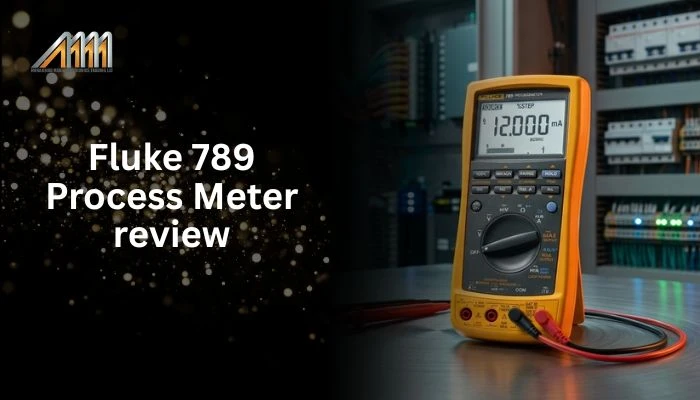
Diagnosing an erratic 4–20 mA current loop on an offshore platform or inside a crowded substation switchgear room usually demands two separate pieces of gear: an accurate digital multimeter to measure line voltages and a dedicated bench loop calibrator to inject mA signals. Carrying multiple heavy instruments up vertical access ladders in intense 48°C Gulf heat creates fatigue and increases troubleshooting downtime.
The Fluke 789 ProcessMeter solves this exact field bottleneck by uniting a 1000 V True-RMS digital multimeter with a precision mA loop calibrator inside a single rugged handheld chassis. Powered by an internal 24 V loop power supply and equipped with built-in HART communication support, it serves as the frontline diagnostic tool for instrumentation technicians, plant electricians, and control systems engineers across the Middle East.
1. What is a Fluke 789 ProcessMeter Used For in Plant Automation?
Before examining individual circuit schematics, technicians must understand where the Fluke 789 fits inside modern industrial architectures. Unlike general-purpose multimeters that only observe passive electrical values, this instrument actively participates in process control loops by injecting precision milliamp signals into analog receiving circuits.
The Fluke 789 ProcessMeter is specifically engineered for five core industrial maintenance duties:
- Loop Calibration and Analog Scaling Verification: Injecting calibrated 4 mA, 12 mA, and 20 mA signals directly into DCS and PLC input cards to verify if SCADA screens accurately reflect field physical units (such as pressure in bar or flow rate in m³/h).
- Powering De-Energized 2-Wire Field Transmitters: Driving pressure, differential pressure, radar level, and temperature transmitters directly using its onboard 24 V DC power source before central plant power grids are switched on.
- Pneumatic Control Valve Stroke Profiling: Sweeping across the full 4–20 mA span in 25% increments to observe if I/P positioners travel smoothly without mechanical binding or valve seat leakage.
- Direct HART Field Interrogation: Providing an internal 250 Ω loop impedance so field communicators (such as Emerson AMS Trex or Fluke 154) can immediately synchronize with smart transmitters without adding messy external resistors.
- Standard Industrial Multimeter Troubleshooting: Measuring up to 1000 V AC/DC, checking resistance continuity across solenoid coils, and assessing line frequency up to 20 kHz.
Whether performing daily routine checks or executing comprehensive plant shutdowns, having the appropriate calibration hardware on site is essential for operational safety.
Looking for industrial calibration gear, temperature calibrators, or signal generators? Browse our full regional portfolio in the Process & Calibration Instruments Category.
2. Fluke 789 Technical Specifications and Measurement Tolerances
Datasheet numbers alone do not reveal how an instrument performs in the mud, dust, and electrical noise of an industrial substation. The following table pairs the manufacturer’s verified laboratory specifications with practical field impacts observed by MME engineering teams during field testing.
| Electrical Parameter | Official Specification | Practical Value in Field Operations |
|---|---|---|
| DC Current Sourcing / Simulating | 0.000 to 24.000 mA (0.05% of span) | Ultra-precise 1 μA resolution uncovers zero-point calibration drift in sensitive transmitters. |
| Internal Loop Power Supply | ≥ 24 V DC @ 20 mA into 1200 Ω | Provides enough drive voltage to push signals through long field cabling with high series resistance. |
| Integrated HART Mode | Selectable internal 250 Ω load resistor | Eliminates makeshift external resistors that cause communication disconnects during configuration. |
| Multimeter Volt / Ohm Ranges | 1000 V True-RMS AC/DC, 40 MΩ, 19.999 kHz | Allows a single technician to verify 415 V motor supplies and 24 V signal wiring with the same tool. |
| Display Readout System | Dual LCD with enhanced backlight | Simultaneously displays absolute mA and span percentage (0–100%) to eliminate manual mental math. |
| Safety & Protection Category | CAT III 1000 V / CAT IV 600 V | Certified for utility intake substations, heavy busbars, and harsh industrial motor control centers. |
While these electrical limits establish baseline safety and precision, the true value of the Fluke 789 appears when utilizing its specialized process features in real commissioning workflows.
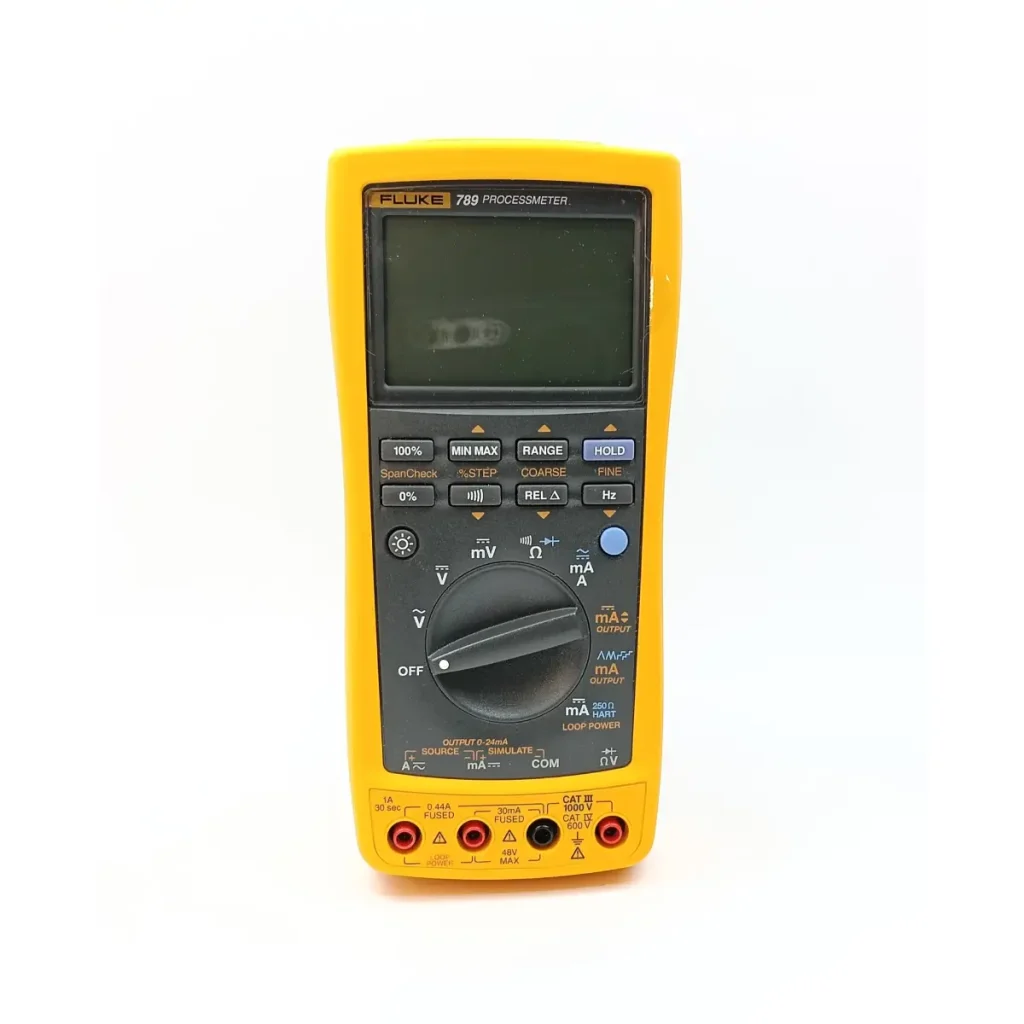
Fluke-789/E Process Meter
Call for price
- Specifications
- Current measurement: Range
- Resolution: 1 mA
- Accuracy: 0.2% + 2 LSD (DC)
- Ran...More info
3. Key Features: 24V Loop Power Supply and HART 250 Ohm Resistor
Many multi-meters offer basic current measurement, but two specific hardware capabilities set the Fluke 789 completely apart from standard test meters: its internal power driver and its dedicated communication circuitry. Understanding how these functions work together simplifies complex diagnostic scenarios.
A. Energizing Unpowered 2-Wire Loops with Internal 24 V DC Power
During plant pre-commissioning or after electrical isolation during maintenance turnarounds, marshalling panels and DCS power distribution units are turned off. Testing whether a newly mounted pressure or differential pressure transmitter is wired properly used to require dragging a heavy external DC power pack into the field.
The Fluke 789 solves this through its Loop Power Mode:
- Direct Terminal Connection: The meter outputs a clean 24 V DC excitation voltage directly through its front jacks into the 2-wire transmitter.
- Simultaneous Current Measurement: While powering the sensor loop, it measures the returning milliamp value through an internal current shunt.
- Instant Fault Identification: With no physical pressure applied, the display should show exactly 4.000 mA. A reading of 0.000 mA identifies an open-circuit broken wire or blown internal transmitter diode within seconds.
B. Built-in 250 Ω Resistor for HART Communicator Coupling
Modern process transmitters use the Highway Addressable Remote Transducer (HART) protocol, which superimposes a high-frequency digital signal on top of the standard 4–20 mA analog wave. For this communication to operate, the loop must have a series resistance between 230 and 250 ohms.
Without the Fluke 789, technicians are forced to insert an external carbon-film resistor using unstable alligator clips. These clips frequently slip off terminal screws, breaking loop continuity and interrupting device configuration. The Fluke 789 integrates a built-in 250 Ω load resistor activated via a front toggle switch. When turned on, you can connect your HART handheld communicator directly across the test leads without carrying spare loose electronic components.
However, even with proper HART communication established, electrical ground loops and line noise can still distort transmitter signals across long plant cable runs.
Struggling with erratic sensor readouts or high-frequency interference? Read our detailed engineering guide: How to Troubleshoot 4-20mA Current Loops in Noisy Industrial Environments.
4. How to Source and Simulate 4–20 mA Signals: Field Setup Guide
One of the most frequent technical support inquiries handled by our engineering desk involves the confusion between Sourcing and Simulating current. Choosing the wrong setting can blow the meter’s internal 440 mA protection fuse or trip an automated safety interlock on the DCS rack. Here is how to configure both modes correctly.
A. Source Mode (Meter Supplies the Loop Power)
Use Source Mode when the target receiving device—such as a panel indicator, chart recorder, or unpowered DCS analog input channel—does not provide its own loop voltage.
- Connect Test Leads: Plug the red test lead into the
OUTPUT mA +jack and the black lead into theOUTPUT mA -jack. - Select Rotary Function: Turn the main rotary switch to the
mA Outputposition. - Select Desired Current Value: Use the coarse/fine adjustment buttons or tap the 25% Step button to toggle between 4 mA (0%), 8 mA (25%), 12 mA (50%), 16 mA (75%), and 20 mA (100%).
- Verify Receiving Screen: Observe the control room SCADA monitor to confirm that the input channel processes the injected values with zero offset.
B. Simulate Mode (External Loop Power Is Already Present)
Use Simulate Mode when testing an active 2-wire loop where the marshalling cabinet power supply is already delivering 24 V DC to the field terminals.
- Connect to Simulate Ports: Insert the test leads into the dedicated
SIMULATE mAjacks. - Set Rotary Dial: Turn the rotary selector to
mA Sim. - Current Regulation: In this mode, the Fluke 789 behaves like a precision variable resistor, precisely modulating current draw between 4.000 mA and 20.000 mA without applying extra voltage that could damage control cards.
While the Fluke 789 masters both sourcing and simulating effortlessly, procurement departments frequently compare it against its smaller sibling, the Fluke 787B, to evaluate return on investment.
5. Fluke 787B vs. Fluke 789: Which ProcessMeter Fits Your Budget?
Both models originate from Fluke’s industry-proven ProcessMeter family, yet they target distinctly different technical workflows. Deciding between them depends on whether your team performs plant-wide commissioning or standard bench maintenance.
| Feature / Capability | Fluke 787B | Fluke 789 | Field Impact on Maintenance Workflows |
|---|---|---|---|
| 24 V Loop Power Source | No | Yes (24 V @ 20 mA) | Without this, field technicians cannot commission cold, unenergized transmitters without external power. |
| Internal HART 250 Ω Resistor | No | Yes (Built-in) | Saves setup time and eliminates dropped communication packets during smart device calibration. |
| Drive Voltage Capacity | 12 V into 500 Ω | 24 V into 1200 Ω | The 789 easily overcomes high line resistance in long, multi-conductor industrial cable runs. |
| Battery Access Design | Requires opening meter case | Separate external battery door | Allows rapid battery replacement in the field without breaking annual calibration tamper seals. |
| Engineering Verdict | Electrical workshop bench use | Full industrial process automation | The 789 justifies its higher price within the first few major loop commissioning projects. |
Beyond electrical specifications and convenience features, industrial instruments deployed in the Gulf must also endure brutal environmental operating conditions.
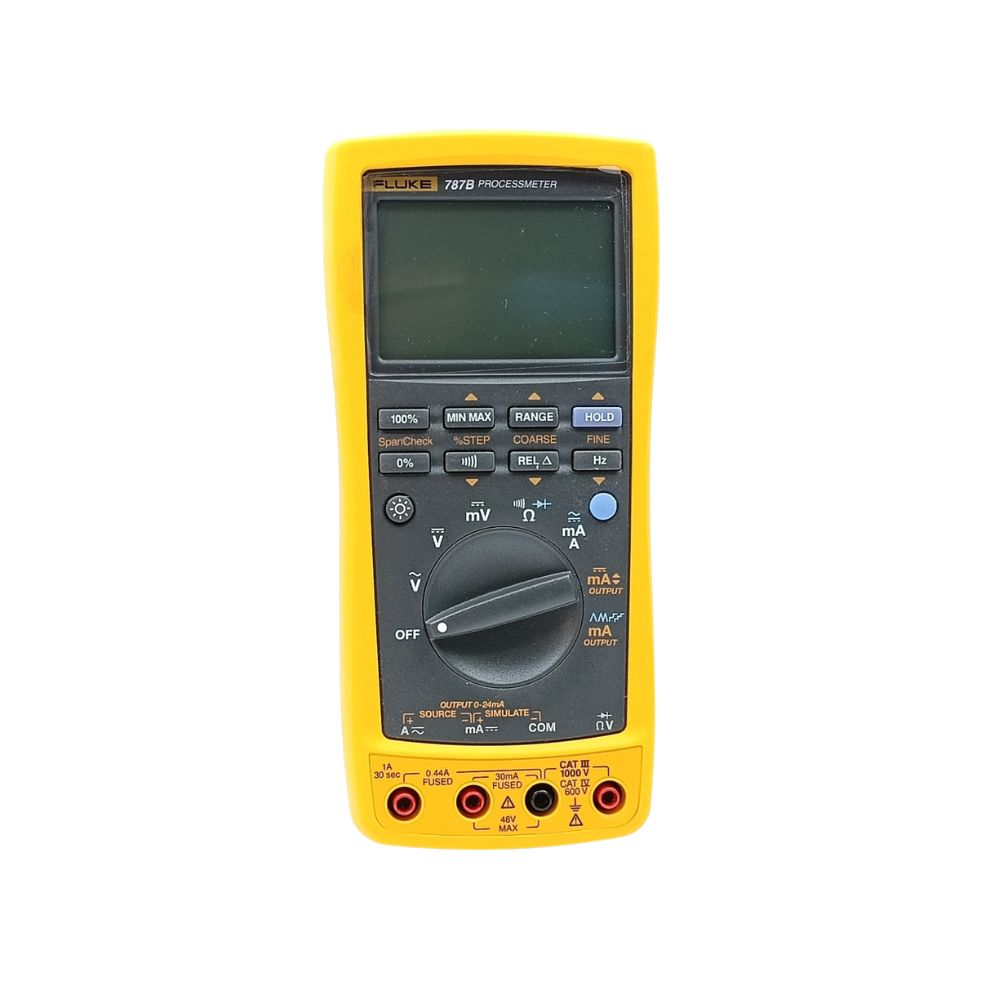
Fluke 787B Process Meter
Call for price
- True-rms process meter with 1000V measurement capability
- DC current output and simulate functions for 4-20mA loops
6. Middle East Durability: Thermal Drift, Sand Ingress, and High Ambient Heat
Measurement equipment deployed across facilities in Dubai, Abu Dhabi, Jubail, and Yanbu faces aggressive environmental conditions rarely experienced in European or North American test benches. Extreme heat, airborne silica particles, and high coastal humidity quickly degrade lesser instruments.
- Thermal Drift Suppression: In summer, ambient temperatures in shaded utility enclosures frequently exceed 45°C. Budget calibrators drift significantly outside their accuracy rating under such conditions. The Fluke 789 operates from -20°C to +55°C with a temperature coefficient of just
±(0.005% of span + 1 digit) per °Coutside its 18°C–28°C baseline, ensuring calibration integrity during intense heat. - Sealing Against Abrasive Desert Dust: The overmolded urethane holster and sealed rotary contact assemblies prevent ultra-fine silica sand from infiltrating rotary contacts and creating noisy signal readings.
- Certified High-Energy Electrical Protection: Compliant with IEC 61010-1 (CAT III 1000 V and CAT IV 600 V), the internal circuit uses blast arches and thick ceramic casing to protect technicians from destructive arc flash incidents during busbar troubleshooting.
Key Industrial Scenarios Where Fluke 789 Excels Across GCC Facilities:
- Industrial Process Control Maintenance: Daily calibration across power generation and water desalination plants.
- 4–20 mA Current Loop Troubleshooting: Quickly isolating transmitter failures from cabling faults.
- Transmitter Testing & Calibration: Providing external loop power during cold plant turnarounds.
- PLC & DCS Signal Verification: Accurately proving safety interlocks and ESD systems.
- HART Diagnostics: Commissioning smart field devices without cumbersome external 250 Ω resistors.
To help maintenance managers and technicians maintain their equipment properly, our technical team answers the most common operational and procurement questions below.
فلوك 789 — بروسيس ميتر ProcessMeter
يجمع Fluke 789 ProcessMeter بين ملتيميتر رقمي True-RMS وكاليبراتور حلقة 4–20 مللي أمبير في جهاز واحد مناسب لأعمال الصيانة الصناعية والتحقق من إشارات الحلقات الكهربائية.
- ملتيميتر + كاليبراتور حلقة 4–20 مللي أمبير
- مصدر حلقة 24 فولت مدمج
- مقاومة HART مدمجة 250 أوم عند استخدام وضع HART مع تغذية الحلقة
- تصنيف أمان CAT III 1000V / CAT IV 600V
Need Price & Stock Availability?
Contact our sales team for current availability, lead time, and quotation details for the Fluke 789 ProcessMeter.
Get Price & Stock on WhatsApp / استعلام السعر والتوفر واتساب
Call: 04 447 6031
What is the Fluke 789 ProcessMeter used for
The Fluke 789 is used for electrical measurement, process loop troubleshooting, and 4–20 mA loop calibration. It combines a True-RMS digital multimeter with loop calibrator functions.
Does the Fluke 789 have a 24 V loop power supply
Yes. The Fluke 789 includes a built-in 24 V loop power supply for powering loop devices during testing and troubleshooting.
Can the Fluke 789 source and simulate mA signals
Yes. The Fluke 789 provides mA source and simulate functions, making it useful for process loop testing and calibration.
Is the Fluke 789 suitable for HART loop work
The Fluke 789 includes a HART mode setting with loop power that adds a 250 ohm resistor, which is useful for HART-related loop applications.
What is the safety rating of the Fluke 789
The Fluke 789 is rated CAT IV 600 V / CAT III 1000 V, and the DMM is designed to meet IEC 61010 CAT III 1000 V and CAT IV 600 V standards.
Can the Fluke 789 measure frequency
Yes. The Fluke 789 can measure frequency up to 20 kHz.
What are the exact replacement fuse part numbers for the Fluke 789?
The Fluke 789 is protected by two high-energy ceramic fuses:
• mA Input Protection Fuse: 440 mA, 1000 V FAST-acting fuse (Fluke Part Number: 943121).
• Amperage Input Protection Fuse: 11 A, 1000 V FAST-acting fuse (Fluke Part Number: 803293).
Safety Warning: Never install standard glass automotive fuses. Standard fuses cannot safely contain high-energy electrical arc faults and will void the meter's CAT III/IV safety rating.


 Bench Multimeters