

Fluke 62 MAX Infrared Thermometer review
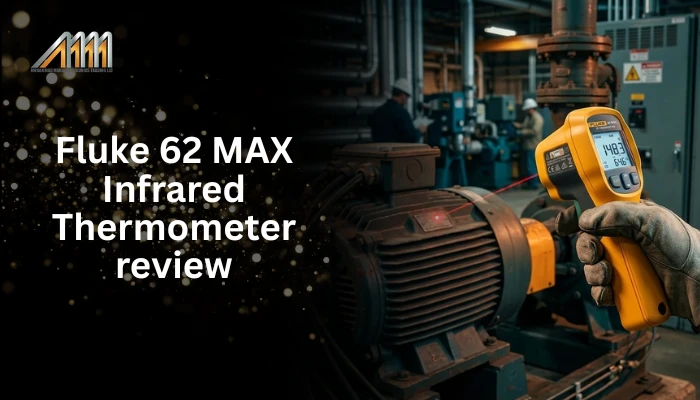
Fluke 62 MAX Infrared Thermometer Review: Industrial Field Testing & Buyer’s Guide
Routine non-contact thermal diagnostics across electrical switchgear, process motors, and high-pressure steam traps require an infrared thermometer that combines laboratory-grade optical consistency with extreme mechanical durability. While standard consumer infrared guns break upon the first accidental drop on a plant floor, the Fluke 62 MAX is built specifically for harsh manufacturing, power utility, and oil and gas maintenance. In this comprehensive review, we evaluate its 10:1 distance-to-spot optics, IP54 dust and liquid sealing, emissivity controls, and real-world durability across Middle Eastern industrial environments.
Why Plant Engineers Choose the Fluke 62 MAX Over Generic Tools
Low-cost consumer infrared thermometers dominate commercial hardware stores, but they introduce massive financial risks in industrial plants. Cheap sensors frequently suffer from thermal drift when exposed to shifting ambient climates, lack optical sealing against abrasive sand, and shatter internally after a single minor fall from a stepladder. A single false reading on an overheating bearing or overloaded transformer can lead to catastrophic motor failure and unplanned plant shutdowns costing tens of thousands of dollars.
The Fluke 62 MAX directly solves these vulnerabilities by engineering every component for plant survival. From its shock-absorbing ergonomic body to precision-calibrated thermal optics, the instrument provides accurate screening data that technicians can trust during routine safety inspections.
Core Technical Specifications & Operational Value
Evaluating an instrument requires looking beyond raw catalog metrics. The table below matches manufacturer specifications with their practical significance during daily industrial predictive maintenance routines:
| Specification | Fluke 62 MAX Metric | Field Application Value |
|---|---|---|
| Measurement Range | -30 °C to 500 °C (-22 °F to 932 °F) | Covers cryogenic refrigerant lines up to high-temperature steam distribution manifolds. |
| Accuracy Rating | ±1.5 °C or ±1.5% of reading (≥ 0 °C) | Guarantees repeatable thermal trending to detect progressive contact degradation before breakdown. |
| Optical Resolution | 10:1 Distance-to-Spot (D:S) | Accurately inspects a 10 cm target area from a safe 100 cm distance away from moving pulleys. |
| Ingress Rating | IP54 Certified (IEC 60529) | Guarantees full dust sealing and splash water protection during washdown procedures. |
| Drop Durability | 3 Meters (9.8 ft) tested | Internal optics stay aligned after accidental drops from catwalks or scissor lifts. |
| Targeting Laser | Single point laser | Pinpoints target center rapidly for fast mechanical surveys. |
| Power Source | 1x AA Alkaline Battery | 10 hours continuous laser runtime; uses universally available, cheap replacement cells. |
In-Depth Engineering Insights: Field Performance Testing
To provide genuine diagnostic value beyond standard promotional literature, we tested the Fluke 62 MAX under demanding field constraints to reveal its real operational nuances:
1. Understanding the 10:1 Distance-to-Spot Optical Physics
The most common operational error when using the Fluke 62 MAX is confusing the single laser point with the total measurement area. The laser points exclusively to the mathematical center of the target zone. The optical receiver collects infrared radiation in a conical field expanding at a 10:1 ratio.
At a working distance of 50 cm, the instrument averages temperature over a 5 cm circle; at 100 cm, it averages over a 10 cm circle. If a technician attempts to measure a small 2 cm breaker terminal from 1.5 meters away, the thermometer will average the breaker temperature together with the cold steel backplate behind it. To achieve exact measurements, technicians must stand close enough so that the intended target completely fills the optical field of view.
2. Managing Emissivity on Reflective Metallic Assets
Infrared instruments read thermal radiation emitted by a surface. Unpainted, polished metals—such as bare copper busbars, stainless steel piping, and aluminum enclosures—exhibit very low emissivity and behave like thermal mirrors, reflecting ambient heat into the sensor lens and yielding false low readings. The Fluke 62 MAX includes an adjustable emissivity setting ranging from 0.10 to 1.00 (factory default is 0.95). When scanning reflective surfaces, technicians should either calibrate the emissivity value in the instrument menu or apply a strip of matte black vinyl electrical tape (emissivity ~0.95) to the target surface for 100% accurate reads.
3. Environmental Resilience & GCC Plant Ergonomics
Industrial facilities across the Middle East expose diagnostic tools to extreme summer heat, heavy humidity, and high airborne sand concentrations. Weighing just 255 grams, the Fluke 62 MAX features an overmolded rubber chassis with deep finger contours that provide non-slip grip even when operators wear heavy leather electrician gloves. Furthermore, its transflective LCD screen maintains razor-sharp contrast whether used under intense outdoor desert sunlight or in unlit substation basement vaults.
Fluke 62 MAX vs. Fluke 62 MAX+: Technical Comparison
Procurement teams and lead engineers frequently ask whether they should deploy the standard 62 MAX or upgrade to the 62 MAX+. Review the primary differences below to specify the right instrument for your facility:
| Technical Feature | Fluke 62 MAX | Fluke 62 MAX+ |
|---|---|---|
| Distance-to-Spot (D:S) | 10:1 Ratio | 12:1 Ratio (Tighter spot at longer standoff distances) |
| Laser Target System | Single Center Laser | Dual Rotating Lasers (Clearly marks circular spot boundary) |
| Temperature Ceiling | 500 °C (932 °F) | 650 °C (1202 °F) |
| Recommended Applications | General electrical panels, mechanical drives, HVAC air balancing | High-voltage substations, petrochemical furnaces, boiler refractory |
For standard building maintenance, HVAC commissioning, and low-voltage electrical panels, the standard Fluke 62 MAX delivers unmatched value. If technicians frequently encounter high-voltage gear requiring extended arc-flash safety clearance, the tighter 12:1 optical ratio of the 62 MAX+ is worth the modest additional investment.
While the 62 MAX is the gold standard for ruggedness, users requiring higher temperature ranges or contact-based thermocouple integration often look at the 500 series. If you are debating between advanced dual-laser models, read our detailed technical comparison: Fluke 568 vs Fluke 561: Which IR Thermometer Wins?
Fluke 62 MAX Manual & Operational Quick-Start Setup
Deploying the Fluke 62 MAX out of the box takes less than two minutes. Follow this step-by-step procedure to configure the instrument for optimal measurement repeatability:
- Battery Installation: Unlatch the front battery compartment located directly beneath the trigger assembly. Insert one standard AA alkaline battery following the polarity diagram molded inside, then snap the latch firmly closed to maintain the IP54 dust seal.
- Configuring Display Diagnostics: Power on the device by pulling the trigger. Press the primary SEL button to cycle through diagnostic tracking metrics: MAX (peaks), MIN (valleys), DIF (temperature difference between two points), and AVG (running average).
- Setting Temperature Scale (°C / °F): Open the battery door to access the internal hardware switch. Move the slider to either Celsius or Fahrenheit to match facility documentation requirements.
- Trigger Scanning: Aim the optical aperture perpendicular to the target surface. Pull and hold the trigger to conduct live continuous scanning; release the trigger to freeze and hold the reading on the display for 7 seconds.
“Not sure if this is the right fit for your specific HVAC or electrical audit? You can explore our full range of industrial-grade Laser Thermometers to find the exact distance-to-spot ratio and thermal sensitivity required for your application.”
What is the Fluke 62 MAX temperature range
The Fluke 62 MAX measures from -30 °C to 500 °C (-22 °F to 932 °F).
What is the distance-to-spot ratio
It has a 10:1 distance-to-spot ratio, which helps with practical target measurement from a safer distance.
Is the Fluke 62 MAX rugged
Yes. It is IP54 rated and tested to survive a 3 m drop.
Does it have a backlit display
Yes, it includes a large, easy-to-read backlit LCD display.
What measurements does it support
The datasheet confirms min, max, average temperature, and difference between two measurements.
How accurate is the Fluke 62 MAX infrared thermometer?
The Fluke 62 MAX delivers an industrial accuracy rating of ±1.5 °C or ±1.5% of the reading (whichever is greater) for temperatures between 0 °C and 500 °C. For cryogenic readings between -10 °C and 0 °C, accuracy is ±2.0 °C. This tight repeatability ensures maintenance technicians can reliably track thermal trends on critical mechanical assets over long operational intervals.
Can the Fluke 62 MAX be used to measure human body temperature?
No. The Fluke 62 MAX is strictly an industrial surface thermometer and must never be used for medical or fever screening. It lacks the narrow physiological calibration curve, clinical accuracy tolerances (±0.2 °C), and compliance with medical diagnostic standards like ASTM E1965-98 required for healthcare screening.
What is the country of origin of the Fluke 62 MAX?
The Fluke 62 MAX is designed and engineered by Fluke Corporation at its headquarters in Everett, Washington, USA. To meet worldwide utility demand, final assembly and optical calibration are carried out in Fluke's ISO 9001-certified global production facilities under strict American quality assurance protocols.
 Bench Multimeters