

What is NCV Feature in multimeters?
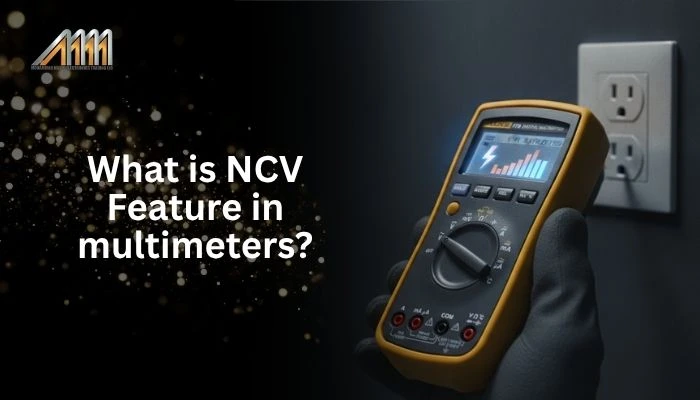
Quick Answer: What Does NCV Mean on a Multimeter?
NCV stands for Non-Contact Voltage. It is a built-in safety feature that detects the electromagnetic field generated by live AC electrical wires without physically touching the conductors or using metal test leads. When the multimeter’s tip gets close to an energized circuit, it alerts you via rapid beeps, flashing LEDs, or a dedicated screen icon.
Multimeters are used in electrical and electronic diagnostics to measure vital parameters such as voltage, current, and resistance. One of the most valuable safety innovations on modern professional digital multimeters is the NCV (Non-Contact Voltage) sensor. Unlike traditional probing methods that require direct metal-to-copper contact on a live terminal, NCV enables technicians and DIYers to verify whether a conductor is energized from outside the wire insulation.
In this guide, we break down exactly how NCV technology works, how to interpret its audible and visual alert modes, essential safety precautions, and why it is indispensable across residential, commercial, and industrial maintenance. If you are also new to general multimeter measurements, review our detailed guide on Everything About Multimeters.
Understanding NCV Alert Signals & Sensitivity Modes
Most modern digital multimeters and clamp meters indicate the strength of the detected AC field using tiered sound and light cues:
| NCV Signal / Display | Field Intensity | What It Means |
|---|---|---|
| Slow Beep + Green / Single Bar | Low / Weak | Live wire is nearby, shielded, or buried deeper inside conduit/wall. |
| Rapid Beep + Amber / Dual Bars | Medium | Approaching an energized circuit, switch, or standard home outlet. |
| Continuous Tone + Red LED / Full Scale | High / Strong | Direct proximity to a hot AC phase wire or active breaker terminal. |
| No Alert / Silence | None detected | Circuit is de-energized, DC voltage (NCV does not detect DC), or wire is armored/shielded. |
Why NCV Matters for Electrical Safety
When working with electricity, personal safety is the baseline requirement. Traditional testing necessitates placing metal probes in direct contact with potentially energized screws, terminal blocks, or bare conductors. In uncertain circumstances, damaged switchboards, or high fault current industrial panels, this creates a severe risk of arc flash, short circuits, or fatal electric shock.
The NCV feature removes direct contact during preliminary checks. Simply by bringing the sensor tip at the top of the multimeter close to the cord, receptacle, or junction box, you can instantly verify live power before inserting your probes or handling wires.
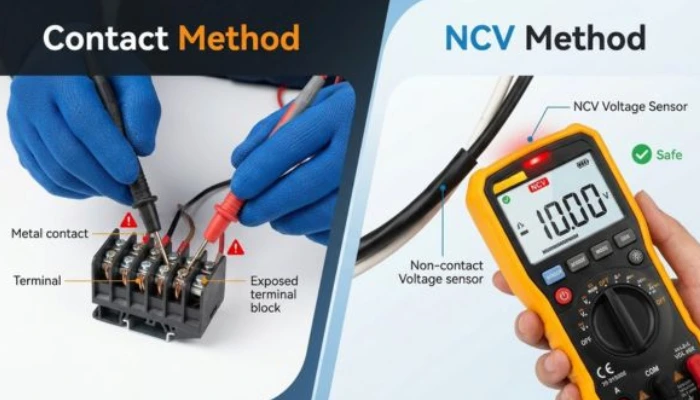
Accident Prevention on Complex Panels
On commercial construction sites and manufacturing plants, circuit schedules are often mislabeled or outdated. Electricians could mistakenly assume a breaker isolated a machine when it actually feeds another active circuit. NCV eliminates this dangerous guesswork by instantly verifying whether power is genuinely cut, significantly curbing accidental electrocution.
Ideal for DIYers and Non-Professionals
Homeowners tackling simple DIY projects—such as replacing a light switch, upgrading a ceiling fixture, or testing an extension lead—often lack formal electrical training. The NCV function makes verification intuitive: no exposed metal probes to slip and touch adjacent grounded enclosures, providing peace of mind during home electrical repairs.
Contactless Safety in High-Risk Environments
In oil and gas, petrochemical plants, and power distribution switchrooms, working on live machinery can trigger catastrophic arc faults. Using NCV for early screening ensures engineers verify status at safe clearances without disturbing delicate mechanical interlocks or exposed lugs.

How NCV Technology Works
How NCV Works: The Science Behind Non-Contact Detection
Non-contact voltage detection relies on capacitive coupling. Whenever alternating current (AC) flows through a live conductor, it produces an alternating electrostatic and electromagnetic field in the surrounding air. The NCV antenna located at the top of your multimeter functions as one plate of a virtual capacitor, while the energized wire serves as the other plate.
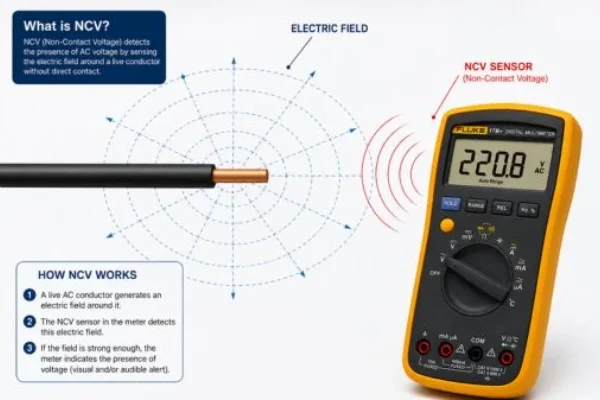
Electromagnetic Field Detection & AC Specificity
Because capacitive coupling requires alternating polarity to induce a measurable signal, standard NCV features respond strictly to AC voltage (typically 50 Hz to 60 Hz) within typical ranges from 24V up to 1000V AC. Standard DC voltages (like car batteries or solar DC strings) do not create oscillating electromagnetic fields, meaning standard NCV functions will not react to steady DC voltage.
Adjustable Sensitivity Settings
Higher-end industrial multimeters include dual-range sensitivity (e.g., Low: 90V–1000V for general distribution, and High: 24V–1000V for control circuits and thermostats). Adjusting sensitivity prevents false triggers caused by ambient electrical noise in densely wired distribution panels.
Visual and Audible Indicators
When a multimeter detects the presence of a voltage, it typically provides an alert to the user. This alert can come in various forms, such as:
- Audible Alerts: Pulsing buzzers that increase in frequency the closer you get to the live conductor.
- Visual LEDs: Flashing indicators, changing from amber or green to bright red when high voltage fields are sensed.
- LCD Bar Graphs: Screen displays that visually represent signal strength on a multi-segment scale.
Advantages of NCV Over Traditional Probes
Traditional probes require contact with the wire or terminal, which can be inconvenient and risky, especially in hard-to-reach places. The NCV feature offers significant advantages in such scenarios:
- Rapid Multi-Cable Tracing: Sweep along bundles of insulated cables in seconds without piercing or stripping.
- Zero Shock Hazard: Keeps hands completely isolated from high-potential conductors.
- Testing Non-Invasive Receptacles: Check tamper-resistant outlets where inserting test probes is difficult.
Real-World Applications of NCV Multimeters
Applications of the NCV feature include the following:
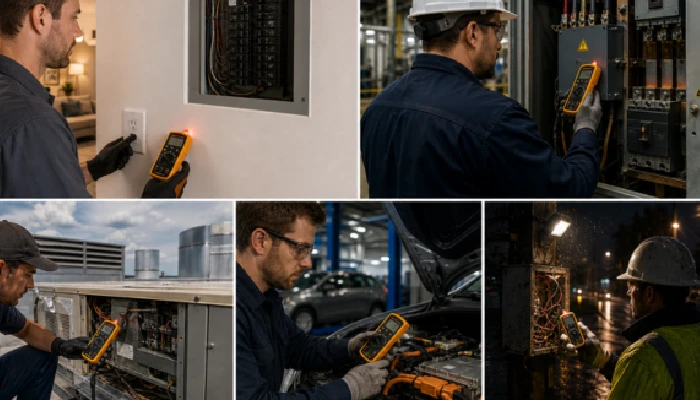
Home and Residential Electrical Troubleshooting
From finding a broken wire inside a decorative lighting string to confirming that a wall switch is off before painting or replacing it, NCV is the first tool every homeowner should use. If you are looking for compact, reliable multimeters for home maintenance, read our review of 4 Small User-Friendly Multimeters for Use at Home.
Industrial Electrical Panels & Routine Inspections
In facilities management, technicians check switchboards, motor control centers (MCC), and disconnect switches. NCV lets technicians quickly identify energized feeds without having to dismount terminal covers or wear heavy arc flash face shields for preliminary scans.
HVAC & Building Automation Systems
HVAC technicians routinely manage mixed voltages—such as 240V compressor mains alongside 24V AC thermostat controls. Using high-sensitivity NCV, technicians can trace low-voltage control signals without unhooking wire harnesses.
Automotive & Electric Vehicle (EV) Pre-Checks
While 12V automotive lines are DC, modern hybrid and electric vehicles (EVs) utilize on-board AC inverters and high-frequency charging systems. High-grade multimeters with specialized non-contact sensors help alert EV technicians to stray high-voltage AC paths on charging ports.
Can NCV detect both AC and DC voltage?
NCV is designed specifically for AC voltage detection. It’s sensitive to the oscillating electric field created by AC power, so it won’t detect DC voltage.
Where is the NCV feature most useful?
NCV is ideal for checking electrical outlets, wires, switches, and circuits in both residential and commercial settings, making it valuable for initial safety inspections and troubleshooting.
What does the NCV feature do in a multimeter?
The NCV (Non-Contact Voltage) feature allows users to detect the presence of AC voltage in wires or outlets without making physical contact, using capacitive sensing to ensure safety and convenience.
What voltage levels can NCV detect?
NCV is ideal for checking electrical outlets, wires, switches, and circuits in both residential and commercial settings, making it valuable for initial safety inspections and troubleshooting.
Can NCV detect live wires through walls
It depends on the wire depth and wall material. NCV can detect wires right behind thin drywall or plaster. However, if wires run inside metal conduits (EMT), shielded cables (armored BX), or deep behind thick masonry, the electromagnetic field is blocked and the NCV sensor will not register a reading.
Can you completely rely on NCV for personal safety?
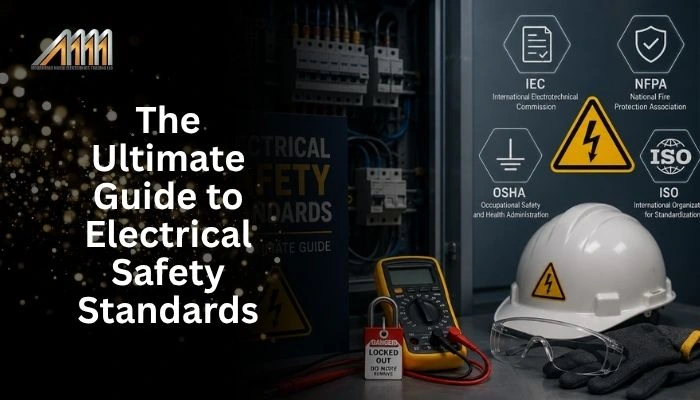
NCV is an excellent screening tool, but for strict de-energized verification before handling wires, safety standards such as NFPA 70E require a three-point test with contact probes: test a known live source, test the target circuit, then retest the known live source.
Looking for reliable multimeters with built-in NCV in the UAE?
MME supplies professional, in-stock digital multimeters and clamp meters from industry-leading brands including Hioki, Kyoritsu, and Marmonix. Explore our full range of digital multimeters or contact our technical sales specialists on WhatsApp for same-day quotations.

 Bench Multimeters