

Fluke 805 Vibration Meter Review: Reliable Bearing & Overall Checks
Key Takeaways for Plant Reliability Engineers
- Patented Force-Sensing Tip: Compensates for hand angle variance and operator pressure, ensuring that baseline trends remain mathematically reliable across different technicians.
- Dual-Band Signal Processing: Simultaneously measures low-frequency overall velocity (10 Hz to 1,000 Hz) and high-frequency bearing impact pulses (4,000 Hz to 20,000 Hz).
- Crest Factor+ (CF+) Technology: Turns high-frequency bearing impacts into a CF+ value that keeps rising as damage worsens, solving the traditional Crest Factor dilemma where catastrophic failure drops raw values.
- ISO 10816 Severity Scales: Fluke states that the 805 compares overall vibration with ISO 10816 severity scales (since revised as ISO 20816) and reports four levels: Good, Satisfactory, Unsatisfactory, Unacceptable.
- 805 vs 805 FC Difference: The 805 FC incorporates wireless Fluke Connect® mobile cloud sync, while the baseline 805 utilizes direct mini-USB export for Excel trending.
What Is the Fluke 805 and Exactly How Does It Screen Machine Health?
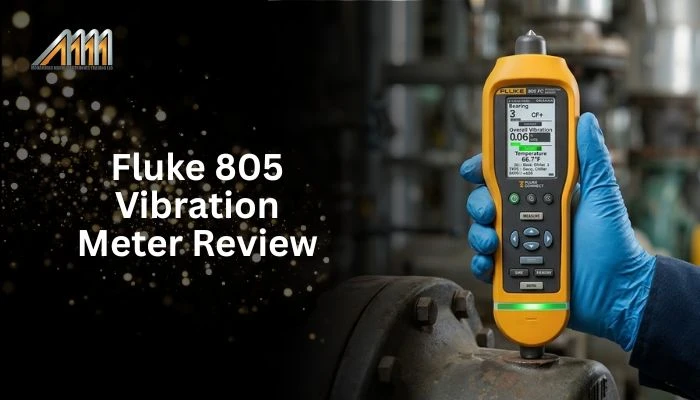
The Fluke 805 is a handheld mechanical screening meter designed to measure overall machine vibration (10–1,000 Hz) and rolling-element bearing wear (4,000–20,000 Hz). Using an internal force sensor, it eliminates operator pressure variance to classify equipment health against ISO 10816 severity scales.
| Engineering Parameter | Fluke 805 Specification | Operational Significance in GCC Plants |
|---|---|---|
| Low-Frequency Range | 10 Hz to 1,000 Hz (Velocity & Acceleration) | Identifies standard mechanical faults: 1X unbalance, shaft misalignment, and structural looseness. |
| High-Frequency Bearing Band | 4,000 Hz to 20,000 Hz (CF+ Acceleration) | Isolates microscopic metal impacts and lubrication starvation before friction generates heat. |
| Measurement Severity Scale | 4-Level: Good, Satisfactory, Unsatisfactory, Unacceptable | Enables frontline technicians to log go/no-go maintenance work orders without needing Level II CAT certification. |
| Infrared (IR) Spot Sensor | -20 °C to 200 °C (±2 °C accuracy) | Simultaneously verifies bearing friction temperature alongside dynamic mechanical vibration. |
| Sensor Dynamic Range | 0.01 g to 50 g (Peak: 50 g, P-P: 100 g) | Handles both low-amplitude precision pump screening and severe structural shake conditions. |
| A/D Conversion & Sampling | 16-bit A/D; sampling 20,000 Hz (low frequency) / 80,000 Hz (high frequency) | High sampling frequency guarantees capture of sharp, short-duration bearing impact transients. |
| Data Memory & Connectivity | 3,500 records; USB 2.0 (805) / Wireless App (805 FC) | Exports directly into custom Microsoft Excel diagnostic trend templates without software licensing. |
Standard vibration pens merely register overall velocity, often blinding technicians to microscopic spalling on internal bearing raceways. The Fluke 805 bridges this gap by processing two distinct frequency zones simultaneously. For organizations outfitting maintenance teams with certified predictive tools, explore our full portfolio of vibration meters and our wider preventive maintenance tools, or browse every Fluke instrument we supply.
Why Does Crest Factor+ (CF+) Outperform Traditional Crest Factor?
Traditional Crest Factor calculates the ratio of peak acceleration to RMS (Peak/RMS). However, as a rolling element bearing reaches terminal failure, severe continuous friction elevates the overall RMS level, paradoxically driving the traditional Crest Factor down and giving a false sense of security. Fluke’s proprietary Crest Factor+ (CF+) algorithm solves this: the higher the CF+ value, the more the bearing damage, so the number keeps climbing as failure progresses.
By extracting dynamic high-frequency peak impacts between 4,000 Hz and 20,000 Hz, the algorithm filters out baseline low-frequency noise (such as structural vibration or pipe hum) and maps the result to the severity bands published in the Fluke 805 user manual:
- CF+ 1 to 5 (Good): Pristine raceways and rolling elements. Baseline running conditions.
- CF+ 6 to 10 (Satisfactory): Early microscopic surface pitting or inadequate lubrication. Re-lubricate and monitor.
- CF+ 11 to 15 (Unsatisfactory): Definite subsurface spalling and cage wear. Schedule planned bearing replacement during the next turnaround.
- CF+ above 15 (Unacceptable): Imminent catastrophic seizure risk. Immediate machine shutdown recommended to protect shafts and housings.
Fluke 805 vs. Fluke 805 FC: Which Model Suits Your Facility?
Both instruments utilize identical hardware sensors, measuring ranges (0.01 g to 50 g), and force-compensating tips. The primary operational distinction lies in data mobility and team collaboration:
| Functional Feature | Fluke 805 (Standard) | Fluke 805 FC (Fluke Connect) |
|---|---|---|
| Data Transfer Method | Direct Mini-USB cable to PC | Wireless Fluke Connect® Mobile App + Mini-USB |
| Cloud Trending & Routes | Manual transfer to Excel template | Real-time cloud database sync & assigned routes |
| Live Video Collaboration | Not supported | ShareLive™ video calling directly from plant floor |
| Ideal Maintenance Workflow | Single technician; dedicated PC logging | Distributed reliability teams; enterprise asset management |
Engineering Verdict: Where Does the Fluke 805 Excel, and What Are Its Boundaries?
Where It Excels: The Fluke 805 is the gold standard for walk-around screening in commercial towers, district cooling plants, and industrial manufacturing across the UAE and GCC. It empowers general mechanical technicians to make repeatable, confident decisions without complex signal training.
Candid Engineering Limitations:
- No Spectral FFT Diagnostics: The Fluke 805 is a screening tool, not an analyzer. It cannot generate Fast Fourier Transform (FFT) spectra. If an asset registers “Unsatisfactory”, it cannot distinguish whether the vibration stems from an unbalance at 1X RPM, a loose hold-down bolt at 2X RPM, or internal electrical blade passing frequencies. For advanced root-cause diagnostics, we recommend referring to our technical review of the Fluke 810 Vibration Tester, which is specifically engineered to automate fault diagnosis.
- Rigid Surface Requirement: Reliable data requires firm contact perpendicular to a rigid, clean bearing housing. It cannot measure through sheet-metal cowlings or flexible pump shields. For tight spots, the optional Fluke 805ES External Sensor must be used (available in the Fluke 805 FC / 805 ES vibration tester package).
Data Management & Reporting: No Proprietary Subscription Fees
Unlike competing vibration analysis tools that lock you into expensive annual software licenses, the Fluke 805 ensures you retain full ownership of your data without recurring operational costs.
How to Manage Your Asset Trends
- Direct Connection: Connect the Fluke 805 to your PC via the included mini-USB cable.
- Data Export: Export your stored measurements (up to 3,500 records) over USB.
- Automated Trending: Drop your data into the free, pre-formatted Microsoft Excel trending templates provided by Fluke.
Engineering Benefit: This open-architecture approach allows your reliability team to integrate vibration trends directly into your existing Enterprise Asset Management (EAM) or CMMS workflows without needing specialized IT permissions or recurring SaaS seats.
جهاز قياس الاهتزاز فلوك 805 (Fluke 805)
يُعد جهاز Fluke 805 جهاز قياس اهتزاز محمولاً يوفّر قراءات موثوقة وقابلة للتكرار على المحركات والمضخات والمراوح والمحامل، مع مقياس شدّة من أربعة مستويات وقياس حرارة مدمج.
- قياس الاهتزاز الكلي وحالة المحامل (Crest Factor+)
- مقياس شدّة من أربعة مستويات وفق ISO 10816
- قياس حرارة بالأشعة تحت الحمراء للتحقق من حرارة الاحتكاك
Fluke 805 Full Technical Specifications
Specifications below are taken from Fluke’s published data for the 805 / 805 FC.
| Parameter | Fluke 805 / 805 FC |
|---|---|
| Overall vibration (low frequency) | 10 Hz to 1,000 Hz |
| Bearing vibration (high frequency, CF+) | 4,000 Hz to 20,000 Hz |
| Severity levels | Good, Satisfactory, Unsatisfactory, Unacceptable |
| Vibration limit | 50 g peak (100 g peak-to-peak) |
| A/D converter | 16-bit |
| Signal-to-noise ratio | 80 dB |
| Sampling rate | 20,000 Hz (low frequency) / 80,000 Hz (high frequency) |
| Sensor sensitivity | 100 mV/g ±10% |
| Measurement range | 0.01 g to 50 g |
| Resolution | 0.01 g |
| Accuracy | ±5% of reading at 100 Hz |
| Units | Acceleration g, m/s²; velocity in/s, mm/s; displacement mils, mm |
| IR thermometer | -20 °C to 200 °C, ±2 °C, focal distance approx. 3.8 cm |
| External sensor (805ES) support | 10 Hz to 1,000 Hz; bias 20–22 VDC; max 5 mA |
| Memory | Up to 3,500 measurements |
| Interface | USB 2.0 (mini-B); 3.5 mm audio output; SMB external sensor input |
| Operating temperature | -20 °C to 50 °C |
| Ingress protection / drop | IP54; 1 m drop |
| Battery | 2 × AA lithium iron disulfide, approx. 250 measurements per set |
| Size / weight | 24.1 × 7.1 × 5.8 cm; 0.40 kg |
| In the box | Meter, USB cable, carrying case, belt holster, quick reference guide, CD-ROM, 2 × AA batteries |
Who Is the Fluke 805 For?
- Frontline maintenance technicians on route-based checks of motors, pumps, fans and compressors who need a clear go/no-go answer.
- District cooling, MEP and facility management teams screening chiller pumps, AHU fans and cooling-tower drives in large building portfolios.
- Plant reliability engineers who want a low-cost first screen before sending a machine for full analysis.
- Contractors and inspectors documenting baseline vibration and bearing condition at commissioning and handover.
It is not the right tool if you need FFT spectra or automatic fault diagnosis. In that case, look at a diagnostic tester instead.
How the Fluke 805 Compares
Fluke 805 vs Fluke 810: the 805 screens and grades severity, while the 810 diagnoses the cause and recommends repair priorities. See our Fluke 810 vibration tester review for the full comparison. Fluke 805 vs basic vibration pens: pens typically give one overall velocity value; the 805 adds a force-sensing tip for repeatable contact pressure, a separate CF+ bearing band, IR temperature and 3,500-point memory.
Motor maintenance rarely stops at vibration. Pair the 805 with an insulation check (see our Fluke 1555 FC insulation tester review) and confirm motor rotation with the tool in our Fluke 9040 phase rotation indicator review.
Fluke 805 FAQ
What does the Fluke 805 vibration meter measure?
It measures overall vibration (10–1,000 Hz), bearing condition with Crest Factor+ (4,000–20,000 Hz) and spot infrared temperature, for quick health checks on motors, pumps, fans, compressors and gearboxes.
What is the severity scale on the Fluke 805?
A four-level scale: Good, Satisfactory, Unsatisfactory and Unacceptable. For bearings, the user manual maps CF+ 1–5 to Good, 6–10 Satisfactory, 11–15 Unsatisfactory and above 15 Unacceptable.
Can the Fluke 805 measure temperature?
Yes. A built-in spot IR sensor reads -20 °C to 200 °C (±2 °C), so you can check bearing housing temperature with each vibration reading.
How many measurements can the Fluke 805 store?
Up to 3,500 measurements in on-board memory, which can be exported over USB and trended in Microsoft Excel using Fluke’s pre-built templates.
Is the Fluke 805 compatible with Fluke Connect?
The 805 FC version is. It adds wireless sharing to the Fluke Connect app on top of the same sensor and severity functions.
What is the difference between Fluke 805 and Fluke 810?
The 805 is an overall vibration screening meter that tells you whether a machine needs attention. The Fluke 810 is a diagnostic tester that identifies specific faults such as unbalance, misalignment, looseness and bearing defects.
Is the Fluke 805 suitable for low-speed machines?
The default setting covers shafts above 600 RPM. Below 600 RPM you change the RPM range, and the meter then does not show a severity scale, so trend the raw values instead.
Need Price & Stock Availability?
Contact our sales team for current availability and a quotation for the Fluke 805 FC.
Get Price & Stock on WhatsApp / استعلام السعر والتوفر واتساب
حتى إذا لم يكن المنتج موجودًا على الموقع، سيتواصل فريق المبيعات بسرعة.
Call: 04 447 6031
 Bench Multimeters