

Fluke 9040 Phase Rotation Indicator Review: Specifications, Features
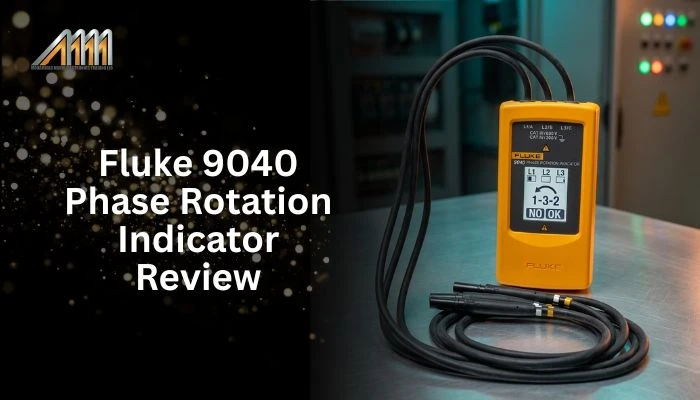
Connecting a 415V three-phase motor in the wrong phase rotation is an industrial nightmare—it can permanently shear chiller impellers, reverse high-pressure centrifugal pumps, and destroy gearbox assemblies within seconds of startup across UAE industrial plants. Finding a dependable, battery-free tester that can verify rotary fields up to 700V in scorching switchgear rooms is critical for MEP and commissioning engineers.
In this comprehensive engineering review, we examine the real-world performance, physical safety mechanisms, and industrial testing limits of the Fluke 9040 Phase Rotation Indicator. You will learn how it operates without an internal battery, how it handles variable frequencies from 15Hz to 400Hz, and how it compares with the Fluke 9062 motor and phase rotation indicator.
⚡ Key Technical Takeaways: Fluke 9040
- No Internal Batteries: Takes its power from the three-phase circuit under test, so there is no battery to go flat or replace.
- Broad Dynamic Range: Works from 40 V to 700 V AC (690 V maximum operating voltage) over 15 Hz to 400 Hz.
- Complete Phase Status: Shows L1, L2 and L3 phase presence on a clear LCD, together with the rotary direction (clockwise or counter-clockwise).
- Safety Rating: Rated CAT III 600 V and CAT IV 300 V, with IP40 protection, to IEC 61010 and IEC 61557-7.
What is the Fluke 9040 Phase Rotation Indicator?
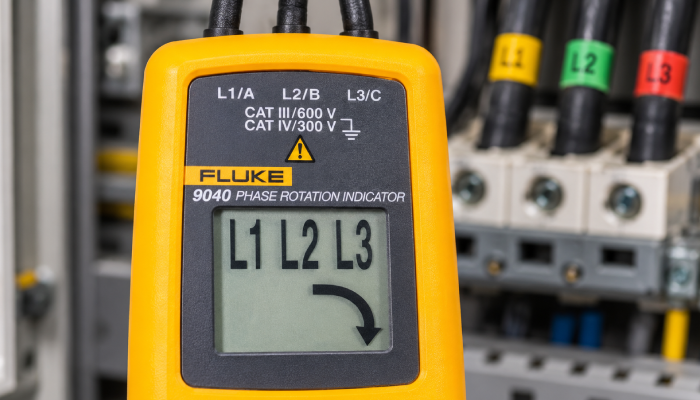
The Fluke 9040 is a handheld, battery-free phase rotation indicator designed to verify the rotary field and phase sequence of three-phase electrical systems from 40V to 700V AC. It determines clockwise (R) or counter-clockwise (L) rotation to prevent motor failure before commissioning.
Unlike battery-powered testers, the Fluke 9040 is powered by the circuit under test, with a nominal test current of only 1 mA per phase. As soon as the three probes touch live phases, the LCD shows which phases are present and the direction of the rotary field. There is no battery to check or replace.
Technical Specifications Matrix
How to Test Phase Rotation Accurately (Standard 4-Step Procedure)
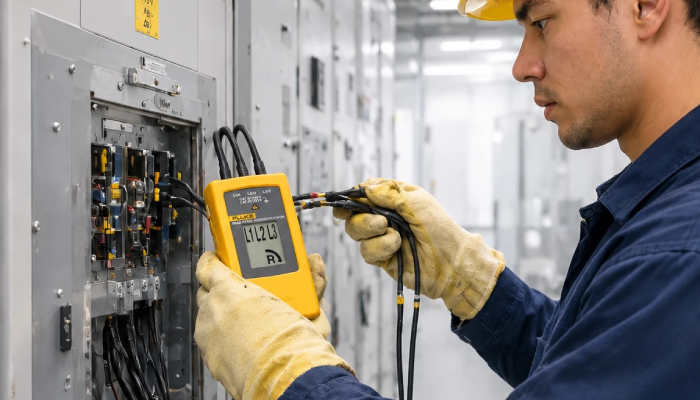
Mistakes during phase rotation testing usually happen due to loose lead contact or high impedance on oxidized busbars. Follow this verified protocol:
Step 1: Visual Inspection & De-Energized Check
Inspect leads and clips for insulation breaks. Ensure the target terminal lugs are clean and free of excessive corrosion before attaching clips.
Step 2: Connect Phase Terminals
Connect the test leads marked L1, L2 and L3 to the three phases. Keep the same order every time so you can trace which conductor is which.
Step 3: Verify Individual Phase Presence
Energize the feed. Check that all three indicators (L1, L2, L3) light up steadily. If one is off, an upstream fuse or line is open.
Step 4: Confirm Rotary Direction
Read the rotation indicator on the LCD: Clockwise (R) indicates true sequence; Counter-Clockwise (L) requires swapping any two phases before startup.
Crucial Commissioning Tip: Beyond Phase Sequence
While the Fluke 9040 guarantees your motors will spin in the designed direction, it does not detect high-resistance winding degradation or bearing defects. For complete electrical asset protection, verify insulation integrity with a specialized tester such as the Hioki IR4057-50 Insulation Tester, or assess post-commissioning vibration signatures with our Fluke 805 Vibration Meter review guide.
Fluke 9040 Full Specifications
| Voltage range | 40 V to 700 V AC (nominal 40 V to 690 V) |
| Maximum operating voltage (Ume) | 690 V |
| Maximum voltage, terminal to earth | 600 V |
| Frequency range | 15 Hz to 400 Hz |
| Nominal test current | 1 mA per phase |
| Display | LCD: L1, L2, L3 phase presence and rotation direction |
| Power supply | From the circuit under test (no battery) |
| Operating time | Continuous |
| Operating temperature | 0 °C to 40 °C (Fluke data sheet) |
| Storage temperature | -40 °C to 60 °C |
| Relative humidity | 15% to 80% |
| Altitude | Up to 2000 m |
| Protection | IP40 |
| Safety | IEC/EN 61010-1, IEC/EN 61557-7; CAT III 600 V, CAT IV 300 V; pollution degree 2 |
| Size / weight | 124 × 61 × 27 mm; 200 g |
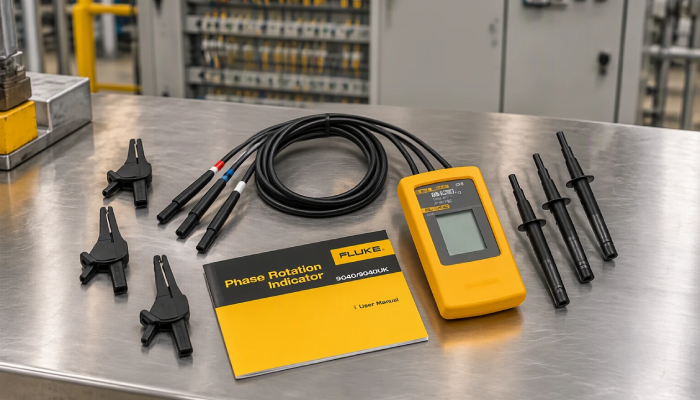
| Included (9040) | 3 self-retaining test probes, 3 alligator clips, users manual |
| Warranty | 2 years |
The 9040UK version comes with 3 fused test probes and a 0.5 A, 1000 V fuse. The 9040EUR version adds Slim-Reach test probes. See the Fluke 9040 product page for the version we supply.
Who Is the Fluke 9040 For?
- Electricians and MEP contractors connecting three-phase motors, pumps, chillers and AHUs.
- Commissioning engineers checking phase sequence at distribution boards, MCCs and generator changeover panels.
- Maintenance teams who want a tester that is always ready, with no battery to check.
It is not the right tool if you need to measure voltage values, check motor direction with the power off, or work above 690 V.
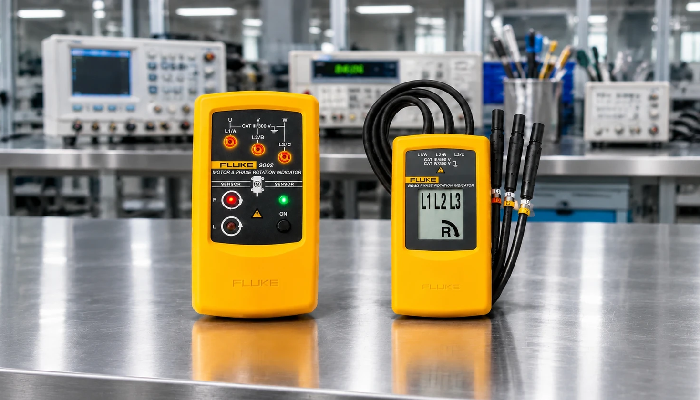
Fluke 9040 vs. Fluke 9062: Which Phase Indicator Do You Need?
A common question among MEP contractors across the UAE is whether to choose the dedicated Fluke 9040 or the hybrid Fluke 9062. Here is the operational comparison:
Engineering Verdict: Is the Fluke 9040 Worth It?
The Fluke 9040 is a simple, dependable phase sequence tester for electrical panels. With no battery inside, there is nothing to go flat or leak while it sits in a hot site container. Its 40 V to 700 V range covers common low-voltage supplies up to 690 V, and the CAT III 600 V / CAT IV 300 V rating suits distribution boards and MCCs. If you also need to check motor direction without power, the Fluke 9062 is the better choice.
خلاصة المراجعة الهندسية: جهاز فلوك 9040 (Fluke 9040)
يُعد جهاز Fluke 9040 أداة موثوقة لفحص تتابع الأطوار وتحديد اتجاه دوران المحركات ثلاثية الطور (3-Phase) حتى 700 فولت. الميزة الكبرى للجهاز أنه لا يحتاج إلى أي بطاريات داخلية، حيث يستمد طاقته مباشرة من الدائرة المختبرة، مما يجعله جاهزاً دائماً للعمل الميداني الشاق دون أعطال مفاجئة.
- نطاق جهد واسع من 40 إلى 700 فولت يناسب شبكات الجهد المنخفض الشائعة.
- فحص موثوق للأطوار الثلاثة بشكل متزامن مع مؤشر دوران واضح (اتجاه عقارب الساعة أو العكس).
- تصنيف أمان عالي CAT III 600V لحماية الفنيين من الارتفاعات الفجائية في الجهد.
How the Fluke 9040 Compares
The closest alternative is the Fluke 9062 motor and phase rotation indicator (see the table above). For testing the motor itself after the phase sequence is right, use an insulation tester such as the one in our Fluke 1555 FC insulation tester review, and check running current with a clamp meter as in our Fluke 323 clamp meter review. For earthing checks on the same installation, read our Fluke 1630-2 FC earth ground clamp review.
Browse all phase rotation testers or more Fluke products.
Fluke 9040 FAQ
Does the Fluke 9040 need a battery?
No. It is powered by the circuit under test, so it works as soon as the probes touch the three live phases. There is no battery to go flat or replace.
What voltage and frequency does the Fluke 9040 cover?
40 V to 700 V AC (690 V maximum operating voltage) and 15 Hz to 400 Hz. The maximum voltage between any terminal and earth is 600 V.
Can the Fluke 9040 check motor direction without power?
No. The 9040 needs an energized three-phase supply of at least 40 V AC. To check an unpowered motor, use the Fluke 9062: connect its leads to the motor terminals and turn the shaft by hand. The 9062 can also detect rotation contact-free on running motors.
What is the difference between the Fluke 9040 and 9062?
The 9040 is battery-free, covers up to 700 V and is rated CAT III 600 V / CAT IV 300 V. The 9062 uses a 9 V battery, covers up to 400 V (CAT III 300 V) and adds motor rotation checks.
Can the 9040 show a missing phase?
Yes. The LCD shows L1, L2 and L3 separately, so a missing phase is easy to see. Fluke warns that the rotation indicator can still light if the neutral is connected instead of a phase, so always check which conductors you are on.
What safety standards does the Fluke 9040 meet?
It is designed to IEC/EN 61010-1 and IEC/EN 61557-7, rated CAT III 600 V and CAT IV 300 V, with IP40 protection.
Need Price & Stock Availability?
Contact our sales team for current availability and a quotation for the Fluke 9040.
Get Price & Stock on WhatsApp / استعلام السعر والتوفر واتساب
حتى إذا لم يكن المنتج موجودًا على الموقع، سيتواصل فريق المبيعات بسرعة.
Call: 04 447 6031

 Bench Multimeters