

The Ultimate Guide to Electrical Insulation Testing: Diagnostics, PI Analysis, and Safety

Electrical insulation testing is often the most underestimated aspect of maintenance—until a catastrophic failure occurs. A sudden motor burnout or a cable fault doesn’t just happen; it is usually the result of a long, silent degradation process.
For maintenance engineers working in harsh environments—from the high humidity of coastal regions to the extreme heat of industrial plants—understanding the health of your insulation is not optional; it is essential. This guide provides a deep dive into the mechanics of insulation resistance testing (IR), interpreting the hidden signals, and executing tests safely.
1. Determining the Minimum Allowed Resistance
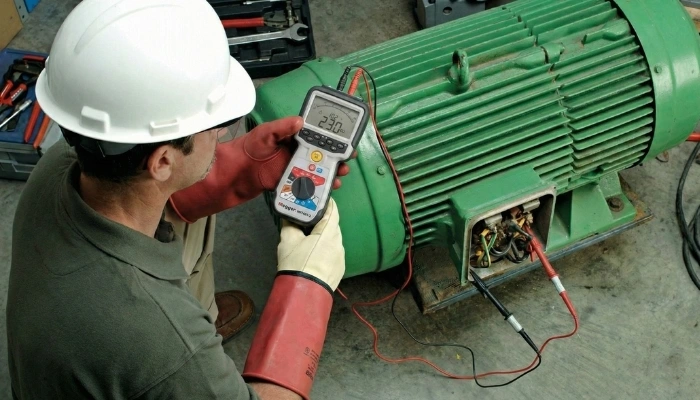
Before testing, you must know what constitutes a passing grade. A well-known industry standard used by professional engineers is the One-Mega-Ohm Rule.
The Rule: The minimum insulation resistance should be higher than 1 mega-ohm (1ΜΩ) for every 1000 volts of operating voltage.
Example: A motor rated at 2,400V should show a minimum of 2.4 ΜΩ (plus a safety margin).
Note: While this rule is a great starting point, the most accurate method is always to consult the specific classification rules or manufacturer specifications applicable to your installation.
2. The Behavior of Insulation Resistance Over Time

Insulation resistance is not a fixed number; it varies over time. By keeping a logbook of measurements, you can monitor the trend.
-
Healthy Scenario: The resistance values remain relatively high and stable over months.
-
Warning Scenario: Even if the value is above the minimum limit, a continuous downward trend over several months indicates aging or contamination accumulation.
3. How to Interpret the Readings

Readings are relative. The trend is more important than the absolute number.
-
Stable but Low: If a reading is low but consistent over time, the installation might still be fine (depending on the type).
-
Sudden Drop: If the previous reading was 30 ΜΩ and today it is 12 ΜΩ, this is alarming, even if 12 ΜΩ is technically safe.
Decision Guide:
| Condition Observed | Recommended Action |
|---|---|
| Fair to high values (Stable) | No cause for concern. |
| Downward trend (Gradual) | Locate the cause (moisture/dirt) and remedy it. |
| Sudden drop | Investigate immediately; check for physical damage. |
| Values unsafe (Too low) | Clean, bake, and dry out the equipment before energizing. |
4. The Physics of Measurement (Current Components)

When you connect a DC insulation tester (Megger), the total current displayed is a sum of three components:
-
Capacitance Charging Current: Starts high and drops rapidly as the insulation charges.
-
Absorption Current: Initially high, then drops as the insulation molecules polarize.
-
Leakage/Conduction Current: The steady current flowing through and over the insulation. This component reveals the true condition of the insulation.
5. Types of Insulation Tests
To get a complete picture, rely on multiple testing methods.
5.1 Short-Time / Spot-Reading Test

In this basic test, voltage is applied for 60 seconds.
-
Pros: Quick and easy.
-
Cons: Highly dependent on temperature. A reading at 40°C will be much lower than at 20°C. It works best for small equipment with low capacitance.
5.2 Time-Resistance Method (PI & DAR)

This method is independent of temperature and equipment size. It compares the Absorption Effect of good insulation against the high leakage of bad insulation.
-
Good Insulation: Resistance rises continuously over time (strong absorption).
-
Bad Insulation: Resistance stays flat (leakage masks absorption).
Key Ratios:
-
Dielectric Absorption Ratio (DAR): 60-second reading / 30-second reading.
-
Polarization Index (PI): 10-minute reading / 1-minute reading.
5.3 Step Voltage Method

This involves applying voltage in steps (e.g., 500V, 1000V, 2500V).
-
Interpretation: If resistance drops significantly at higher voltages, it indicates weaknesses like pinholes, cracks, or dry, brittle insulation that only fails under high stress.
6. Test Voltage vs. Equipment Rating
Using the correct test voltage is crucial to avoid damaging the equipment.
Routine Maintenance Voltages (DC):
| Equipment AC Rating | Recommended DC Test Voltage |
|---|---|
| < 100 V | 100 – 250 V |
| 440 – 550 V | 500 – 1000 V |
| 2400 V | 1000 – 2500 V |
| 4160 V and above | 1000 – 5000 V |
Note: Proof testing (factory acceptance) voltages are significantly higher and require specific calculations (2 × Rating + 1000V).
7. Tests During the Drying-Out Process
When drying out wet equipment (e.g., a flooded motor), the resistance behavior follows a specific curve:
-
Initial Drop: As the equipment heats up in the oven, resistance drops (due to temperature rise).
-
Rise: As moisture evaporates, resistance starts to climb.
-
Final Stabilization: Resistance reaches its peak when the equipment cools down to room temperature.
Tip: If the equipment was exposed to salt water, it must be washed with fresh water to remove corrosive salt deposits before drying.
8. Effect of Temperature on Insulation Resistance

Temperature drastically affects readings.
The Golden Rule:
For every 10°C increase in temperature, the insulation resistance halves.
Conversely, for every 10°C decrease, the resistance doubles.
Always correct your readings to a base temperature (e.g., 20°C) to make valid comparisons.
9. Preparation and Safety Precautions
Safety is paramount. Follow this checklist before testing:
-
Take Out of Service: Shut down, open switches, and de-energize.
-
Disconnect: Physically disconnect lines and neutral/earth connections (obtain a sanction to test).
-
Discharge Capacitance: Critical Rule! After the test, discharge the winding for a period of 4 times the duration of the test voltage application.
-
Isolate: Ensure no induced voltages from nearby live cables affect your reading or safety.
-
Explosion Hazard: Do not use the tester in explosive atmospheres (hazardous zones) without proper permits, as arcing may cause ignition.
- Electrical insulation testing – Classification and methods. Electrical Engineering Portal. Electrical insulation testing – Often underestimated until things go really bad[↩]



 Bench Multimeters