

Fluke 117 vs Megger AVO215: The Commercial Star vs The Industrial Heavyweight
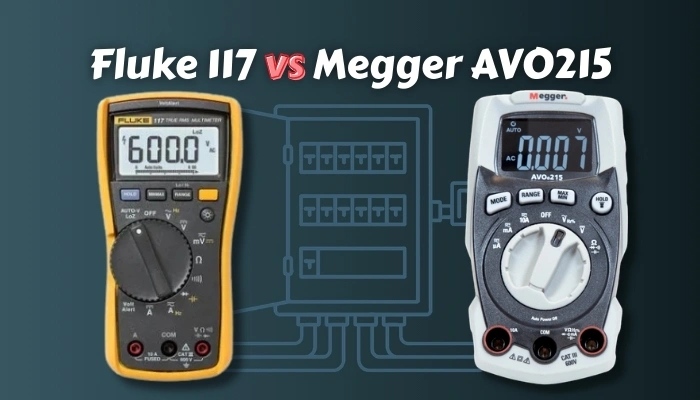
Are you looking for a new digital multimeter? You probably see the Fluke 117 everywhere. It is the most famous electrician’s tool in the world. But is famous always best?
Many professional electricians are now switching to the Megger AVO215. Why? Because it offers industrial durability and features that the Fluke 117 is missing.
In this technical comparison, we look at capability, battery convenience, and durability to help you decide which instrument is right for your job.
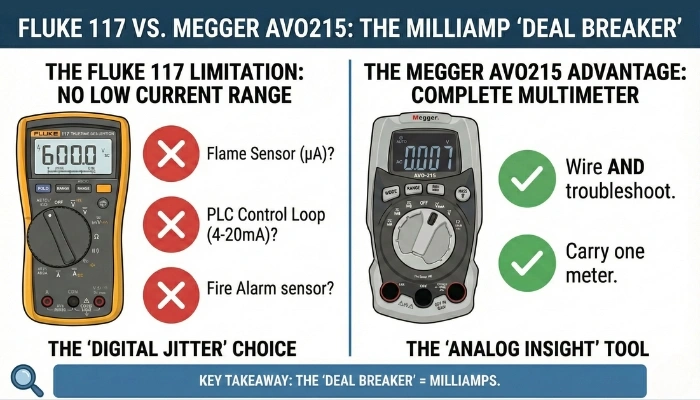
1. The Deal Breaker: Do You Need to Measure Milliamps?
This is the 1 reason professionals choose Megger.
Most people don’t realize this until after they buy:
-
The Fluke 117 Limitation: It has NO range for low current (Milliamps or Microamps). It measures 0 to 10 Amps, but nothing smaller.
-
The Real-World Problem:
-
Need to test a Flame Sensor on a furnace? (Requires µA). The Fluke cannot do it.
-
Need to troubleshoot a PLC Control Loop? (Requires 4-20mA). The Fluke cannot do it.
-
Need to check a Fire Alarm sensor? The Fluke cannot do it.
-
-
The Megger AVO215 Advantage: The AVO215 is a complete multimeter. It has dedicated settings for mA (Milliamps) and µA (Microamps).
-
Benefit: You can wire a main breaker panel AND troubleshoot a sensitive control board with the same tool. You don’t need to carry two meters.
-
2. Frequency Response and Bandwidth
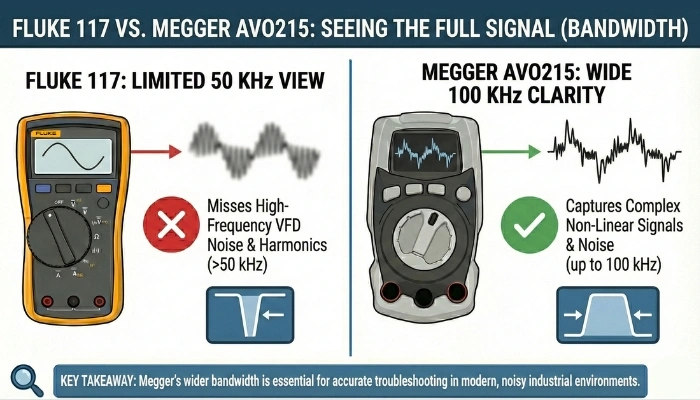
Industrial environments are full of electrical noise from Variable Frequency Drives (VFDs) and switching power supplies.
-
Fluke 117: Features a frequency response up to 50 kHz.
-
Megger AVO215: Offers a wider bandwidth of up to 100 kHz.
The Advantage: The wider frequency response of the Megger AVO215 ensures more accurate readings of non-linear loads and high-frequency harmonics that commercial-grade meters might filter out or misinterpret.
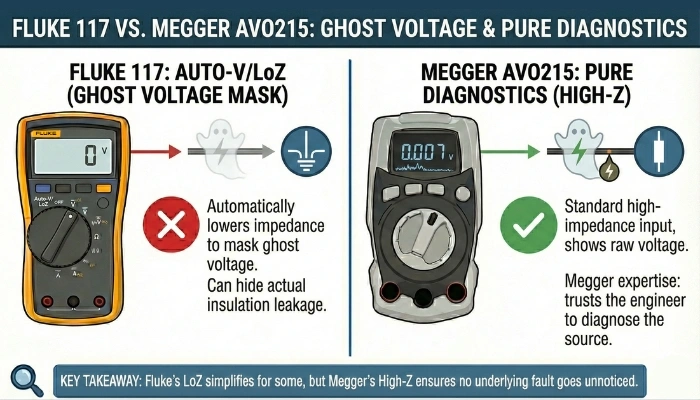
3. Ghost Voltage (LoZ) vs. Pure Diagnostics
-
Fluke 117 (Auto-V/LoZ): This feature automatically lowers input impedance to mask ghost voltages (induced static). While helpful for residential wiring, it can sometimes hide actual insulation leakage.
-
Megger AVO215: Employs a standard high-impedance input. As a brand world-famous for Insulation Testing, Megger trusts the engineer to see the raw voltage and use their expertise to diagnose the source, ensuring no underlying fault goes unnoticed.
4. Battery Frustration: 9V Block vs. Standard Batteries
Running out of power on a job site is a nightmare. The type of battery your meter uses matters.
-
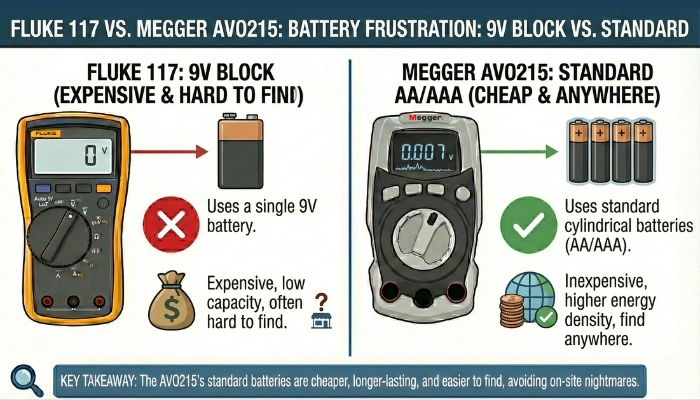
Fluke 117 (9V Block):
-
It uses a single 9V battery. These are expensive, have low capacity, and are often hard to find at gas stations or convenience stores.
-
-
Megger AVO215 (Standard AA/AAA):
-
It uses standard cylindrical batteries (AA/AAA). You can find these anywhere in the world for pennies. They have a higher energy density, meaning your meter runs longer for less money.
-
5. The Ghost Voltage Debate
-
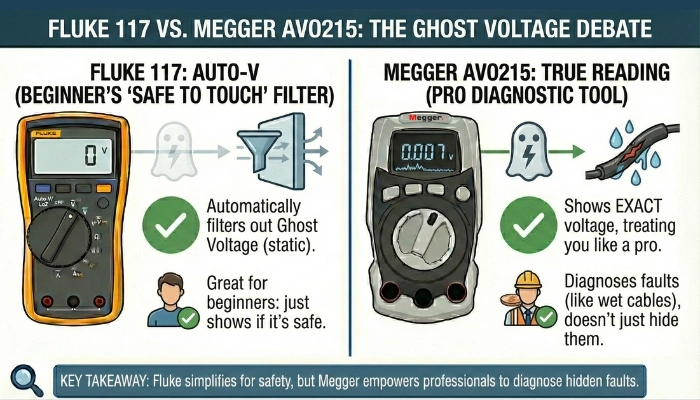
Fluke 117 (Auto-V): This meter automatically filters out Ghost Voltage (static electricity). This is great for beginners who just want to know “Is it safe to touch?”
-
Megger AVO215 (True Reading): Megger treats you like a professional. It shows you the exact voltage on the line. Why? Because sometimes, that ghost voltage is actually a warning sign of a wet cable or bad insulation. The Megger helps you diagnose the fault, not just hide it.
6. Build Quality: Commercial vs. Armored
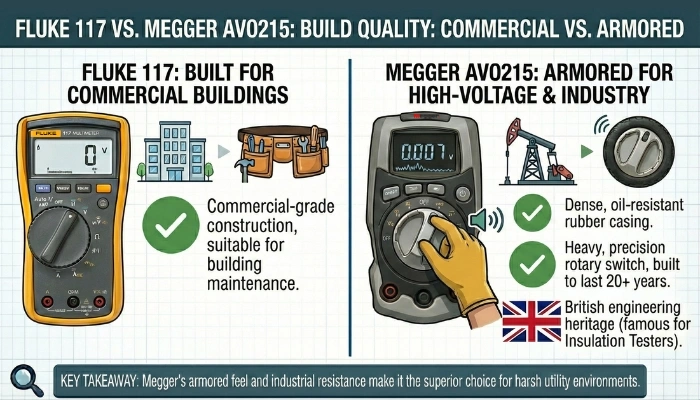
Megger is a British company famous for inventing the Insulation Tester. They build tools for high-voltage utility workers.
-
The Difference: While the Fluke 117 is built for commercial buildings, the Megger AVO215 has an Armored feel. The rubber casing is dense and resistant to industrial oils and grime. The rotary switch clicks with a heavy, mechanical precision that feels like it will last for 20 years.
Quick Comparison: Which Tool Fits Your Job?
| Feature / Specification | Fluke 117 (Commercial) | Megger AVO215 (Industrial) | Why Megger Wins? |
|---|---|---|---|
| Low Current (Microamps – µA) | Essential for HVAC Flame Sensors. | ||
| Low Current (Milliamps – mA) | Critical for PLC & Control Loops. | ||
| High Current (Amps) | 10 Amps | 10 Amps | Equal Capability. |
| Battery Type | 9V Block (Expensive) | Cheaper and easy to find globally. | |
| Display Style | Backlit LED | High-Contrast LCD | Better visibility in sun & longer battery life. |
| Ghost Voltage (LoZ) | Filters automatically | Shows True State | Better for advanced fault diagnostics. |
| Build Quality | Standard Housing | High-Voltage Industrial Heritage. |
Final Verdict: The Professional’s Choice
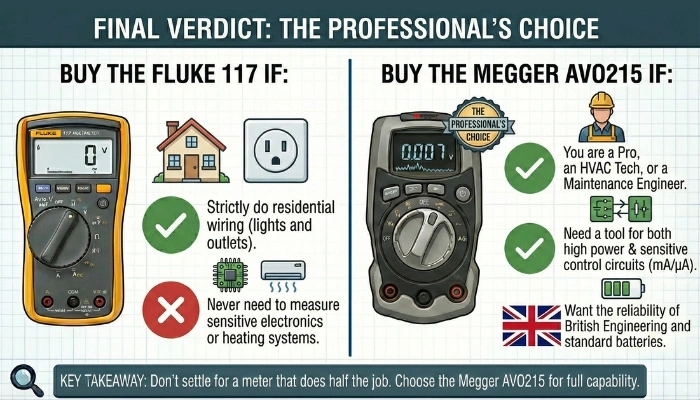
Buy the Fluke 117 if:
-
You strictly do residential wiring (lights and outlets).
-
You never need to measure sensitive electronics or heating systems.
Buy the Megger AVO215 if:
-
You are a Pro, an HVAC Tech, or a Maintenance Engineer.
-
You need a tool that can handle both high power and sensitive control circuits (mA/µA).
-
You want the reliability of British Engineering and standard batteries.
Don’t settle for a meter that does half the job. Choose the Megger AVO215 for full capability.


 Bench Multimeters