

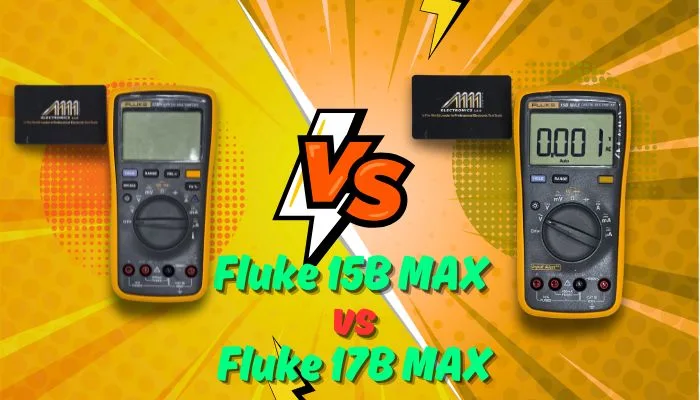
Choosing the right multimeter can directly affect the accuracy of your electrical measurements and the efficiency of your work. Whether you’re performing routine maintenance or troubleshooting complex electrical systems, the right tool will help you get the job done faster and with greater accuracy. The Fluke 15B MAX and Fluke 17B MAX both offer robust features, but understanding their differences is crucial to making an informed decision. In this article, we will compare the Fluke 15B MAX and Fluke 17B MAX, highlighting their unique features, strengths, and limitations. By the end of this guide, you’ll have a clearer understanding of which model is best suited for your needs.
Quick Overview of Fluke 15B MAX and Fluke 17B MAX
| Feature | Fluke 15B MAX | Fluke 17B MAX |
|---|---|---|
| Type | General-purpose multimeter | Professional advanced multimeter |
| Best For | Everyday electrical work | HVAC, electronics, VFDs, industrial |
| Price Category | More affordable | Slightly more expensive |
| Safety Rating | CAT III 600V | CAT III 600V |

| Extra Feature | Available in 15B MAX? | Available in 17B MAX? |
|---|---|---|
| Frequency Measurement | ❌ No | ✅ Yes (up to 100kHz) |
| Temperature Measurement | ❌ No | ✅ Yes (–40°C to +400°C with type-K probe) |
| Display Backlight | ❌ No | ✅ Yes |
| Duty Cycle Support | ❌ No | ✅ Yes |
These additions make the 17B MAX more suited for advanced applications like:
-
Testing variable frequency drives
-
Monitoring thermal conditions in HVAC
-
Working in dimly lit environments
Technical Comparison Table Between Fluke 15B MAX and Fluke 17B MAX
| Specification | Fluke 15B MAX | Fluke 17B MAX |
|---|---|---|
| DC Voltage | 600 mV – 1000 V ±(0.5%+3) | Same |
| AC Voltage | 600 mV – 1000 V ±(1.0%+3) | Same |
| DC/AC Current | Up to 10 A ±(1.5%+3) | Same |
| Resistance | Up to 40 MΩ | Same |
| Capacitance | Up to 2000 µF | Same |
| Frequency | ❌ Not Available | ✅ 50Hz – 100kHz ±(0.1%+3) |
| Temperature | ❌ Not Available | ✅ –40°C to +400°C ±(2%+1°C) |
| Diode Test | Up to 2.0 V | Same |
| Continuity Beeper | Threshold ~70 Ω | Same |
| Display Backlight | ❌ No | ✅ Yes |
| Battery Life | 2x AA – ~500 hours | Same |
| Protection Rating | CAT III 600V, IEC 61010 | Same |
| Application Area | Fluke 15B MAX | Fluke 17B MAX |
|---|---|---|
| Home electrical repair | ✅ Yes | ✅ Yes |
| Automotive diagnostics | ✅ Basic support | ✅ Better for temp sensors |
| HVAC systems | ❌ Limited (no temp) | ✅ Ideal with temp probe |
| Industrial VFDs/frequency | ❌ Not suitable | ✅ Full frequency support |
| Electronics troubleshooting | ✅ Good for resistors, caps | ✅ Great for all components |
Final Verdict: Which One is Right for You?
| You are… | Recommendation |
|---|---|
| A beginner or DIYer | ✅ Go with 15B MAX |
| On a budget and need core features only | ✅ 15B MAX is sufficient |
| A professional in HVAC or electronics | ✅ Choose 17B MAX |
| Frequently working in dark environments | ✅ Choose 17B MAX |
| Testing VFDs, frequency signals, or temp | ✅ 17B MAX is ideal |
Both the Fluke 15B MAX and Fluke 17B MAX are excellent choices within Fluke’s reliable multimeter lineup — but they serve slightly different user needs.
-
Choose the Fluke 15B MAX if you need a cost-effective, solid, and easy-to-use multimeter for everyday voltage, current, resistance, and capacitance measurements. It’s ideal for students, beginners, and general-purpose electricians.
-
Choose the Fluke 17B MAX if your work involves more demanding environments, such as HVAC systems, industrial electronics, or variable frequency drives. With features like frequency and temperature measurement, backlit display, and duty cycle support, it delivers more versatility and convenience.
Not sure which model is right for you? Click here to open popup



د.إ0.00 (excl.VAT)
(4 reviews)


د.إ0.00 (excl.VAT)
(5 reviews)

 Bench Multimeters