

Fluke 1625-2 vs Megger DET4TCR2: The Honest Field Review (2026 Update)
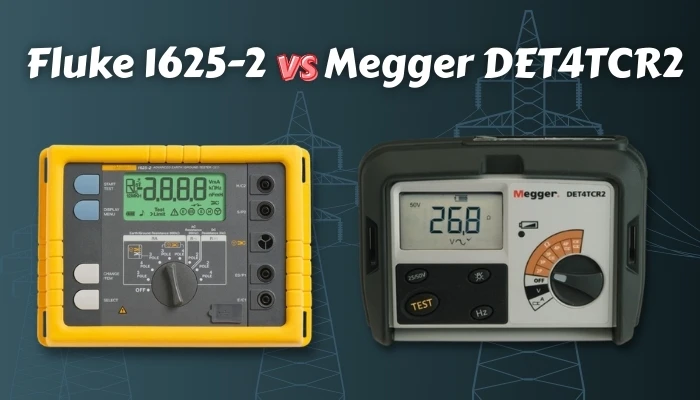
When selecting a high-end earth ground tester, the shortlist almost always comes down to two heavyweights: The Fluke 1625-2 and the Megger DET4TCR2.
On paper, these datasheets look remarkably similar. Both offer 3 and 4-pole testing, soil resistivity (Wenner method), and advanced stakeless capabilities. However, relying solely on specifications tells only half the story. The real difference isn’t found in a catalog; it is found when you are standing in a muddy trench, wearing HV gloves, with the sun glaring off your screen.
In this comprehensive comparison, we move beyond the brochure. We analyze how these two flagship devices perform in the harsh reality of daily fieldwork. By the end of this review, you will understand why, despite Fluke’s legendary reputation for precision, many seasoned field technicians are switching to the Megger DET4TCR2.
Quick Verdict (The Too Long; Didn’t Read)
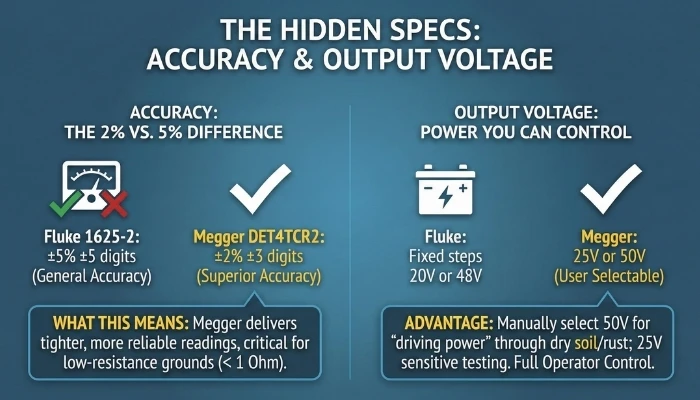
For Lab Managers & Data Analysts: Choose the Fluke 1625-2. Its internal memory (1,500 records) and USB port make it the gold standard for generating digital reports without typing data manually.
For Field Engineers & Contractors: Choose the Megger DET4TCR2. In real-world scenarios, it wins on three critical fronts:
Safety: It is rated CAT IV 100V, offering higher protection than the Fluke (CAT II).
- Accuracy: It offers a tighter base accuracy (±2%) compared to Fluke’s general spec (±5%).
Power: The Rechargeable + AA Backup system means you never get stranded.
Simplicity: The interface is faster to set up with gloves than Fluke’s multi-button layout.
Winner for Fieldwork: 🏆 Megger DET4TCR2
1. The Hidden Specs: Accuracy & Output Voltage
Most reviews ignore the fine print in the datasheets, but this is where Megger quietly beats the competition. We compared the official technical specifications side-by-side.
Accuracy: The 2% vs. 5% Difference
There is a common misconception that Fluke is always the most precise tool. However, looking at the general ground resistance testing specifications:
-
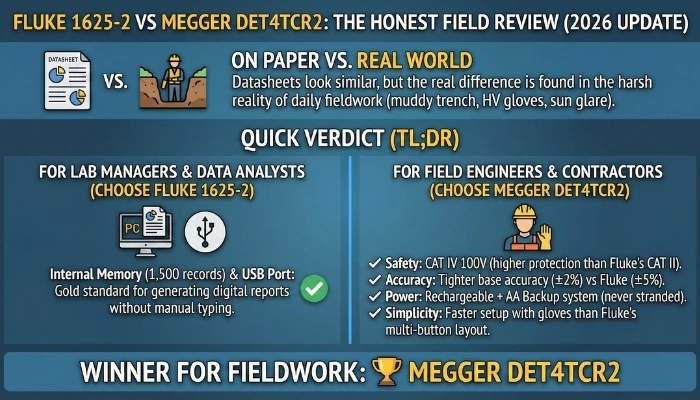
Fluke 1625-2: Has a general accuracy of ±5% ±5 digits.
-
Megger DET4TCR2: Delivers a superior accuracy of ±2% ±3 digits.
What this means: In standard field conditions, the Megger is engineered to provide a tighter, more reliable reading. For contractors verifying critical low-resistance grounds (like < 1 Ohm for data centers or substations), that 3% difference is a massive advantage for Megger.
Output Voltage: Power You Can Control
High output voltage helps punch through dry soil, rust, and high contact resistance.
-
Fluke: Offers fixed steps of 20V or 48V.
-
Megger: Offers 25V or 50V (User Selectable).
The ability to manually select 50V on the Megger gives it a slight edge in “driving power” over the Fluke’s 48V. Furthermore, having the option to drop to 25V allows for safer testing in sensitive environments, giving the operator full control.
2. Interface & Usability: Button Clutter vs. Rotary Simplicity
In 2026, efficiency is everything. While both devices use a central rotary switch to select the test mode, the design philosophy is completely different.
The Fluke Approach: The Scientific Calculator
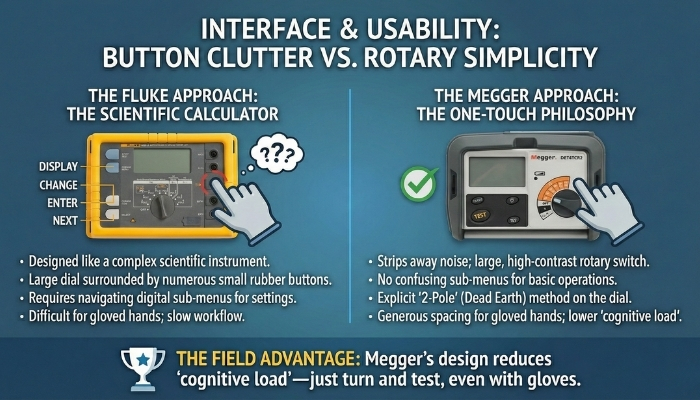
The Fluke 1625-2 is designed like a complex scientific instrument. While it has a large dial, it is surrounded by numerous small rubber buttons(DISPLAY, CHANGE, ENTER, NEXT). To perform advanced tests or change settings, you often need to navigate digital sub-menus. For a technician wearing thick electrical safety gloves, pressing these small buttons without hitting the wrong one can be frustrating and slow down the workflow.
The Megger Approach: The One-Touch Philosophy
The Megger DET4TCR2 strips away the noise. It features a large, high-contrast rotary switch that handles almost everything.
-
Design Logic: There are no confusing sub-menus for basic operations. You simply turn the dial to the desired icon (e.g., 2P, 4P, or ART) and press the massiveTEST button.
-
2-Pole Capability: Megger explicitly highlights its 2-Pole (Dead Earth) method on the dial, allowing for ultra-fast checks using a water pipe or neutral as a reference.
-
The Field Advantage: The spacing is generous, designed specifically for gloved hands. It reduces the “cognitive load” on the operator—you don’t have to “program” the device; you just turn it and test.
3. Power Management: The Hybrid Advantage
Running out of power in the middle of a job is a nightmare. This is where Megger’s design clearly targets the field worker.
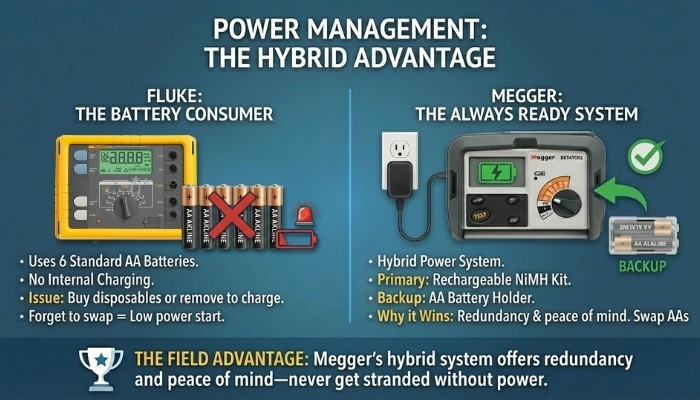
Fluke: The Battery Consumer
The Fluke 1625-2 runs on 6 standard AA alkaline batteries. While AA batteries are easy to find, the device does not have an internal charging circuit.
-
The Issue: You are constantly buying disposables, or you must remove the batteries every night to charge them in a separate wall charger. If you forget to swap them, you start the day with low power.
Megger: The Always Ready System
The Megger DET4TCR2 (the ‘R’ stands for Rechargeable) uses a smart Hybrid Power System:
-
Primary: It comes with an internal Rechargeable NiMH kit. You plug the adapter directly into the device to charge it (just like a laptop).
-
Backup: It also includes a battery holder for standard AA Alkaline batteries.
-
Why it Wins: Did you forget to charge the unit last night? No problem. Swap in the AA holder and keep working. This redundancy gives contractors peace of mind that Fluke simply doesn’t offer.
4. Safety Ratings: CAT II vs. CAT IV
This is a critical specification often overlooked in basic comparisons, but clearly highlighted in technical datasheets.
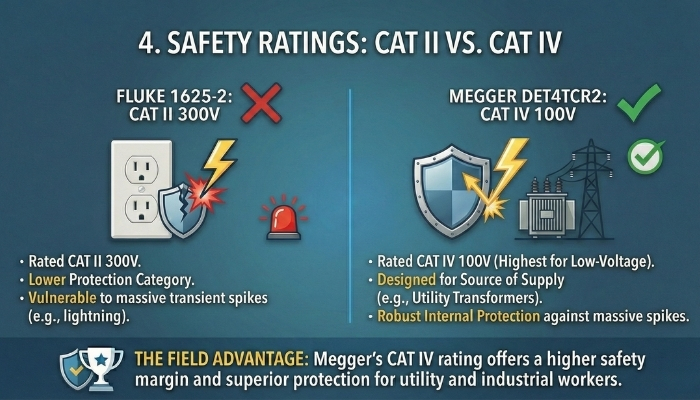
-
Fluke 1625-2: Rated CAT II 300V.
-
Megger DET4TCR2: Rated CAT IV 100V.
What does this mean? CAT IV is the highest safety category for low-voltage equipment, designed for the source of supply (e.g., utility transformers, outdoor feeder lines). By achieving a CAT IV rating, Megger demonstrates that the DET4TCR2 has more robust internal protection against massive transient voltage spikes (like lightning strikes nearby). For utility workers and industrial electricians, the Megger offers a higher safety margin.
5. Performance in Noise
Ground testing often happens near energized substations where electrical noise is high.
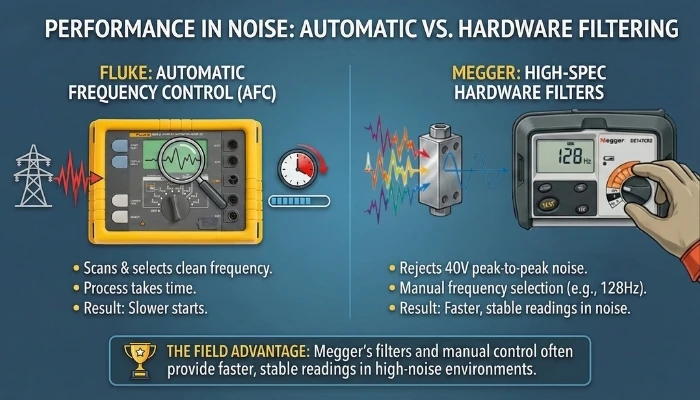
-
Fluke uses AFC (Automatic Frequency Control). It scans for noise and selects a clean frequency. It works well, but it takes time to process, leading to slower test starts.
-
Megger uses high-specification hardware filters capable of rejecting 40V peak-to-peak noise. It also allows manual frequency selection (e.g., 128Hz) to avoid power line harmonics. In practice, the Megger often locks onto a stable reading faster in “dirty” electrical environments.
6. The Memory Trade-off
We must be honest: The Fluke 1625-2 wins on data storage. It has internal memory and a USB port. The Megger DET4TCR2 does not store results (you need to upgrade to the DET4TC2 or higher series for that).
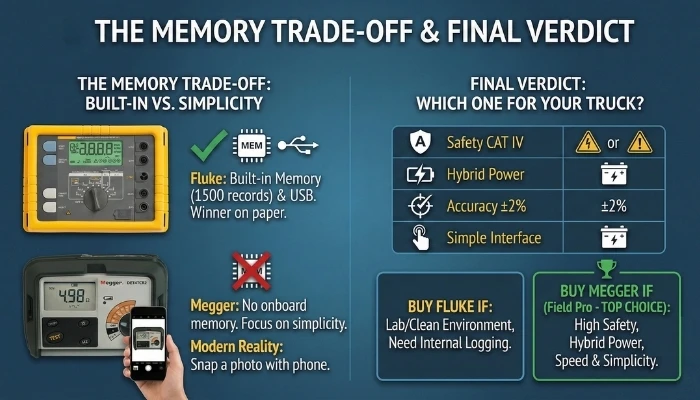
Most modern technicians prefer to snap a photo of the result with their smartphone or write it directly into a tablet app. Megger sacrifices the memory module to keep the device simpler, more affordable, and focused purely on testing.
Side-by-Side Specification table
This table compares the critical specs based on the official data:
| Feature / Spec | Megger DET4TCR2 (Top Choice) | Fluke 1625-2 |
|---|---|---|
| Device Type | 4-Terminal (Rechargeable) | 4-Terminal GEO Tester |
| User Interface | Simple Rotary Switch | Rotary + Complex Menu |
| Power Source | Hybrid (Rechargeable + AA) | 6x AA Alkaline Batteries |
| Safety Rating | CAT IV 100V (Highest Safety) | CAT II 300V / IP56 |
| Noise Rejection | 40V Peak-to-Peak | AFC (Auto Frequency Control) |
| Test Methods | 2, 3, 4-Pole, ART, Stakeless | 3, 4-Pole, Selective, Stakeless |
| Accuracy | ±2% ±3 digits | ±5% ±5 digits (General) |
| Output Voltage | 25V or 50V (Selectable) | 20V or 48V |
| IP Rating | IP54 (Weather/Dust Proof) | IP56 (Water Resistant) |
| Memory Storage | No (Focus on Speed) | Yes (1500 records + USB) |
| Stakeless Test | Yes (Needs ICLAMP/VCLAMP) | Yes (Needs 2 Clamps) |
Conclusion: Which One Earns a Spot in Your Truck?
Making a choice between these two brands is difficult because neither is a “bad” product. However, they serve different masters.
Buy the Fluke 1625-2 if:
-
You work in a clean environment (Lab/Maintenance).
-
You require strict digital data logging inside the device.
-
You are already deeply invested in the Fluke ecosystem.
Buy the Megger DET4TCR2 if:
-
You value reliability: The Rechargeable battery with AA backup is a lifesaver.
-
You value safety: The CAT IV rating is essential for utility and outdoor work.
-
You value speed: The interface is designed to get the job done instantly, without navigating menus.

For the field professional who needs a tool that works as hard as they do, the Megger DET4TCR2 is the superior all-arounder. It strips away the complexity and delivers rugged, practical engineering.
Ready to order? Shop genuine Megger equipment in the UAE from MME, the official Megger distributor in Dubai and the GCC.

 Bench Multimeters