

Using HART Communicators in Oil & Gas Operations

Oil & Gas Instrumentation Guide
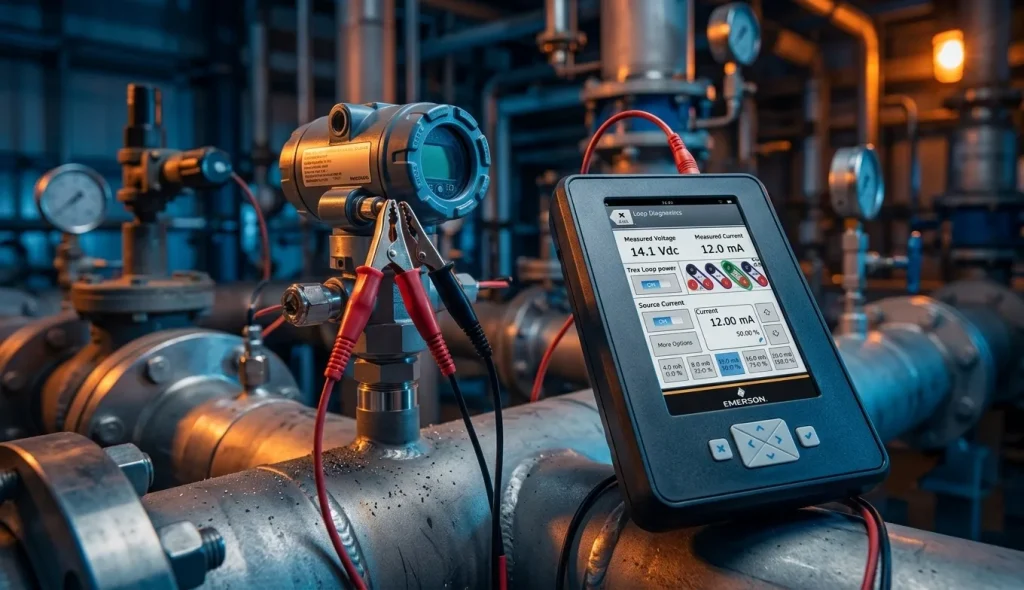
HART communicators are essential field tools for configuring, validating, troubleshooting, and maintaining smart instruments across oil and gas facilities. From commissioning transmitters to diagnosing control valves, they help technicians work faster, safer, and with better visibility into instrument health.
Quick Summary
- A HART communicator gives digital access to smart field devices without removing the 4–20 mA loop from service.
- In oil and gas, it is widely used for commissioning, loop checking, maintenance, diagnostics, and troubleshooting.
- It is especially valuable for pressure, temperature, flow, level, and control valve applications.
- Unlike a multimeter, it communicates directly with the instrument and reads configuration and diagnostics.
- Modern platforms such as Emerson AMS Trex add loop-power capability, synchronization, and advanced field diagnostics.
New to HART field devices?
Before diving into oil and gas applications, read our
Complete Guide to HART Field Communicators: Selection, Setup & Troubleshooting
for a broader look at device selection, setup steps, and troubleshooting best practices.
What Is a HART Communicator?
A HART communicator is a handheld device used to communicate with smart field instruments that support the HART protocol. HART, or Highway Addressable Remote Transducer, combines digital communication with the traditional 4–20 mA analog signal used across industrial control systems.
In practical terms, this allows technicians to read device parameters, verify tag information, inspect diagnostics, review configuration, and make approved changes without taking the loop out of service. In oil and gas facilities, where uptime and process continuity are critical, that capability is highly valuable.
Why it matters
A HART communicator helps answer not just “Is there a signal?” but also “Is this instrument configured correctly and reporting healthy data?”
Why HART Still Matters in Oil & Gas
Oil and gas operations depend on accurate field instrumentation for process control, equipment protection, safety systems, and production efficiency. A wrong range setting on a pressure transmitter, poor damping on a level device, or hidden fault in a valve positioner can lead to unstable control, false trips, process losses, or unnecessary maintenance.
HART communicators matter because they provide direct access to the intelligence inside the instrument. Instead of only measuring loop current, technicians can verify configuration, compare digital process values, inspect alerts, and identify whether a problem is caused by the device itself, the wiring, the loop power, or the control system.
Where HART Communicators Are Used in Oil & Gas
HART communicators are used throughout upstream, midstream, and downstream operations.
Upstream
Used in wellheads, production skids, separators, and gathering systems to check pressure, temperature, and level instruments during startup and maintenance.
Midstream
Common at pipeline stations, terminals, compressor stations, metering systems, and tank farms for validation and troubleshooting.
Downstream
Refineries, LNG sites, gas plants, and petrochemical units use HART tools for commissioning, diagnostics, shutdown work, and reliability programs.
Offshore
Offshore teams value handheld communicators because they reduce troubleshooting time in space-limited and hazardous environments.
Core Uses in Daily Field Work
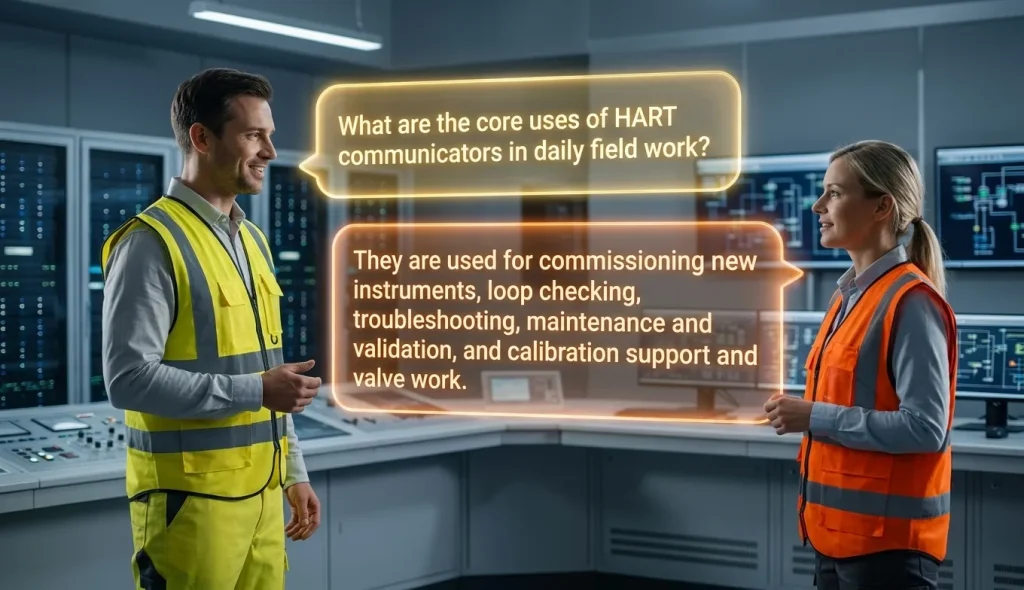
1) Commissioning New Instruments
Technicians use HART communicators to verify tag names, engineering units, lower and upper range values, damping, alarm behavior, and output settings before the loop is handed over to operations.
2) Loop Checking
During pre-commissioning and startup, HART devices help confirm that the field instrument, wiring, marshalling, I/O card, and control system all match the design intent.
3) Troubleshooting
When a reading looks wrong or communication appears unstable, a HART communicator helps isolate whether the issue comes from the instrument, the loop power, the wiring, or the control system.
4) Maintenance and Validation
Maintenance teams use HART access to confirm that field devices still match approved settings and to review device diagnostics before replacing parts unnecessarily.
5) Calibration Support and Valve Work
HART communicators support trim tasks, configuration checks, and control valve diagnostics, making them useful in calibration workflows and reliability-focused maintenance.
Typical Applications by Instrument Type
Pressure Transmitters
Used to confirm range, units, damping, tag data, and device diagnostics on process lines, separators, pumps, and compressor systems.
Temperature Transmitters
Useful for checking sensor type, range, burnout direction, and configuration in heating, cooling, and process protection applications.
Level Transmitters
Helps review setup and diagnostics on tanks, separators, and drums where unstable or misleading level readings can create operating problems.
Flow Instruments
Supports verification of configuration and helps troubleshoot mismatches in process balance, reporting, or control performance.
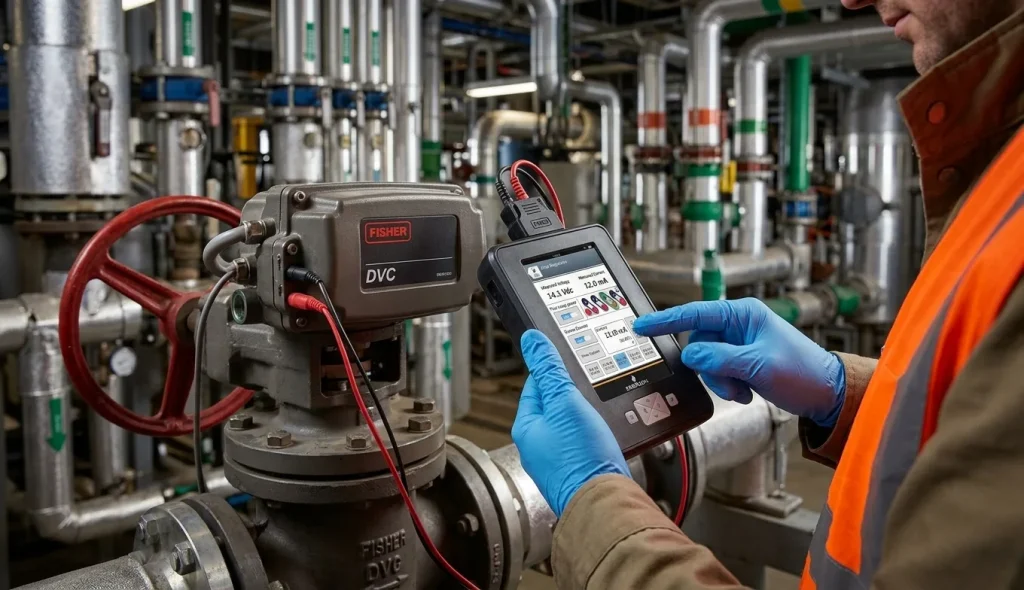
Valve Positioners
A communicator can access valve position, alerts, travel feedback, and diagnostic data to help identify friction, tuning, or air supply issues.
HART Communicator vs Multimeter
A multimeter is excellent for electrical measurements, but it does not replace a HART communicator. The two tools serve different purposes and often work best together.
Field Tip
The best troubleshooting workflow often uses both tools: a multimeter for the electrical side of the loop and a HART communicator for the smart device configuration and diagnostics.
Typical Field Workflow
- Confirm work permit and hazardous-area requirements.
- Identify the correct loop and field device tag.
- Connect the communicator at the approved point.
- Establish communication with the instrument.
- Review tag, model, revision, and live process value.
- Verify range, units, damping, and alarm settings.
- Compare digital value with analog output and control-room indication.
- Inspect diagnostics and alert messages.
- Apply approved changes if needed.
- Document and synchronize field changes.
Troubleshooting Scenarios
Pressure Transmitter Mismatch
The control room shows the wrong pressure value. The HART communicator reveals that the installed range does not match the approved datasheet setting.
Unstable Level Reading
The communicator shows damping or configuration values that are not suitable for the application, helping stabilize the reading after proper review.
Valve Performance Issue
Digital valve diagnostics indicate friction, travel problems, or supply issues, allowing maintenance teams to focus on the actual fault.
Startup Without Full Loop Power
A communicator with loop-power capability can help configure or validate a device before the entire control infrastructure is fully available.
Hazardous Areas and Intrinsic Safety
Oil and gas sites often require intrinsically safe equipment for field work. This makes industrial communicators much more suitable than general-purpose electronics.
For example, the AMS Trex Device Communicator datasheet states that it meets global intrinsic safety requirements including ATEX, CSA (US/Canada), IECEx, and FISCO

Example of a Modern HART Communicator: Emerson AMS Trex
The Emerson AMS Trex Device Communicator is a strong example of a modern field communicator designed for industrial use.
Confirmed Trex highlights from the datasheet
- Helps commission and validate devices faster.
- Can automatically synchronize field changes with AMS Device Manager.
- Supports advanced diagnostics and inline valve testing.
- Includes a pre-installed DD library for more than 2,000 HART and FOUNDATION Fieldbus devices.
- Provides built-in USB and Wi-Fi connectivity.
- Includes power-the-loop capability for field troubleshooting and setup.
- Offers a 5.7-inch resistive touchscreen designed for glove-friendly operation.

The datasheet also confirms support for applications such as Field Communicator, Loop Diagnostics, Fieldbus Diagnostics, WirelessHART Provisioning, Radar Master, and ValveLink Mobile.
Why Loop-Power Capability Matters
One particularly useful feature in field work is the ability to power the loop directly from the communicator. According to the Trex datasheet, this helps configure devices before full infrastructure is ready and helps isolate issues related to power supply, wiring, I/O cards, and configuration
This can save valuable time during startup, replacement work, troubleshooting, and pre-commissioning activities.
Best Practices for Oil & Gas Technicians
- Verify wiring and loop conditions before assuming device failure.
- Record original parameters before making changes.
- Use approved change-control procedures.
- Compare digital process values with analog output and DCS readings.
- Review diagnostics before replacing hardware.
- Follow hazardous-area rules and permit requirements.
- Document and synchronize all field changes whenever possible.
Conclusion
HART communicators remain indispensable in oil and gas operations because they give field teams digital access to smart instruments without unnecessary process interruption. They support commissioning, loop checks, troubleshooting, configuration review, maintenance validation, and valve diagnostics across upstream, midstream, and downstream facilities.
More importantly, they help technicians answer the questions that matter most in the field: Is this device configured correctly? Is the reading trustworthy? Is the fault in the instrument, the loop, or the control system? Can the problem be solved without replacing equipment unnecessarily?
Modern tools such as the Emerson AMS Trex Device Communicator extend these core HART capabilities with rugged design, intrinsic safety certifications, loop-power support, synchronization features, and advanced diagnostics suitable for real industrial environments
Ready to Upgrade Your Instrumentation Toolkit?
Stop carrying external power supplies. Start diagnosing smarter with advanced HART and fieldbus communication tools built for real oil and gas environments.
What are the primary functions of a HART communicator in the field?
Technicians use HART communicators for device configuration (tagging, ranging), loop testing, real-time diagnostics, and troubleshooting smart instruments like pressure or level transmitters without interrupting the 4-20mA signal.
Why is the "Power the Loop" feature in Emerson AMS Trex important?
This feature allows technicians to power a field instrument directly from the handheld device. It is critical for commissioning or troubleshooting when the host system's power or I/O infrastructure is not yet available or is suspected to be faulty.
Are HART communicators safe for use in hazardous Oil & Gas zones?
Yes, provided they are Intrinsically Safe (IS). Modern devices like the AMS Trex carry ATEX, IECEx, and CSA certifications, making them safe for Class I, Division 1, and Zone 0/1 environments common in refineries and offshore platforms.
How does a HART communicator improve control valve maintenance?
By using applications like ValveLink Mobile, a communicator can run digital signatures and travel checks on valve positioners. This identifies issues like high friction or air leaks before they cause a process trip.
Can I use a HART communicator for Foundation Fieldbus devices?
Multi-protocol communicators, such as the Emerson AMS Trex, support both HART and Foundation Fieldbus (FF) devices, providing a single tool for diverse instrumentation architectures in modern plants.



 Bench Multimeters