

Megger VF-T5 vs Fluke 2AC: The Real Difference Between Two Popular Non-Contact Voltage Testers

Quick Verdict:
Both detectors are rated CAT IV 1000V and are extremely safe.
-
Choose the [Fluke 2AC] if: You want speed and simplicity. Its “Always-On” technology means there are no buttons to press, making it the fastest tool for quick checks.
-
Choose the [Megger VF5] if: You work in noisy or dark environments. It features a built-in flashlight and a vibrating alert, which the Fluke 2AC lacks.
Choosing between Megger VF-T5 and Fluke 2AC is not about brand loyalty, but about matching the right non-contact voltage tester to your real working environment. This in-depth comparison explains the practical differences that matter before you buy.
Why This Comparison Deserves Your Attention
Non-contact voltage testers are among the most widely used electrical safety tools in the world. From professional electricians working on live panels to students learning basic electrical diagnostics, these compact devices play a critical role in preventing accidents and improving workflow efficiency.
Among the many models available, Megger VF-T5 and Fluke 2AC stand out as two of the most commonly considered options. Both come from highly respected brands, both are widely distributed globally, and both promise fast, reliable detection of live AC voltage.
However, despite their similar appearance and purpose, these two voltage tester pens are designed with different priorities, sensitivity philosophies, and user expectations in mind. This article goes beyond surface-level specifications to explore how they actually perform in real-world scenarios, helping you decide which one truly fits your needs.

Megger VF-T5 Overview: Designed for Industrial and Noisy Environments
Megger is widely recognized for industrial electrical testing and safety equipment. The Megger VF-T5 goes beyond basic voltage detection by combining multiple safety-related functions into a single handheld device.
In addition to non-contact AC voltage detection, the VF-T5 features a laser infrared thermometer, allowing users to identify overheating cables, terminals, and electrical connections. This added temperature awareness is especially valuable in industrial and commercial environments, where abnormal heat often indicates early-stage electrical faults.
According to the official datasheet, key VF-T5 features include:
-
AC voltage detection from 12 V to 1000 V
-
Audible beeper and LED visual indication
-
Built-in LED torch for low-light conditions
-
IP54 protection against dust and water splashes
-
CAT IV 1000 V safety rating
These specifications position the VF-T5 as a multi-purpose electrical safety tool rather than a simple voltage detector.
Fluke 2AC Overview: Simple and Fast Voltage Detection
Fluke is known for producing reliable and easy-to-use electrical tools. The Fluke 2AC follows a minimalist design philosophy, focusing on one primary task: fast detection of live AC voltage.
Based on the official datasheet, the Fluke 2AC offers:
-
AC voltage detection from 90 V to 1000 V
-
Visual LED indication at the tip
-
Always-on operation for instant voltage checks
-
Lightweight and compact design
-
CAT IV 1000 V safety rating
Unlike the VF-T5, the Fluke 2AC does not include temperature measurement, audible alerts, flashlight functionality, or environmental sealing. Its strength lies in simplicity and speed.
Design, Build Quality, and Ergonomics: Megger VF-T5 and Fluke 2AC

After understanding the functional scope of each tester, physical design and ergonomics become important for daily use.
The Megger VF-T5 feels more solid and industrial. It is designed for frequent use in electrical panels, commercial installations, and industrial environments. The additional features slightly increase size and weight but also expand its functional value.
The Fluke 2AC is lighter and more compact, making it comfortable to carry throughout the day. This design suits technicians who perform frequent, quick voltage checks in residential, office, and light commercial settings.
The difference here is not build quality, but design intent and application focus.
Voltage Detection Performance and Sensitivity Comparison: Megger VF-T5 & Fluke 2AC
Voltage detection is the core function of both devices, but their sensitivity profiles differ.
The Megger VF-T5 can detect AC voltage starting from 12 V, making it suitable for low-voltage control circuits and industrial applications. Its controlled sensitivity helps reduce false alerts in environments with dense wiring and electromagnetic interference.
The Fluke 2AC, with a detection range starting at 90 V AC, responds very quickly when approaching live conductors. This fast response is ideal for standard electrical systems but may require user judgment in electrically noisy environments.
Accuracy, Stability, and False Alert Behavior: Megger VF-T5 vs Fluke 2AC
False alerts can reduce confidence in safety tools.
The VF-T5 combines controlled sensitivity with audible and visual feedback, providing stable and predictable behavior, especially in complex installations.
The Fluke 2AC relies on higher sensitivity and visual indication, enabling rapid detection but sometimes responding to nearby energized conductors rather than the exact target.
Safety Standards and Environmental Protection: Megger VF-T5 vs Fluke 2AC
Both devices carry a CAT IV 1000 V safety rating, making them suitable for use at the source of low-voltage electrical installations.
A key difference is environmental protection:
-
Megger VF-T5: IP54 rated for dust and water splash resistance
-
Fluke 2AC: No IP rating specified
This distinction is important for outdoor, industrial, or harsh working environments.
Ease of Use for Electricians, Technicians, and General Users: Megger VF-T5 vs Fluke 2AC
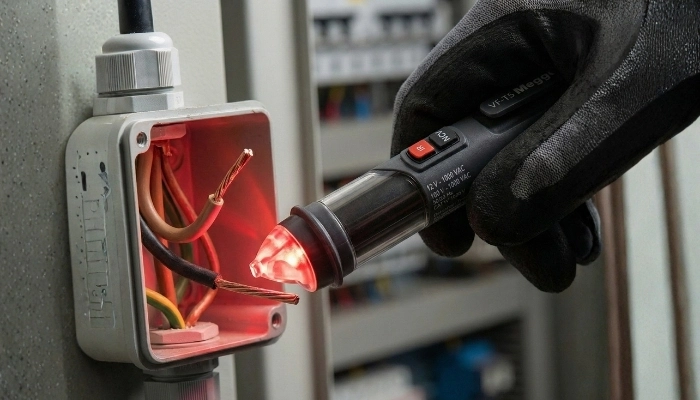
Ease of use is one of the most important factors when choosing a non-contact voltage tester, especially for users who perform voltage checks on a daily basis. Different users have different expectations depending on their experience level and working environment.
-
Professional electricians and engineers often prefer the VF-T5 for its stability, low-voltage detection, and added diagnostic awareness.
-
Maintenance technicians and facility staff typically favor the Fluke 2AC for its speed and simplicity.
-
Students and general users usually find the Fluke 2AC easier to learn and use immediately.
Battery Performance and Operational Reliability: Megger VF-T5 vs Fluke 2AC
Battery condition plays an important role in how much users trust a non-contact voltage tester. A safety tool must be ready to work at any moment, especially before approaching live electrical circuits or panels.
The Fluke 2AC includes a clear battery check function, allowing users to confirm readiness before use.
The Megger VF-T5 is designed to maintain consistent detection behavior even as battery power decreases, supporting reliable operation in professional environments.
Both tools require routine battery checks as part of standard maintenance.
Durability and Long-Term Use in Real Environments: Megger VF-T5 vs Fluke 2AC
Durability is an important consideration for any non-contact voltage tester, especially for
users who rely on the tool daily in demanding environments. Long-term reliability directly
affects safety, confidence, and overall value.
The VF-T5’s rugged construction, IP54 protection, and multi-function design make it suitable for long-term use in industrial and commercial environments.
The Fluke 2AC is widely trusted for long service life in everyday electrical work when handled properly.
Price differences between the two models are generally moderate. The real value depends on how well the tool matches your application:
-
VF-T5 offers greater value for users needing low-voltage detection, temperature awareness, and environmental protection
-
Fluke 2AC offers strong value for users prioritizing speed, simplicity, and portability
Price and Overall Value Comparison: Megger VF-T5 vs Fluke 2AC
When comparing non-contact voltage testers, price is often one of the first factors users consider.
However, the price difference between the Megger VF-T5 and the Fluke 2AC
is usually small and should not be the main deciding factor.
The real value of a voltage tester comes from how well it matches your working environment,
usage frequency, and safety expectations. A tool that performs reliably in your daily tasks
will always offer better long-term value than a cheaper option that does not fit your needs.
In the Megger VF-T5 vs Fluke 2AC comparison, value is not only about cost,
but about choosing the tester that provides the right balance of reliability, usability,
and confidence for your specific type of work.
Additional Capabilities and Practical Limitations of Megger VF-T5

One of the key advantages of the Megger VF-T5 compared to simpler non-contact voltage tester pens is its integrated temperature measurement capability.
The built-in infrared thermometer allows users to quickly identify overheating components such as terminals, cables, and electrical connections, helping detect potential faults before failure occurs.
Another important advantage is the lower voltage detection range. The VF-T5 can detect AC voltage at lower levels, expanding its usability to low-voltage control circuits and applications where standard voltage testers may not respond.
These additional capabilities also come with practical limitations that should be clearly understood. Although the VF-T5 can detect the presence of voltage, it does not display the actual voltage value. Like all non-contact voltage testers, it only indicates whether voltage is present or absent and should not be used as a measuring instrument.
In addition, temperature measurement accuracy may be reduced on reflective or shiny surfaces, where infrared readings can be affected. In such cases, temperature results should be interpreted with caution and verified using dedicated contact-based measurement tools when higher accuracy is required.
Technical Comparison: Megger VF-T5 vs Fluke 2AC
The following table compares Megger VF-T5 and Fluke 2AC strictly based on official manufacturer datasheets and real-world use cases.
| Feature | Megger VF-T5 | Fluke 2AC |
|---|---|---|
| Product Type | Non-contact voltage tester with IR thermometer | Non-contact voltage tester |
| AC Voltage Detection Range | 12 V to 1000 V AC | 90 V to 1000 V AC |
| Low Voltage Detection | Yes (from 12 V AC) | No |
| Voltage Display | No (presence/absence indication only) | No (presence/absence indication only) |
| Temperature Measurement | Yes (laser infrared thermometer) | No |
| Audible Alert | Yes (beeper) | No |
| Visual Indication | LED indicators | LED indicator at tip |
| Built-in Flashlight | Yes (LED torch) | No |
| Environmental Protection | IP54 (dust and water splash resistant) | No IP rating specified |
| Safety Rating | CAT IV 1000 V | CAT IV 1000 V |
| Operating Behavior | Controlled sensitivity for reduced false alerts | High sensitivity for fast detection |
| Typical Use Case | Industrial panels, low-voltage circuits, fault diagnostics | Residential and commercial quick voltage checks |
Final Verdict: Which One Should You Choose?
The Megger VF-T5 vs Fluke 2AC comparison shows that there is no universal winner.
Choose Megger VF-T5 if you work in industrial or commercial environments and benefit from additional safety features and diagnostic insight.
Choose Fluke 2AC if you need a lightweight, fast, and easy-to-use voltage detector for routine electrical checks.
Both tools are reliable, safe, and effective when used according to their intended purpose.



 Bench Multimeters