

Megger AVO850 vs Fluke 289: The 2026 Industrial Multimeter Showdown [Expert Review]
![Megger AVO850 vs Fluke 289: The 2026 Industrial Multimeter Showdown [Expert Review]](https://mme-ae.com/wp-content/uploads/2025/12/Megger-AVO850-vs-Fluke-289_-The-2026-Industrial-Multimeter-Showdown.webp)
Verdict Up Front:🚀
If your job demands lab-grade precision (0.025%) and diagnosing noisy motor drives (VFDs), the Fluke 289 remains the undisputed heavyweight champion. However, if you prioritize a modern color interface, rechargeable mobility, and built-in connectivity without dongles, the Megger AVO850 is the smarter, higher-value choice for the modern engineer.
In the world of industrial maintenance, good enough doesn’t cut it. When you are standing in front of a 600V switchgear in a remote UAE facility, you need a tool that is safe, accurate, and ready to log data for hours.
For years, the Fluke 289 has been the gold standard. But the Megger AVO850 has entered the ring with specs that challenge the status quo. At MME, we didn’t just read the datasheets; we filtered the specs through years of field experience to separate marketing hype from reality.
Here is the definitive comparison to help you decide where to invest your budget.
| Feature | Fluke 289 🇺🇸 | Megger AVO850 🇬🇧 | The Winner? |
|---|---|---|---|
| DC Voltage Accuracy | 0.025% | 0.05% | Fluke (More Precise) |
| Display Technology | 1/4 VGA Dot Matrix (Mono) | TFT Color LCD (320×240) | Megger (Better UI) |
| Frequency Bandwidth | ~1 MHz (999.99 kHz) | 10 MHz | Megger (Higher Range) |
| Power Source | 6x AA Batteries | Li-ion Rechargeable | Megger (Modern) |
| Logging Memory | 15,000 Readings | 9,000 Readings | Fluke (Deeper Memory) |
| Drop Test (Ruggedness) | 1 Meter | 2 Meters | Megger (Tougher Drop) |
| VFD / Low Pass Filter | Yes | Not Specified | Fluke (Better for Drives) |
1. Accuracy & Industrial Noise (The Fluke Edge)
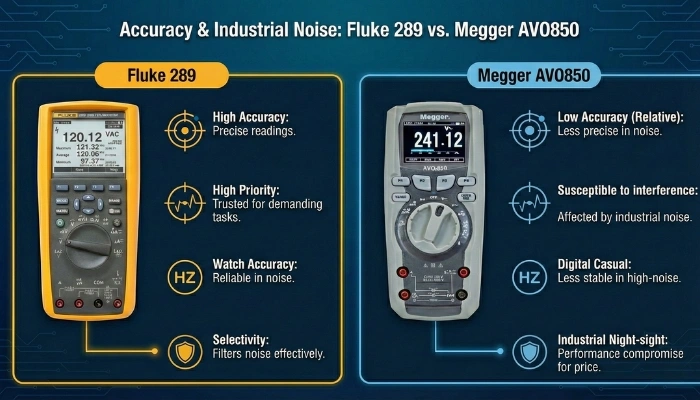
This is where the Fluke 289 earns its reputation.
-
Precision: With a basic DC accuracy of 0.025%, the Fluke 289 is essentially a handheld calibrator. The Megger AVO850 is no slouch at 0.05%, which is excellent for maintenance, but Fluke takes the crown for critical R&D work.
-
VFD Troubleshooting: The Fluke 289 features a dedicated Low Pass Filter. This allows you to accurately measure voltage and frequency on adjustable speed motor drives (ASDs) by blocking high-frequency noise. It also includes a LoZ (Low Impedance) mode to eliminate ghost voltages, a feature critical for verifying if a circuit is truly dead.
2. Interface & Usability (The Megger Edge)
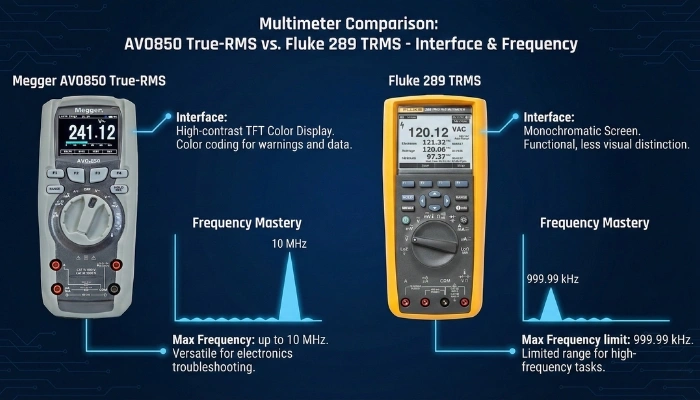
If you are tired of monochromatic screens from the 2000s, the Megger AVO850 is a breath of fresh air.
-
The Screen: Megger utilizes a high-contrast TFT color display. This isn’t just cosmetic; color coding helps you distinguish between warnings, primary readings, and secondary data instantly in dark electrical rooms.
-
Frequency Mastery: The AVO850 can measure frequency up to 10 MHz , vastly outperforming the Fluke’s 999.99 kHz limit. This makes the Megger significantly more versatile for electronics and communications troubleshooting.
3. Power & Mobility (The Daily Carry)
-
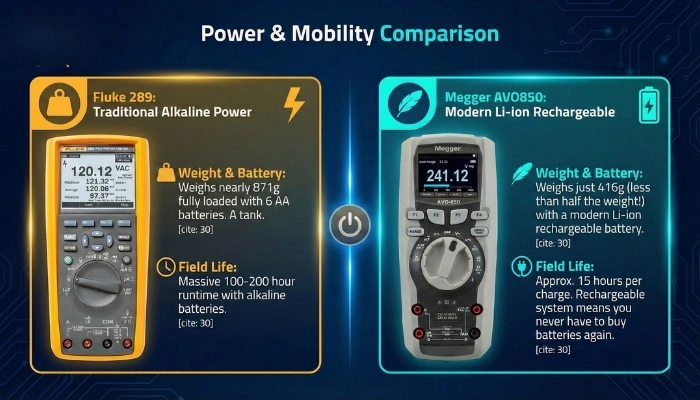
Weight & Battery: The Fluke 289 is a tank, weighing nearly 871g fully loaded with its 6 AA batteries. In contrast, the Megger AVO850 runs on a modern Li-ion rechargeable battery and weighs just 416g —less than half the weight!
-
Field Life: While Fluke’s alkaline batteries offer a massive 100-200 hour runtime , the Megger’s rechargeable system (approx. 15 hours per charge) means you never have to buy batteries again—just plug it in like your phone.
4. Connectivity & Ecosystem
-
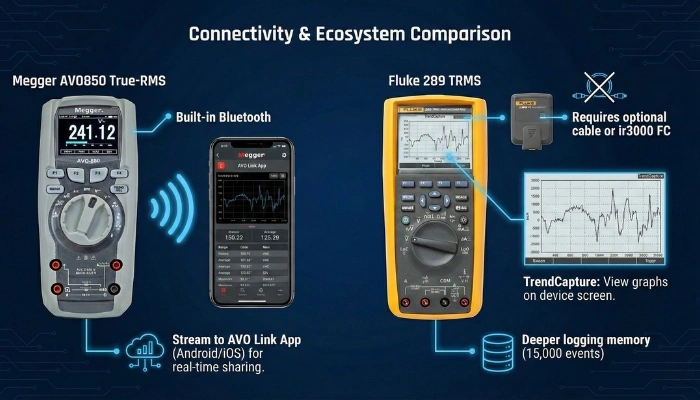
Megger: Built for the wireless age. It features Bluetooth connectivity built-in. You can stream data directly to the Megger AVO Link App on your Android/iOS device for real-time sharing.
-
Fluke: Requires an optional optical cable or the ir3000 FC module to connect wirelessly. However, for deep data analysis, the TrendCapture feature allows you to view graphs on the device screen without needing a PC , and its logging memory is deeper (15,000 events vs Megger’s 9,000 ).
5. Display Showdown: Color Clarity vs Classic Monochrome
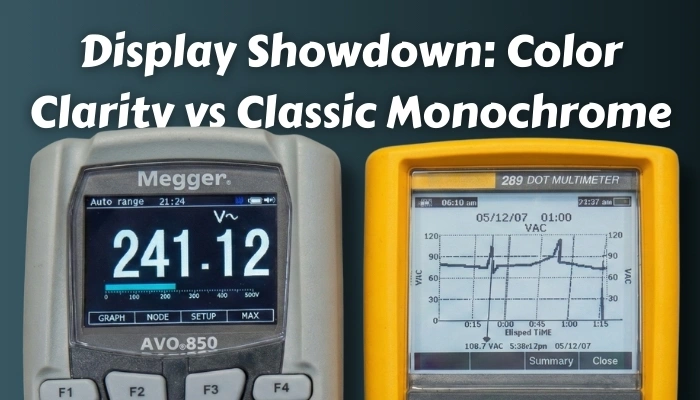
The primary distinction between these two devices lies in their visual technology; according to official specifications, the Megger AVO850 is equipped with a modern, full-color TFT LCD featuring a 320×240 pixel resolution, which provides high contrast for distinguishing data and graphs. In contrast, the technical documentation for the Fluke 289 confirms that it utilizes a monochrome Dot Matrix display (1/4 VGA standard) with a white backlight; while it matches its competitor with a 50,000-count precision, it lacks the visual capabilities and color separation offered by the Megger model.
Pros & Cons: The Final Breakdown
| 🇬🇧 Megger AVO850 (The Modern Choice) | 🇺🇸 Fluke 289 (The Classic Pro) |
|---|---|
✅ The Good
High Frequency: Measures up to 10 MHz. Rechargeable: Li-ion battery included. Tough: Withstands a 2-meter drop. Process Ready: 4-20mA loop reading. ❌ The BadMemory: Max 9,000 readings. Rating: IP40 (Indoor focus). |
✅ The GoodPrecision: 0.025% DC accuracy. VFD Mode: Low Pass filter for motor drives. Graphing: TrendCapture on-screen. Safety: LoZ eliminates ghost voltage. Memory: 15,000 readings. ❌ The BadHeavy: Weighs ~870g (with batteries). Dated: Monochrome screen & AA batteries. |
Final Recommendation: Which One Fits Your Tool Belt?
Choose the Megger AVO850 if:
You are a modern technician who values speed and mobility. The combination of a lightweight design, rechargeable battery, and built-in Bluetooth makes it perfect for field service. If you work with process control loops (4-20mA) or higher frequency electronics (up to 10MHz), the Megger provides superior versatility at a great value.
Choose the Fluke 289 if:
You are a plant engineer dealing with Variable Frequency Drives (VFDs) and critical power quality issues. The Low Pass Filter and superior 0.025% accuracy are non-negotiable for complex industrial troubleshooting. If you need to log data for days and analyze trends directly on the meter face, Fluke is still the king.


 Bench Multimeters