

AI in Power Quality: How Smart Test Tools Are Transforming the Future of Electric Grids

Artificial Intelligence in Power Quality is no longer just a buzzword—it’s changing the way we design, test, and maintain modern power systems. Today, as the world shifts toward electrification, renewable energy, and high-demand data centers, the pressure on electrical grids has never been greater. Even a small issue in power quality can lead to downtime, costly failures, or even safety risks in critical industries.
That’s why engineers are turning to smart test tools powered by AI. Devices like the Fluke 1777 Power Quality Analyzer or Hioki PQ3100 are more than just measurement tools; they act as intelligent assistants. They don’t just collect raw data—they help interpret it, highlight hidden problems, and even predict failures before they happen. This means less guesswork, faster troubleshooting, and more reliable power systems for industries that simply cannot afford mistakes.
In this article, we’ll look at how AI and electrification are driving a new generation of testing solutions, why these innovations matter for engineers and utilities, and how smart test tools are helping us build a safer, smarter, and more resilient energy future.
AI & Electrification Drive New Electronics Testing Solutions
Electrification is surging worldwide. From electric mobility (EVs) to renewable power integration, the demand for advanced electronic testing solutions is skyrocketing. Traditional test equipment, while precise, often falls short in handling today’s massive data streams and real-time grid fluctuations.
Two tech trends artificial intelligence (AI) and electrification are reshaping electronics testing and measurement. These systems demand more speed and power than ever before, requiring next-generation testing solutions that can keep up with high-performance signals and ensure compliance with global standards.
More and more intelligence is being pushed to the edge wearables and electric vehicles are perfect examples of embedded systems that require advanced testing, explained an industry expert.
How AI-Powered Test Tools Are Changing the Game
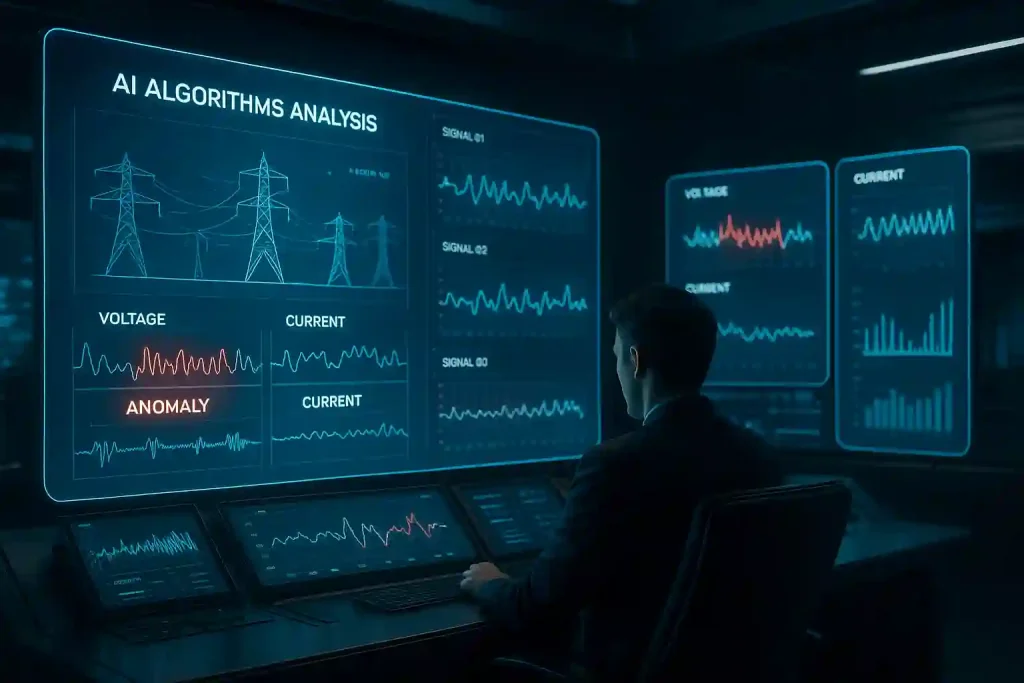
- Automated anomaly detection: AI algorithms can flag irregularities in voltage, current, or harmonics faster than human analysis.
- Self-learning systems: Modern analyzers can learn from historical grid data to predict failures before they disrupt operations.
- Cloud-connected monitoring: Tools like the Fluke 1777 Power Quality Analyzer provide remote, AI-enabled cloud access for real-time insights, while the Fluke 435-II Series offers advanced data logging to track harmonics, voltage sags, and transient events.
- Integration with Industry 4.0: Smart test devices feed directly into digital twin models, enabling more efficient design, predictive diagnostics, and troubleshooting.
For a deeper look into practical applications, explore our comprehensive guide on the Fluke 435-II Power Quality and Energy Analyzer — a professional tool designed for detecting harmonics, measuring energy losses, and verifying compliance with modern power quality standards.
AI doesn’t work too well if processing takes too long. That’s why modern AI systems and data centers must be verified at extremely high speeds—moving huge amounts of signals while consuming lots of power, said another specialist.
Electrification and New Testing Demands
Electrification is accelerating across industries—from automation systems to medical devices. Each requires high-power converters capable of switching in nanoseconds.
We are seeing the electrification of everything. All these devices demand power electronics that need to be tested faster and more accurately than ever, noted one engineer.
To keep pace, companies are adopting advanced Fluke power quality analyzers and digital multimeters, which support standards such as IEC 61000 and provide engineers with tools for faster, more-accurate analysis across both current-generation and next-generation products.
Preparing for the Future: From Electrical to Optical Signals
Another major shift on the horizon is the potential move from electrical signals over copper to optical signals using lasers and light. Optical transmission, already common in fiber systems, is immune to many forms of interference.
Engineers who have always designed with copper now face a new learning curve—designing with optical transmission lines, said a senior power systems consultant.
Fluke is also advancing solutions to help engineers transition to new testing requirements, ensuring that measurement remains accurate, efficient, and ready for future technologies.
By merging AI and electrification, companies are achieving higher energy efficiency, lowering operational costs, and ensuring compliance with stringent standards such as IEC 61000. At the same time, they are preparing for a future where AI-driven predictive diagnostics, electrified systems, and even optical transmission lines become the new normal. 1
As one Fluke technical advisor explained: We have to ensure our instruments do not interfere with signals. That’s why modern measurement algorithms are designed to be more efficient and deliver the lowest noise possible.
Utilities Are Tiptoeing into AI as Climate Change and Data Center Growth Add Stress to the Energy Grid
The modern power grid is reaching a breaking point. Climate change, with its extreme heatwaves, wildfires, and violent storms, is destabilizing supply lines, while AI-driven data centers, cloud services, and streaming platforms are consuming unprecedented amounts of electricity. According to the US Department of Energy, blackouts could cost American businesses up to $150 billion annually, leaving millions without reliable power.
Utilities now face two pressing challenges:
- Maintaining power quality under volatile and fluctuating loads.
- Predicting and preventing outages before they disrupt millions of customers.
How AI and Smart Test Tools Are Helping
- Grid monitoring with AI-powered analyzers: Devices like the Fluke 435-II Power Quality Analyzer and Fluke 1777 Series detect harmonics, flicker, and transient events in real time. This allows utilities to isolate weak points in the grid before they escalate into outages.
- Load forecasting: AI-driven models forecast peak demand from EV charging stations, server farms, and industrial clusters, enabling utilities to balance loads more effectively and prevent blackouts.
- Predictive maintenance: By embedding sensors in transformers, switch gears, and transmission lines, utilities can feed real-time data into AI systems. Machine learning then analyzes these patterns to forecast equipment failures in advance.
As one consulting partner noted: “Predictive maintenance is delivering the fastest returns. With AI, utilities can move from guesswork to precision.”
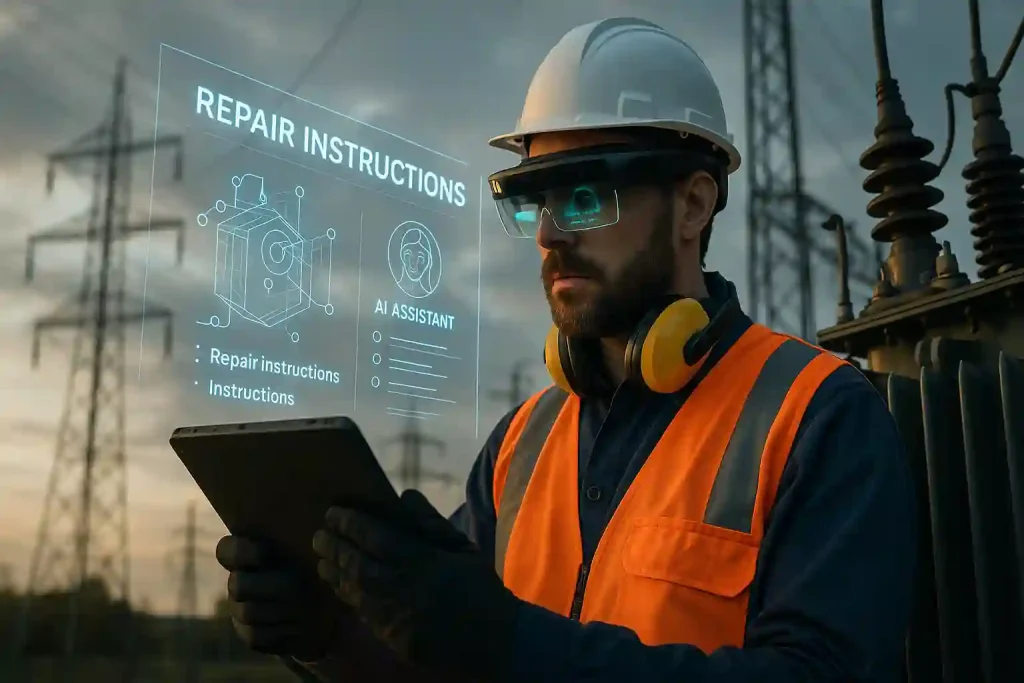
- Smarter field operations: Some utilities are deploying AI-based assistants on mobile devices, giving technicians real-time troubleshooting support. Instead of relying on manuals or waiting for expert advice, workers can query AI systems and receive step-by-step repair instructions.
It empowers our workforce by providing field technicians with real-time access to expert-level support, said one utility CIO.
Climate-Driven Risk Mapping
Beyond maintenance, utilities are beginning to use AI platforms to map climate-driven risks such as wildfires, vegetation growth, and storm impacts. By creating digital risk maps, operators can identify which parts of the grid are most vulnerable and prioritize upgrades for maximum impact.
A utility executive explained: We reduced storm-induced outages by more than 70% after deploying AI-based climate risk models. It was the first time we could clearly see where to invest each dollar for the biggest return.
The Road Ahead
Despite promising results, challenges remain: poor data quality, outdated infrastructure, and unclear regulatory frameworks make large-scale adoption difficult. Still, optimism is growing as utilities migrate to the cloud, train employees in AI literacy, and collaborate with regulators.2
Without AI, monitoring the complexity of today’s grid is like trying to fly a plane blindfolded,” said an energy executive.
Another expert added: AI won’t replace core grid functions, but it will increasingly act as an accelerant.
Electrical Electronics Engineering Artificial Intelligence
The field of electrical and electronics engineering (EEE) is being fundamentally reshaped by AI. Testing, once a purely manual task, now benefits from automation, robotics, and machine learning.
Key applications include:
- Automated Test Equipment (ATE): AI speeds up production line testing for semiconductors, circuit boards, and electronic systems.
- Fault diagnosis: Algorithms can pinpoint hidden defects that standard tests may overlook.
- Signal analysis: AI enhances accuracy in spectrum analyzers and oscilloscopes used in RF and wireless testing.
- Power systems engineering: AI helps model and simulate how renewable sources integrate into existing grids.
Universities and R&D labs are also using AI in EEE to train the next generation of engineers, ensuring future test tools are even smarter, more connected, and more reliable.
Traditional vs. AI-Driven Testing: A Comparison
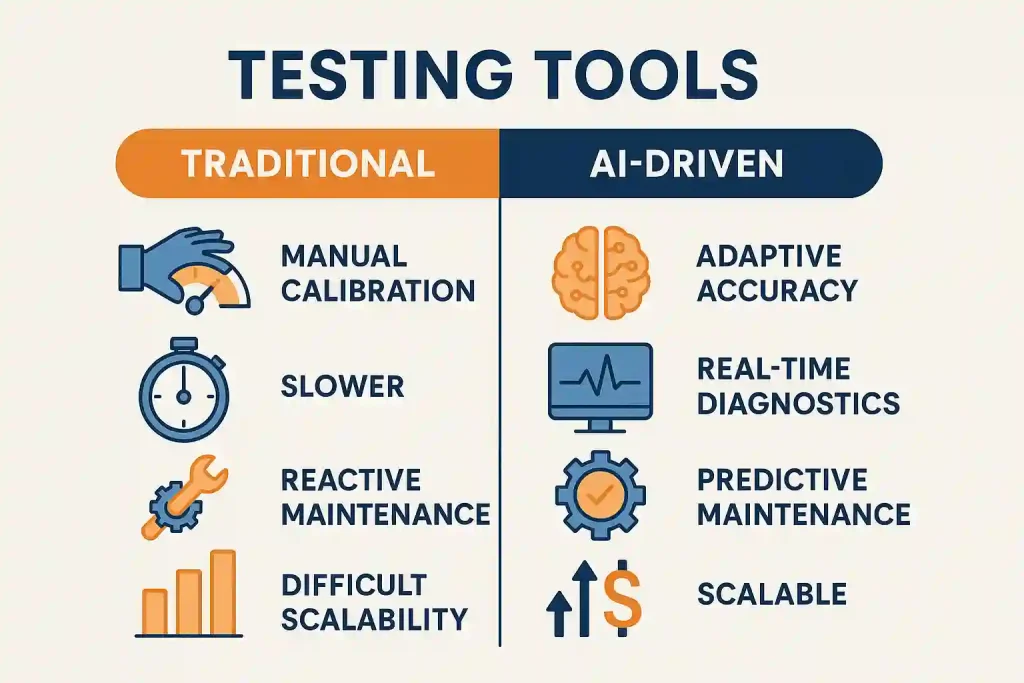
In recent years, traditional testing methods have faced significant limitations. The integration of AI into testing and measurement has brought a major transformation. The table below highlights the key differences between traditional testing tools and AI-driven solutions.
| Feature | Traditional Testing Tools | AI-Driven Testing Tools |
|---|---|---|
| Accuracy | Limited to manual calibration | Self-learning, adaptive accuracy |
| Speed | Slower, requires manual checks | Real-time, automated diagnostics |
| Predictive Maintenance | Reactive only | Predicts failures before they occur |
| Scalability | Difficult to scale across networks | Seamlessly scalable for large grids |
| Cost Efficiency | High long-term maintenance costs | Lower OPEX through automation |
Smart Test Tools & Power Quality Analyzers
Leading manufacturers are already integrating AI into their test solutions:
- Fluke 1777 Power Quality Analyzer – Offers automatic measurements, harmonics detection, and cloud connectivity with predictive features.
- Fluke 435-II – Known for analyzing power disturbances and calculating energy losses caused by poor power quality.
- Hioki PQ3100 – Provides continuous recording and advanced visualization of power anomalies with AI-assisted analytics.
These tools are not only measuring parameters but making decisions and providing actionable insights—something impossible a decade ago.
Market Insights & Future Trends
According to Future Market Insights and MarketsandMarkets, the global market for AI in electrical testing and power quality solutions is projected to grow at 15–20% CAGR through 2030.
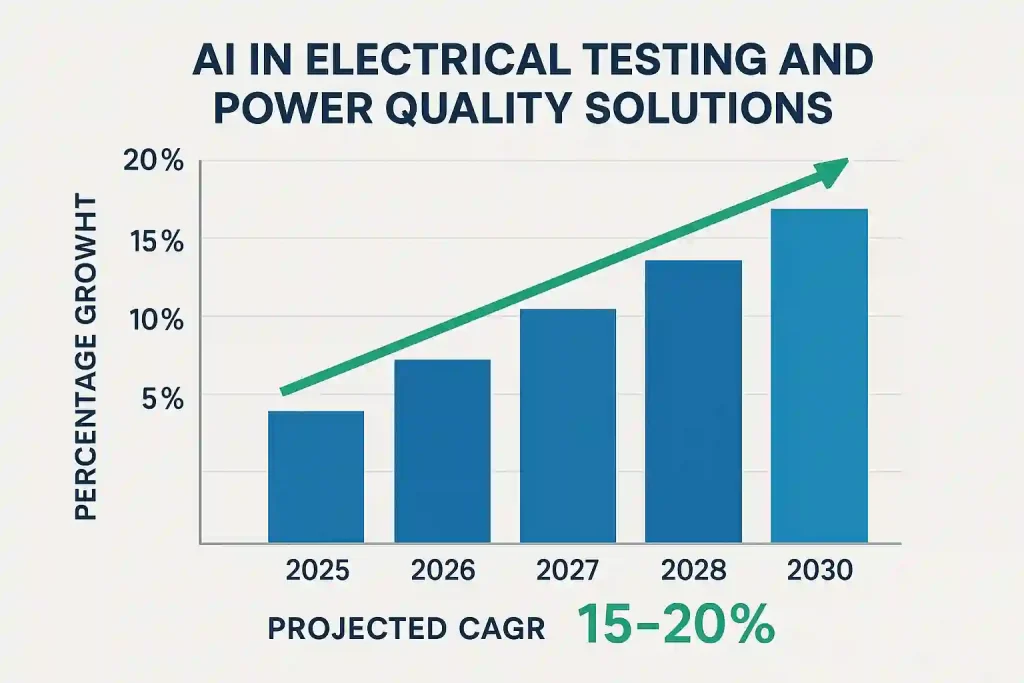
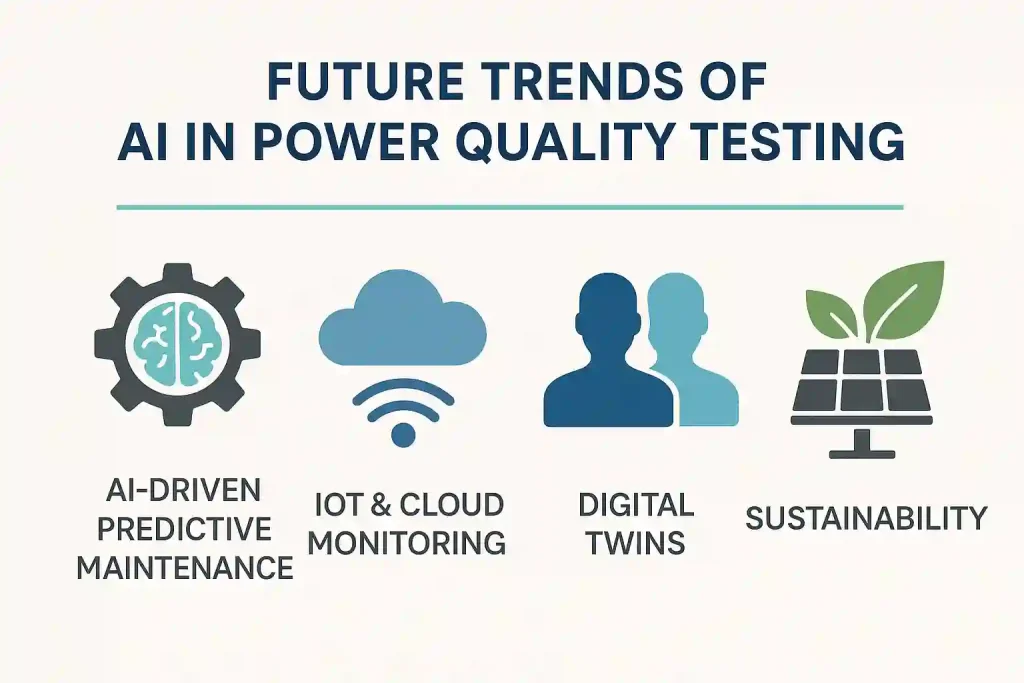
Future trends include:
- AI-driven predictive maintenance becoming the norm in utilities and industrial plants.
- Integration of IoT and cloud platforms for 24/7 monitoring.
- Wider adoption of digital twins for grid stability and product testing.
- Sustainability focus: AI helping optimize renewable integration and carbon-neutral operations.
Companies that adopt AI-enabled testing solutions early will gain a competitive edge in efficiency, compliance, and customer satisfaction. 3
Benefits of AI-Powered Test Tools for Engineers & Industries
- Higher Accuracy: AI reduces human error and detects anomalies invisible to traditional tools.
- Faster Testing Cycles: Automation shortens diagnostic and commissioning times.
- Cost Reduction: Predictive analytics prevent costly downtime and equipment failures.
- Scalability: AI systems adapt as energy demand grows (EVs, data centers).
- Regulatory Compliance: Helps meet standards like IEEE 519 for harmonics.
Real-world use case: A manufacturing facility using AI-enhanced PQ analyzers reported a 30% reduction in downtime and 20% energy cost savings within one year.
Artificial Intelligence is transforming power quality and electronics testing. From utilities under climate stress to engineers in high-tech industries, the demand for smart, AI-enabled test tools is only going to grow.
Companies like Fluke, Hioki are leading this revolution, equipping professionals with instruments that don’t just measure but analyze, predict, and optimize.
For organizations looking to stay ahead, investing in AI-powered test solutions is no longer optional—it’s the future of reliable, efficient, and sustainable energy management.
At MME, we supply cutting-edge power quality analyzers, digital multimeters, and advanced test equipment that empower engineers and industries to embrace this AI-driven transformation.
For expert consultation, click the link
Need power quality analyzers in the UAE?
MME supplies professional power quality analyzers in the UAE. Browse the range or chat with our team on WhatsApp.
- Design News. (2025, March 19). AI & electrification drive new electronics testing & measurement solutions.
[↩]
- Business Insider. (2025, June 17). Utilities are tiptoeing into AI as climate change and data center growth add stress to the energy grid.[↩]
- Future Market Insights. (2025, June 23). Test and measurement equipment market analysis – size, share, and forecast outlook 2025 to 2035. Future Market Insights.[↩]


 Bench Multimeters