

13 Ground Testing Mistakes That Confuse Even Pros (2026 Guide)
Is your grounding system actually safe, or do you just hope it is?
Ground testing (Earth Resistance Testing) is notoriously misunderstood. For many electrical engineers and technicians who don’t perform these tests daily, the process is often filled with uncertainty and confusion.
Why is this critical? A poor grounding system endangers lives and sensitive equipment. Yet, countless professionals still rely on unreliable methods—like the “Dead Earth” technique—or use the wrong instruments to verify their systems.
In this technical guide, we clarify the 13 most common mistakes and questions regarding ground testing. Whether you are a beginner or a seasoned engineer, this guide will help you troubleshoot your testing procedure with confidence.
Part 1: Choosing the Right Tools (Don’t Make These Mistakes)
The most fundamental errors happen before the test even begins. Using the wrong instrument renders your results useless.
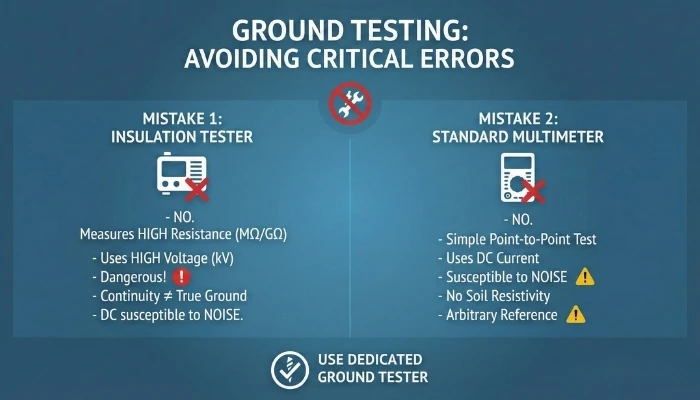
1. Can I use an Insulation Tester (Megger) for ground testing?
No. This is a critical error. While an Insulation Tester and a Ground Tester may look similar, they sit at opposite ends of the resistance spectrum.
-
Insulation Testers: Designed to measure high resistance (Megohms/Gigaohms) using high voltage (kV).
-
Ground Testers: Designed to measure low resistance (Ohms) using low voltage for safety.
The Trap: Many operators use the “Continuity” function of an insulation tester. This is dangerous because it only measures continuity between an electrode and a reference point (like a pipe), not the true resistance of the earth to a fault current. Furthermore, DC continuity tests are easily corrupted by soil transients and electrical noise.
2. Can I simply use a Standard Multimeter?
No. A standard Digital Multimeter (DMM) cannot perform a valid earth resistance test for two main reasons:
-
Noise Interference: Multimeters use DC current, which is highly susceptible to distortion from ground currents and electrical noise in the soil. Ground testers use specific AC frequencies to filter this out.
-
Arbitrary Reference: A multimeter only measures resistance between two points. It cannot verify the Soil Resistivity or the “Sphere of Influence” of the ground electrode.
Part 2: Testing Methods & Techniques
Understanding the difference between a Quick Check and a Standard Test is vital for compliance.
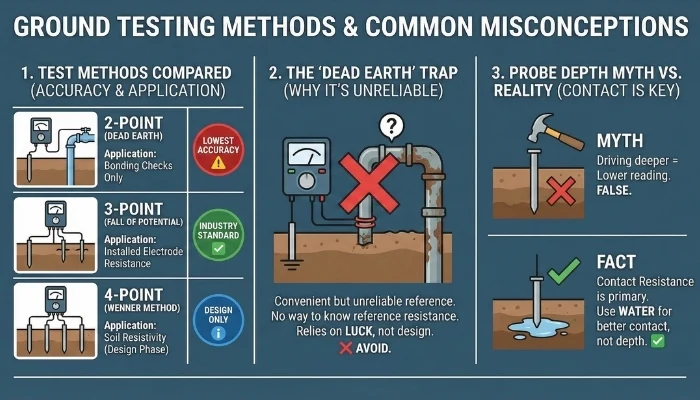
3. What is the difference between 2-Point, 3-Point, and 4-Point tests?
These terms refer to the number of connections made to the soil.
-
2-Point (Dead Earth): Connects the ground electrode to a secondary reference (like a water pipe). Lowest accuracy.
-
3-Point (Fall of Potential): The industry standard. Uses the electrode under test + 2 auxiliary probes (Current and Potential). It measures the actual resistance of the grounding system.
-
4-Point (Wenner Method): Uses 4 probes and no installed electrode. It is used exclusively for measuring Soil Resistivity (Rho) to design a new grounding system.
| Method | Application | Technical Limitation |
|---|---|---|
| 2-Point (Dead Earth) | Bonding checks only | Includes return path resistance; highly inaccurate. |
| 3-Point (FOP) | Installed Electrode Resistance | Requires disconnecting the neutral bond (unless using selective clamps). |
| 4-Point (Wenner) | Soil Resistivity ($\rho$) | Used for design phase, not verification. |
4. Why is the Reference Ground (Dead Earth) method not recommended?
Testing against a reference ground (like a metal fence or water pipe) is convenient but unreliable. Since the reference is chosen based on convenience rather than electrical design, you rely on pure luck. You have no way of knowing if that water pipe has a low enough resistance to earth to act as a valid reference. Always prefer the Fall of Potential method.
5. How deep should I drive the test probes? (The Depth Myth)
Myth: Driving test probes deeper lowers the reading. Fact: Depth is not the primary factor; contact resistance is. You do not need to hammer probes deep into the ground. They only need enough contact to pass the current. If your ground tester shows a “High Contact Resistance” warning, driving them deeper might help, but pouring a little water around the probe is often more effective and faster.
Part 3: Interpreting Results & Standards
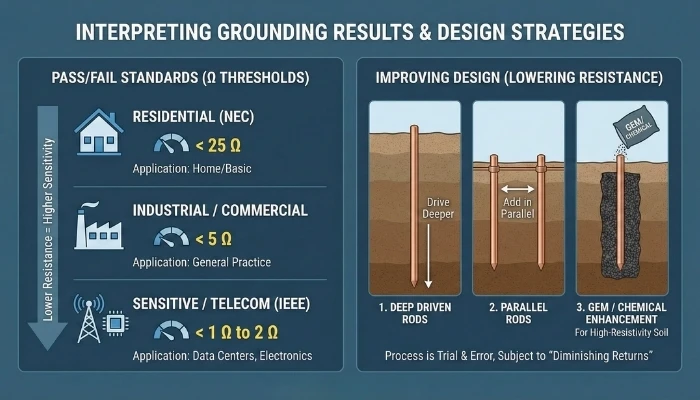
A test result is only as good as your ability to interpret it. In this section, we define the ‘Pass/Fail’ thresholds based on NEC and IEEE standards and outline the corrective engineering steps required if your system fails to meet these targets
6. How do I know if my ground resistance is Good?
“Good” depends on the application. Here are the general industry standards:
| Application | Target Resistance | Standard Reference |
|---|---|---|
| Residential | 25 Ω or less | NEC (National Electrical Code) |
| Industrial / Commercial | 5 Ω or less | General Industry Practice |
| Sensitive Electronics / Telecom | 1 Ω to 2 Ω | IEEE / Telecom Standards |
7. How do I design a ground to meet these specs?
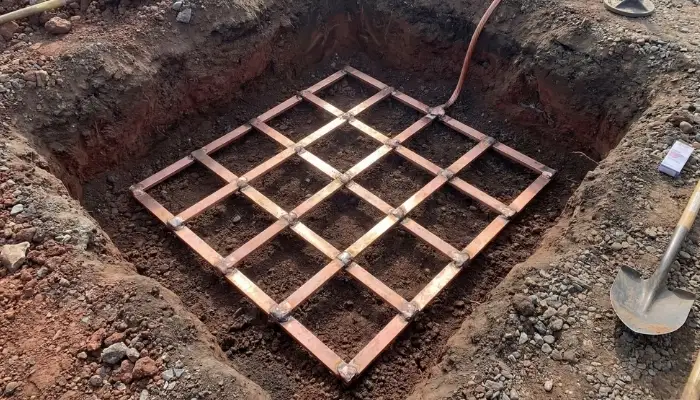
Designing a ground bed is often a process of trial and error, subject to the “Law of Diminishing Returns.”
-
Step 1: Drive a rod and test it.
-
Step 2: If resistance is too high, couple a second rod and drive deeper (Deep Driven Rods).
-
Step 3: Alternatively, add a second rod in parallel (connected by a conductor).
-
Tip: In high-resistivity soil, consider using Ground Enhancement Materials (GEM) or chemical rods instead of endlessly adding copper.
Part 4: Environmental Challenges (Rain, Rock, and Concrete)
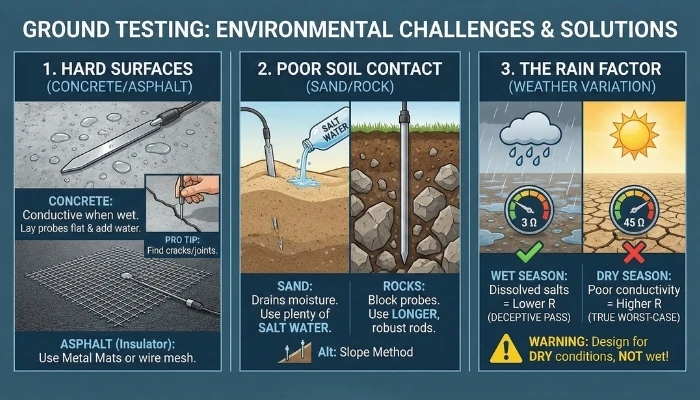
Real-world conditions are rarely perfect. Here is how to handle the tough spots.
8. Testing on Concrete or Asphalt (Macadam)
The Problem: You cannot drive probes into a parking lot or warehouse floor. The Solution:
-
Concrete: It conducts electricity fairly well. Lay the probes flat and wet the area with water.
-
Asphalt: It is an insulator. You may need to use metal contact mats or heavy wire mesh with water to establish a connection.
-
Pro Tip: Look for expansion joints or cracks where you can insert a thin probe to reach the soil beneath.
9. Testing in Sandy or Rocky Soil
The Challenge: Sand drains moisture instantly, and rocks prevent good contact. The Solution:
-
Moisture: Use plenty of salt water around the test probes to improve conductivity.
-
Longer Probes: In rocky terrain, standard spikes may not work. Use longer, robust probes.
-
Alternative Methods: If the required distance for a standard test is impossible due to terrain, switch to the Slope Method (a variation of Fall of Potential).
10. The Rain Factor: Does weather influence the test?
Yes, significantly. Rain dissolves salts in the soil, increasing conductivity and lowering resistance.
-
Warning: If you test immediately after a storm, you are cheating yourself. A ground system that passes barely after rain will likely fail during dry summer months.
-
Best Practice: Design your system to pass standards in the worst-case scenario (dry season), not the best.
Part 5: Safety and Maintenance Schedules
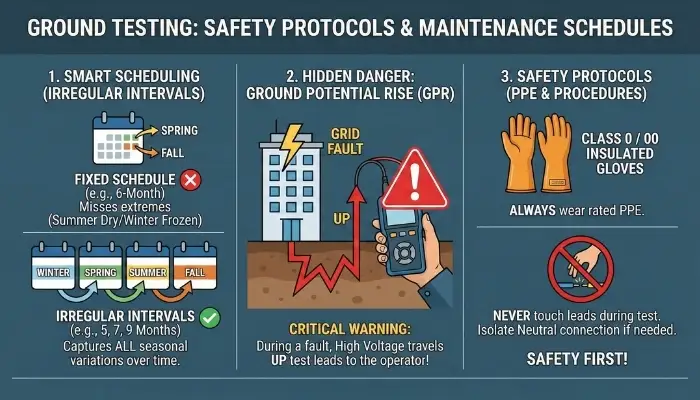
Effective ground maintenance is not a set it and forget it task. It requires a strategic schedule that accounts for seasonal soil changes, alongside strict safety protocols to protect operators from unpredictable grid faults.
11. How often should I test my grounds?
Avoid testing on a rigid quarterly (3-month) or semi-annual (6-month) schedule. Why? If you test every 6 months, you might consistently test in “Spring” and “Fall,” missing the extreme weather of “Summer” (dry) and “Winter” (frozen). Recommendation: Use irregular intervals (e.g., every 5, 7, or 9 months). This ensures your testing cycle rotates through all seasons over a few years, revealing the true worst-case performance.
12. Safety First: The Hidden Dangers
Modern Ground Testers (like Fluke or Megger models) are generally safe, limiting output to ~50V and <50mA. However, the real danger comes from the grid.
⚠️ CRITICAL WARNING: If a ground fault occurs in the facility while you are testing an active electrode, high voltage can travel up the test leads to your instrument.
Always wear insulated gloves (PPE).
Always use a distinct, safe disconnection procedure.
Never touch the leads during a test if there is a risk of lightning or system faults.
13. Neglecting Ground Potential Rise (Safety Hazard)
The Hazard: During a live test, if a line-to-ground fault occurs in the facility, the Ground Potential Rise (GPR) can energize the ground electrode.
Safety Protocol:
- Always utilize Class 0 or Class 00 Insulated Gloves when handling leads.
- Never bridge the gap between the test leads and the electrode with bare hands.
- Isolate the system neutral connection if utilizing a 3-Pole Fall of Potential test to prevent feedback loops.
- Twelve doubts in ground testing that make electrical engineers pretty confused. Electrical Engineering Portal.[↩]




 Bench Multimeters