


When it comes to choosing a reliable digital multimeter, the debate often comes down to Hioki DT4282 vs Fluke 87V. Both are trusted by professionals worldwide, but which one is truly the right fit for your needs? In today’s fast-paced electronics industry, accuracy, safety, and advanced features can make all the difference — whether you’re working on smart homes, electric vehicles, or industrial automation.
This comprehensive comparison guide dives deep into the key differences between the Hioki DT4282 and Fluke 87V, covering everything from measurement accuracy and unique features to build quality, durability, and ease of use. By the end, you’ll have a clear understanding of which multimeter offers the best value for your work — so you can make your decision with confidence.
How to Choose the Best Multimeter: Hioki DT4282 vs. Fluke 87V (Hioki vs Fluke)
After the evaluations conducted by our team, we will now explain the features, specifications, and key advantages of these two digital multimeters: Hioki DT4282 and Fluke 87V.
Comparison of the accuracy of the Hioki DT4282 and Fluke 87V
One of the main questions from users is which multimeter offers better accuracy. For example, the Hioki DT4282 provides acceptable accuracy in measuring DC voltage (±0.025%) and current, making it suitable for laboratories and precise applications, while the Fluke 87V, with an accuracy of ±0.05% for DC voltage, is still perfectly suitable for many industrial users.
Additional features of the Hioki DT4282 and Fluke 87V
Additional features are another common question from users. Many users ask whether features like data logging and internal memory for data storage are important. The Hioki DT4282, with its data storage capability and data logging features, is a great choice for those who need to store and analyze data. On the other hand, the Fluke 87V offers features like Min/Max and a bar graph display, which are more useful for field applications and oscillating signals.
Choosing the Best Multimeter for Industrial Environments: Fluke 87V vs. Hioki DT4282
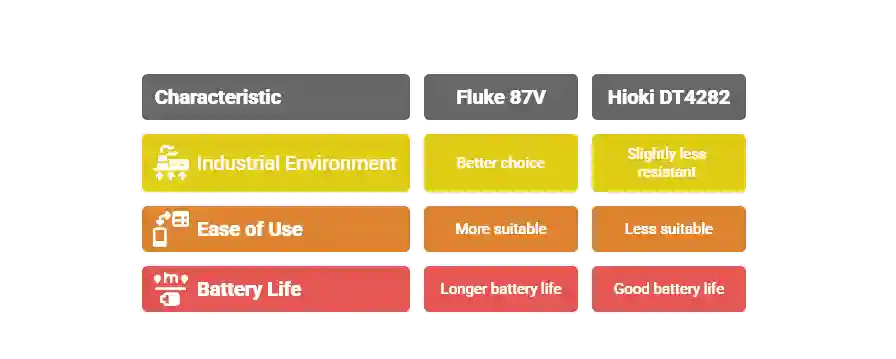
Another question that may occupy users’ minds is which multimeter is more suitable for industrial environments. In this regard, the Fluke 87V, with its shock-resistant design, water resistance, and enhanced safety for harsh conditions, is a better choice for industrial environments. This device is highly suitable for technicians working in challenging conditions. In contrast, the Hioki DT4282 also has a robust build, but it may be slightly less resistant in extremely harsh industrial environments.
Ease of Use and Design: Fluke 87V vs. Hioki DT4282 for User-Friendly Multimeter Selection
Design and ease of use are other factors that users consider when choosing a multimeter. Some users may wonder which device is easier to use. In this case, the Fluke 87V is more suitable for those who need a quick and easy-to-use multimeter, thanks to its simpler design and more readable display. Additionally, the Fluke 87V features a bar graph, which is very useful for observing signal fluctuations.1
Battery Life Comparison: Fluke 87V vs. Hioki DT4282 for Fieldwork Durability
Another question that may arise for users is which multimeter has a longer battery life. The Fluke 87V, due to its more efficient design, offers longer battery life and is better suited for fieldwork where recharging opportunities are limited. While the Hioki DT4282 also has good battery life, it may require more frequent battery replacements due to its additional features.2
Fluke vs Hioki: Which One Should You Choose?
Here’s a side-by-side comparison:
| Feature | Hioki DT4282 3 | Fluke 87V4 |
|---|---|---|
| DC Accuracy | ±0.025% of reading (Ultra High Accuracy) | ±0.05% + 1 digit (Excellent for field use) |
| Display Resolution | 60,000-count, 0.001 mV, Dual Display | 6,000/19,999-count, 0.1 mV, with analog bar graph |
| Voltage Range | Up to 1000V AC/DC, with Low-pass filter | Up to 1000V AC/DC, True RMS, Low-pass for VFD |
| Current Range | Up to 10A AC/DC (continuous) | Up to 10A (20A for 30 seconds), True RMS |
| Resistance Range | Up to 600 MΩ | Up to 50 MΩ, 0.2% accuracy |
| Capacitance | Up to 6000 µF | Up to 9999 µF (0.01 nF resolution) |
| Frequency Range | Up to 100 kHz with PWM filter | Up to 200 kHz with stable RMS accuracy |
| Temperature | –40 to +1000°C (K-type thermocouple) | –200 to +1090°C (80BK probe) |
| True RMS | Yes (for AC voltage and current) | Yes (highly accurate for distorted waveforms) |
| Analog Bar Graph | No | Yes |
| Special Features | Dual display, Parabolic filter, 400 data memory, input shutter | Min/Max/Avg logging, Backlight, Input alert |
| Build & Safety | CAT IV 600V / CAT III 1000V, 1m drop tested | CAT III 1000V / CAT IV 600V, IP67 (MAX), 4m drop resistant |
| Size & Weight | 197×93×53 mm, ~647 g | 201×98×52 mm, ~355 g (without holster) |
| Repairability | SMD components, ceramic fuse, limited user repair | Modular PCB, user-replaceable fuses & LCD, full service manual available |
| Internal Components | ADS1247 ADC, UPD78F MCU, LTC1968 RMS chip, analog switches | AD737 RMS converter, discrete power stages, fuse slots, LCD connector |
| Ideal Use Case | R&D labs, signal analysis, calibration, engineering precision | Field technicians, maintenance, industrial troubleshooting |
Hioki DT4282 – Precision Powerhouse

The Hioki DT4282 is tailored for professionals who demand superior accuracy. It’s especially suited for complex electrical environments such as R&D labs, manufacturing, and advanced troubleshooting.
- Accuracy: Exceptional 0.025% basic DCV accuracy
- Range: Measures up to 600V AC/DC, 10A current, 60 MΩ resistance
- Resolution: As fine as 0.001 mV
- Functions: Diode testing, continuity, temperature (up to 1000°C), capacitance (up to 6000 µF), frequency (up to 1 MHz)
- Safety Features: CAT IV 600V / CAT III 1000V, auto power off, input fuse protection
Ideal for precision-demanding tasks where stability and signal fidelity matter.

Fluke 87V – Rugged & Reliable
The Fluke 87V is a trusted favorite among technicians and field engineers. It’s known for durability, user-friendliness, and solid performance across a wide range of applications.
- Accuracy: 0.05% DCV accuracy
- Range: 1000V AC/DC, 10A AC/DC, 50 MΩ resistance
- Resolution: 0.1 mV resolution – suitable for most use cases
- Functions: True RMS, low-pass filter, temperature, frequency (up to 200 kHz), and capacitance (up to 10,000 µF)
- Safety Features: CAT III 1000V / CAT IV 600V, auto shut-off, input protection, backlit display
Built to withstand tough environments and get the job done, every time.
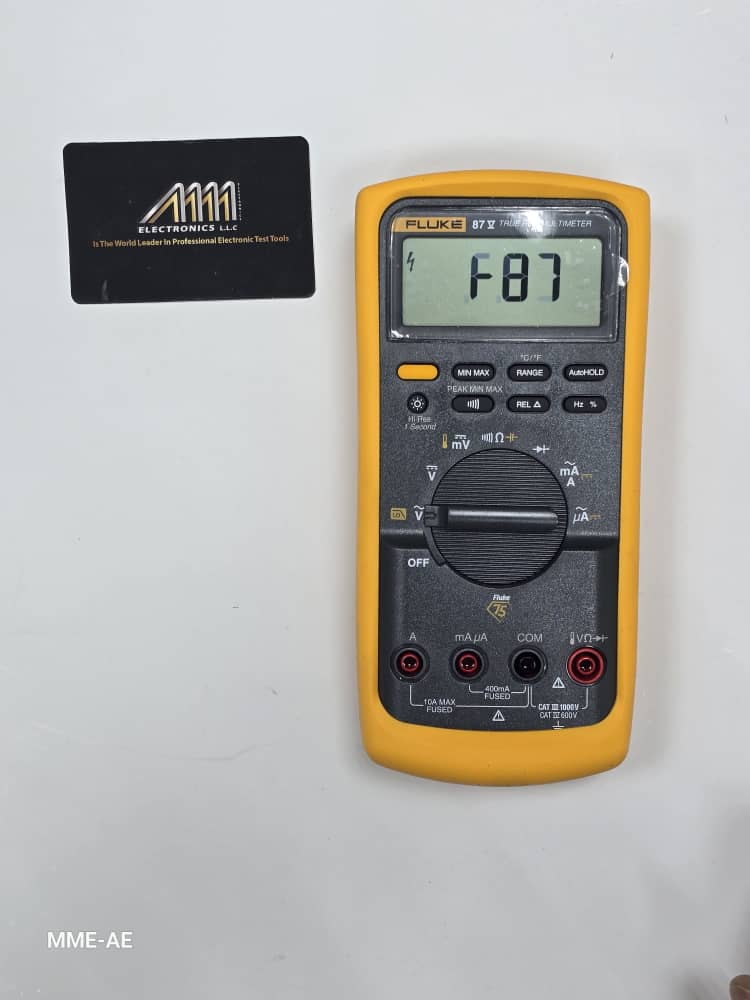
Finally, considering the specific needs for accuracy, design, and features, the choice between the Hioki DT4282 and Fluke 87V becomes a bit easier based on your intended use. Both multimeters are excellent, and ultimately, it depends on which features matter most to you.
In the article [Fluke 87V vs 87V IMSK vs 87V MAX], all the essential details and comparisons are provided; we highly recommend checking it out before making your decision.
Have questions about the Hioki DT4282 or Fluke 87V?
Just ask us! Our team is ready to help you anytime.

- [RS] RS Components. (n.d.). Digital multimeter DT4281/DT4282 [Data sheet]. RS Online. Retrieved August 19, 2025[↩]
- Fluke Corporation. (2004). 80 Series V multimeters: Users manual (Rev. 3). Fluke. Retrieved August 19, 2025[↩]
- Hioki E.E. Corporation. (n.d.). Digital multimeter DT4282. Hioki. Retrieved August 19, 2025[↩]
- Fluke Corporation. (n.d.). Fluke 87V industrial multimeter. Fluke. Retrieved August 19, 2025[↩]





د.إ0.00 (excl.VAT)
(5 reviews)

د.إ0.00 (excl.VAT)
(4 reviews)






 Bench Multimeters