


Did you know that using a multimeter or clamp meter without following electrical safety standards can lead to fatal electric shocks or severe fires in just seconds? According to official OSHA statistics, hundreds of workplace accidents each year are caused by the use of unsafe electrical testing equipment, many of which are entirely preventable.
Choosing a safe multimeter is not just about buying a precise tool — it is a critical decision to protect human lives, industrial equipment, and infrastructure. Brands like Fluke, Hioki, and Kyoritsu, by complying with international standards such as IEC 61010 and safety CAT ratings, have earned the trust of engineers and electrical technicians worldwide.
In this guide, you’ll learn about key concepts such as CAT categories (CAT II, CAT III, CAT IV), IP ratings, and overvoltage protection. By the end, you will have a safe multimeter and clamp meter buying checklist to help you make the best possible choice with confidence.
Familiarity with the Hazards of Working with Measuring Equipment
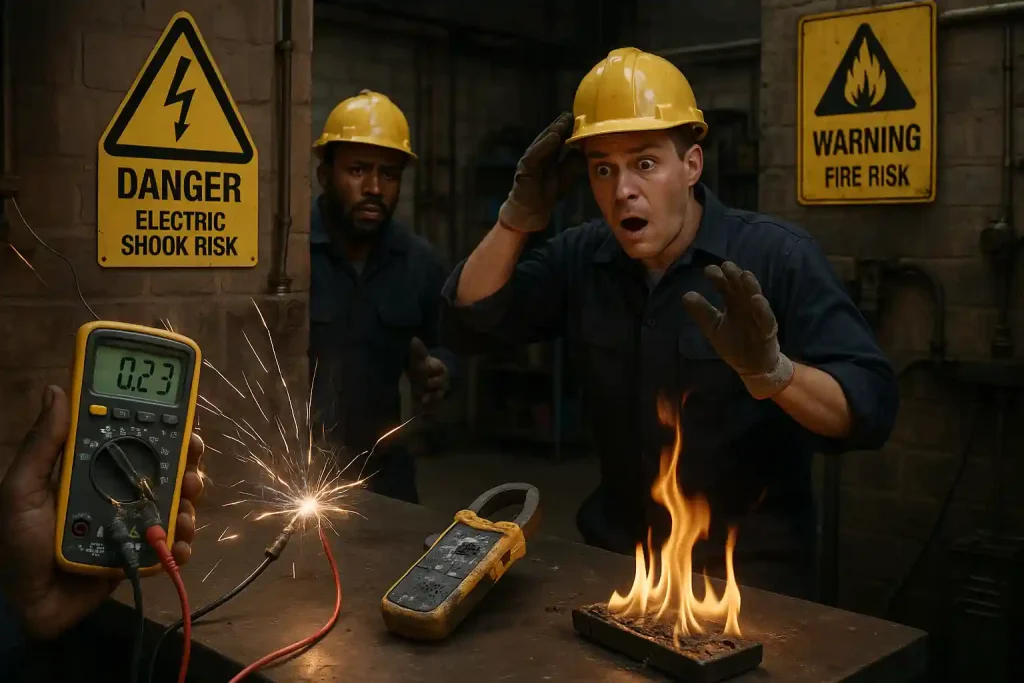
- Electric Shock Hazard
Electric shock is one of the most serious threats when working with testing and measuring equipment. Even low voltages can be fatal under certain conditions, especially if the current path passes through the heart. Using a device with an inappropriate safety rating can allow excessive current to flow through the operator’s body.
- Damage to the Device
Connecting the device to a voltage or current source beyond its rated capacity can result in the burning of circuit boards, fuses, and sensors. In some cases, permanent damage occurs that cannot be repaired.
- Fire and Explosion
Incorrect connections, fuse failure, or the ingress of conductive dust can create sparks, leading to fire or even explosion. This risk is significantly higher in industrial environments or locations with flammable gases.
Overview of Global Standards
Global safety standards for measuring instruments are a set of rules and guidelines developed by international and regional bodies to protect users’ lives and the integrity of equipment when working with electricity. These standards define the required characteristics a device must have in terms of design, insulation, voltage withstand capability, mechanical protection, and resistance to environmental conditions.

Some of the most well-known standards in this field include:
IEC 61010
Developed by the International Electrotechnical Commission (IEC), this standard specifies the electrical and mechanical safety requirements for measuring, control, and laboratory equipment. The CAT ratings (CAT I to CAT IV) are part of this standard and define a device’s ability to withstand transient overvoltages.
IEC 61326
This standard covers electromagnetic compatibility (EMC) requirements, ensuring that equipment maintains safe and accurate operation under electromagnetic interference or radio frequency emissions.
UL 61010
The U.S. version of the IEC 61010 standard, implemented and certified by Underwriters Laboratories (UL). This version is designed to comply with U.S. regulations.
CE Mark
A European conformity mark indicating that the product meets all applicable EU safety, health, and environmental protection requirements. The CE Mark is mandatory for entering and selling products in the European market.
NFPA 70E
A standard from the National Fire Protection Association (NFPA) that addresses electrical safety in the workplace. It includes practical guidelines for hazard assessment, selection of personal protective equipment (PPE), and safe work practices when dealing with electrical systems.
| Standard / Mark Name | Issuing Organization | Coverage Scope | Relevance to Multimeter & Clamp Meter Safety |
|---|---|---|---|
| IEC 61010 | IEC | Electrical & mechanical safety; CAT ratings | Defines voltage safety levels, insulation requirements, and shock protection |
| IEC 61326 | IEC | Electromagnetic compatibility (EMC) | Prevents measurement errors under electromagnetic interference |
| UL 61010 | UL (USA) | Electrical safety per U.S. regulations | Required for sale in the U.S. market |
| CE Mark | European Union | Safety, health, environmental protection | Authorization to sell in the EU market |
| NFPA 70E | NFPA (USA) | Electrical safety at work; PPE; safe work practices | Reduces risk of electric shock and workplace incidents |
Voltage Safety Categories (CAT Ratings)
CAT ratings define how safely a multimeter or clamp meter can handle transient overvoltages and surges at different points in an electrical system.1

What is CAT (Category) in electrical safety?
CAT (Category) is a safety classification (defined in IEC 61010) that indicates the transient energy a tester can withstand at specific locations in the power distribution chain.
- It’s about surge energy and impulse withstand, not measurement accuracy.
- Always consider both the CAT level and the voltage rating printed on your instrument and test leads.2
CAT Rating Chart
The measurement load is categorized into four distinct levels based on its type.
| Typical Location in the System | Common Examples | Practical Guidance | |
|---|---|---|---|
| CAT I | Internal, low-energy circuits | Signal boards, bench electronics, adapter outputs | Not suitable near mains distribution |
| CAT II | Load side / receptacle level | Household outlets, appliances, office gear | Not enough for distribution panels |
| CAT III | Building distribution | Switchboards, distribution panels, fixed wiring, motors, hard-wired UPS | Standard for most facility work inside buildings |
| CAT IV | Service entrance / outdoors | Utility meters, service feeders, outdoor lines | Highest protection for the harshest transients |
What is the difference between CAT III and CAT IV?
- Location: CAT III = inside the building’s distribution system; CAT IV = at or near the service entrance and outdoors.
- Transient energy: CAT IV must survive higher-energy surges than CAT III.
- Use cases:
- Work on distribution panels and fixed building wiring → CAT III
- Work on service feeders, meters, outdoor conductors → CAT IV
- Downward compatibility: CAT IV tools can be used in CAT III/II locations; CAT III tools must not be used in CAT IV areas
CAT III 1000V vs CAT IV 600V — which is safer for you?
It depends on where you measure and how much voltage is present.
| Scenario | Better Choice | Why |
|---|---|---|
| Measuring at a service entrance, meter, or outdoor feeder up to 600 V | CAT IV 600V | Location is CAT IV; higher surge exposure demands CAT IV even if voltage is 600 V |
| Measuring inside a distribution panel up to 1000 V | CAT III 1000V | Location is CAT III; you need the higher voltage rating |
| Mixed/unknown environments | CAT IV 600V (or higher) | Safer default; higher CAT covers more hazardous locations |
How to read CAT markings on your meter (and leads)
Look for labels like CAT III 600V or CAT II 1000V:
- First part (CAT level) = where in the system you can safely measure.
- Second part (voltage) = maximum rated working voltage for that CAT level.
Examples:
-
- CAT III 600V → Safe for CAT III locations up to 600 V
- CAT II 1000V → Safe for CAT II locations up to 1000 V
- CAT III 600V / CAT II 1000V → In the more hazardous CAT III environment, the allowable voltage is lower.
How to Choose the Right CAT Rating

To choose the right CAT rating for measuring equipment, you first need to consider your work environment. CAT I is suitable for low-energy circuits, such as electronics or battery-powered devices. If your work involves testing devices connected to power outlets, CAT II is a good choice. For working with electrical distribution systems or circuit panels, look for equipment rated CAT III. Finally, if you’re working in high-risk environments or dealing with high-voltage lines and main electrical service entries, CAT IV offers the highest level of safety. Additionally, you should pay attention to the voltage and current levels you will encounter and choose equipment with a higher CAT rating for environments with greater risks. The higher the CAT, the more resistance the device has against sudden and excessive voltage, ensuring enhanced safety.
Environmental Protection Standards (IP Ratings)
If you’ve ever searched for an easy IP rating chart, the official IP rating standard (IEC 60529), or a plain-English guide to IP ratings meaning, this section breaks it all down so you can choose the right multimeter, clamp meter, or thermometer for tough environments.3
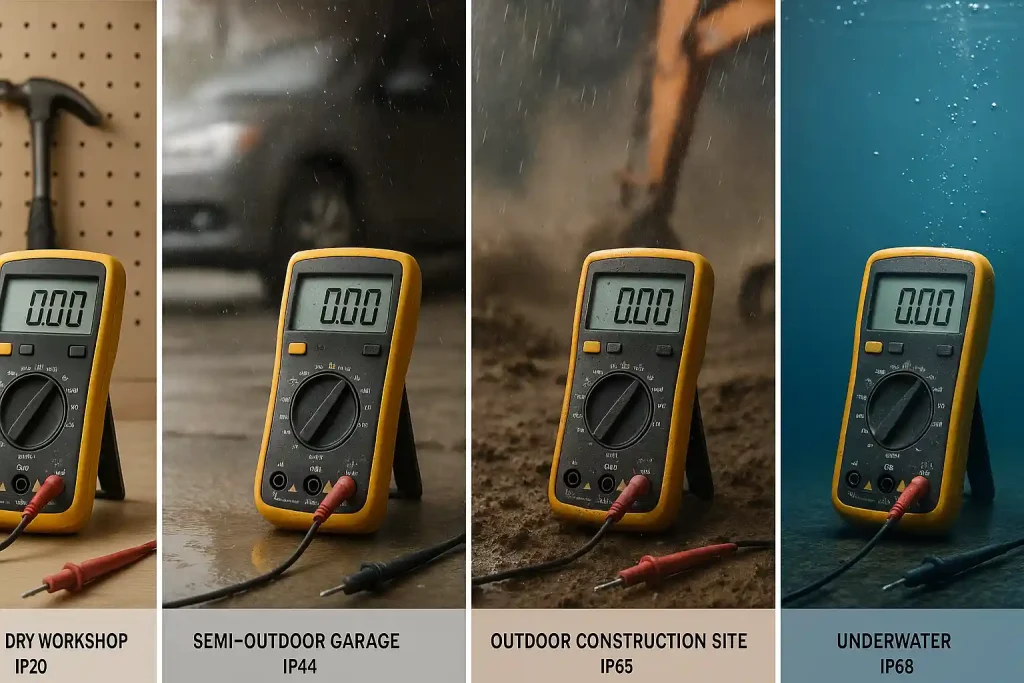
How the IP code is structured
The code looks like IPXY:
- X (first digit, 0–6): protection against solid objects/dust
- Y (second digit, 0–9/9K): protection against water
Example: IP54 means “limited dust protection” and “resistant to water splashes from any direction.
IP rating chart (full meaning for X and Y)
| Digit | Meaning |
|---|---|
| 0 | No protection |
| 1 | >50 mm (back of hand) |
| 2 | >12.5 mm (finger) |
| 3 | >2.5 mm (tools, thick wires) |
| 4 | >1 mm (most wires, small debris) |
| 5 | Dust-protected (limited ingress) |
| 6 | Dust-tight (no ingress) |
| Digit | Meaning |
|---|---|
| 0 | No protection |
| 1 | Dripping water (vertical) |
| 2 | Dripping water up to 15° |
| 3 | Spraying water up to 60° |
| 4 | Splashing water from any direction |
| 5 | Water jets (low pressure nozzle) |
| 6 | Powerful water jets / heavy seas |
| 7 | Temporary immersion (≈1 m, ~30 min; per datasheet) |
| 8 | Continuous immersion (depth/time per manufacturer) |
| 9 | High-pressure, high-temperature water (industrial washdown) |
| 9K | High-pressure/steam-jet washdown (commonly referenced from ISO 20653; used for hygienic/industrial cleaning) |
- IP40 – Solid object protection only; no water protection. Suited to clean, dry indoor labs and classrooms.
- IP54 – Limited dust ingress + water splash resistance. Good for light industrial maintenance and semi-humid areas.
- IP67 – Dust-tight + temporary immersion capable. Ideal for harsh outdoor sites, rain, mud, and incidental dunking.
- IP69/IP69K – Withstands high-pressure, high-temperature cleaning; typical for hygienic or chemical washdown zones.
How to choose the right IP rating (quick guide)
- Dry, controlled indoor spaces → IP40 is typically sufficient.
- Dusty shops or occasional splashes → ≥ IP54.
- Outdoor work / heavy dust / rain / occasional immersion → IP67.
- Regular high-pressure hot washdown → IP69/IP69K.
Other Safety Parameters
When selecting and using electrical measuring instruments, besides CAT ratings and IP ratings, there are several other safety parameters that help prevent hazards and increase the longevity of the equipment. Below, we explain these parameters and how to choose them correctly.
HRC Fuses (High Rupturing Capacity Fuses)
HRC fuses are key components in electrical safety. These fuses are capable of handling high fault currents and quickly disconnecting the flow of excess current in case of an overload or short circuit. HRC fuses have a high breaking capacity and are used to prevent fuse explosions and other damages during short circuits or voltage spikes.
Always use HRC fuses with appropriate capacity according to the device’s specifications to ensure the device’s safety and proper functioning.
Double Insulation Design
Double insulation design means using two separate layers of insulation between the device’s live parts and its outer casing. This feature prevents the transfer of voltage from inside the device to the external surface, which is especially important for devices exposed to moisture or harsh conditions.
In devices that require high safety, such as CAT III and CAT IV multimeters, double insulation design can prevent electric shocks and protect the user from electrical hazards.
Overvoltage Protection
Overvoltage protection is one of the most important safety features in measuring devices. These systems protect the equipment from voltage spikes or surge events. In case of overvoltage, these systems automatically divert the extra current and protect both the device and the user.
Ensure that the device you choose has overvoltage protection, especially in environments prone to transient spikes or significant voltage fluctuations.
Input Alert
The Input Alert feature is available in many modern multimeters. This feature alerts the user when the probes are connected to the wrong input port. This prevents common mistakes and increases both the safety of the device and the user.
Devices with Input Alert ensure that the user cannot make incorrect connections, allowing for more confident and accurate measurements.
Special Standards for Industrial Environments
Depending on the type of work environment, measuring instruments may need specific certifications to perform safely under certain conditions. These standards ensure that devices maintain their safe operation in harsh or hazardous environments.
ATEX for Explosive Environments
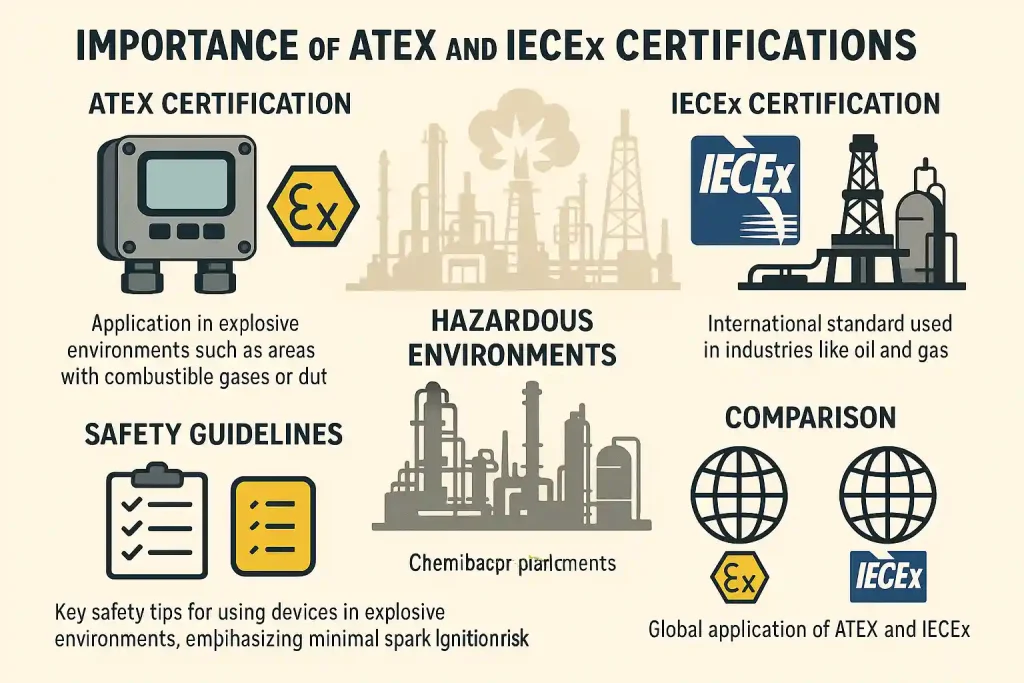
ATEX (short for Atmosphères Explosibles) is a European standard for explosive environments such as areas with combustible gases or dust. Devices used in these environments must comply with ATEX standards to prevent accidents.
Tip: ATEX-approved devices for use in explosive environments should have minimal spark and ignition risk. This standard is essential for industries such as chemicals, oil, gas, and mining. 4
IECEx
IECEx is the international equivalent of ATEX and provides certification for devices used in explosive environments worldwide. The IECEx standard is particularly useful in hazardous areas like the oil and gas industry. 5
If your equipment needs to be used in areas with combustible gases, make sure it has either an IECEx or ATEX certification.
International Certifications and Approvals
Measuring instruments should have relevant international certifications such as UL, TÜV, CSA, and CE to ensure safe operation and compliance with regulations. These certifications show that the equipment has undergone rigorous safety testing and can prevent electrical hazards.
Before purchasing industrial equipment, ensure that it carries the appropriate certifications like CE, UL, TÜV, and CSA to guarantee product quality and safety
Safety Tests and Maintenance Tips for CAT and IP Ratings
Having a multimeter or measuring instrument with the correct CAT standard and IP protection rating is only part of the story. If these tools are not properly maintained or tested, even the best certifications can’t guarantee safety. This section teaches you how to keep your equipment safe and extend its lifespan with regular tests and maintenance tips.
Safety Tests Before Use
Before every use, check the following:
- Visual Inspection
- Look for cracks, breakages, or wear in the body of the device.
- Check if the display is scratched or cloudy.
- Inspect for any discoloration or leakage around the ports.
- Test Leads (Probes) Inspection
- Ensure the insulation is intact with no cuts.
- Make sure the metal tips are clean and free of rust.
- Check for Short Circuits
- Test for any unintended shorts with another multimeter to ensure safe operation.
- Fuse Check
- Use the manufacturer-recommended fuses.
- Ensure the fuse is functioning by performing a continuity test.
Maintaining CAT Rating
The CAT rating depends on the device’s internal design and safety features, but improper use can nullify its safety standards.
- Avoid Unauthorized Modifications: Opening or repairing the device by non-professionals can compromise internal safety.
- Use Original Parts: Replacing components with non-standard fuses or probes can affect overvoltage protection and the device’s overall safety.
- Keep Ports Clean: Dust can lead to arcing and reduce the device’s safety level.

Maintaining IP Rating
The IP rating depends heavily on the physical design and sealing of the device.
- Avoid Unnecessary Opening: Opening the device may damage seals and gaskets, compromising its IP rating.
- Proper Cleaning: Use a damp cloth (not immersion) to clean dust or dirt from the device.
- Dry the Device: Even if the device is waterproof, dry it thoroughly after working in wet environments.
Periodic Safety Tests
Industrial organizations recommend periodic testing of measuring equipment:
- Insulation Test: Check the resistance of the internal insulation.
- Dielectric Strength Test: Test the device’s ability to withstand voltages higher than its operational range.
- Calibration Check: Compare the device’s reading with a reference source.
Test Interval Suggestions:
- In heavy industrial environments: every 6 months.
- For general use: annually.
Practical Tips to Extend Equipment Lifespan
- Use Protective Holsters: Always store the device in a shockproof holster to protect it from drops.
- Store at Recommended Temperatures: Keep your device within the manufacturer’s recommended temperature range to avoid overheating.
- Remove Batteries for Long-Term Storage: If the device will not be used for extended periods, remove the batteries to prevent leakage.
- Use Finger Guard Probes for High Voltage (CAT IV) Work: For safety in high-voltage environments, use probes that feature finger guards.
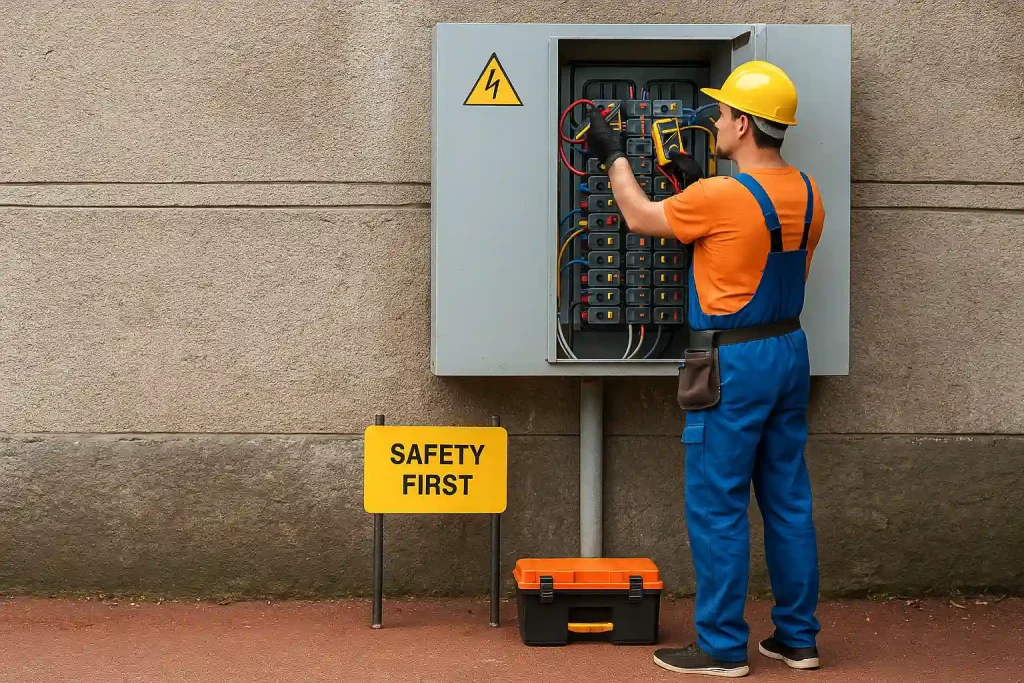
Complementary Standards and International Legal Requirements
In addition to the CAT and IP standards, which determine the safety and physical durability of a device, there are several other international standards and certifications that are important for manufacturers to follow and for buyers to consider. These standards typically ensure that a tool is not only safe in terms of performance but also verified for electromagnetic compatibility, hazardous materials restrictions, and compliance with global regulations.
UL Certification (Underwriters Laboratories)
UL is an independent testing and certification organization in the United States that evaluates products for safety and performance. The presence of the UL mark on a multimeter or measuring tool means the device has been tested for electrical safety and meets strict U.S. standards.
CE Mark (Conformité Européenne)
The CE mark indicates that the product complies with the European Union’s safety, health, and environmental protection regulations. CE-marked equipment can be legally sold across Europe.
RoHS Standard (Restriction of Hazardous Substances)
RoHS limits the use of hazardous substances such as lead, mercury, cadmium, and bromine in electrical and electronic equipment. This standard ensures that the device is environmentally friendly and that toxic materials are minimized in the manufacturing process.
EMC Standard (Electromagnetic Compatibility)
EMC ensures that the device is resistant to electromagnetic interference and does not cause interference with other equipment. In industrial environments with numerous pieces of equipment, electromagnetic compatibility prevents performance disruptions and ensures proper functioning of the devices.
| Standard | Purpose | Application in Measuring Equipment |
|---|---|---|
| ISO 9001 | Quality Management System | Ensures a stable and controlled manufacturing process |
| ISO 14001 | Environmental Management | Reduces the environmental impact of production |
| CSA (Canada Standards Association) | Safety and Performance | Similar to UL but for the Canadian market |
| TÜV | Safety and Quality Testing | Popular in the German and European markets |
Why Are These Certifications Important?
- Global Quality and Safety Assurance: These certifications guarantee that the equipment meets international standards for safety and performance.
- Increased Customer Trust: Products with recognized certifications such as UL, CE, and RoHS build customer confidence.
- International Sales Opportunity: These certifications open doors for selling products internationally, ensuring market access.
- Regulatory Compliance: Meeting these standards helps manufacturers avoid fines, penalties, or product returns due to non-compliance.

- Advanced Energy. (n.d.). Application Note 603: Understanding the CAT ratings on a voltmeter. Retrieved[↩]
- Digikey. (2020, February 25). What are multimeter CAT (category) safety ratings?[↩]
- Apem. (2023, September 10). Understanding IP rating: Protect your HMIs from dust and water. Retrieved[↩]
- European Commission. (2021). ATEX: Equipment for explosive atmospheres. European Commission[↩]
- International Electrotechnical Commission (IEC). (2020). IECEx: Explosive atmosphere standards for electrical equipment. IEC.[↩]




د.إ0.00 (excl.VAT)
(5 reviews)

د.إ0.00 (excl.VAT)
(4 reviews)





 Bench Multimeters