


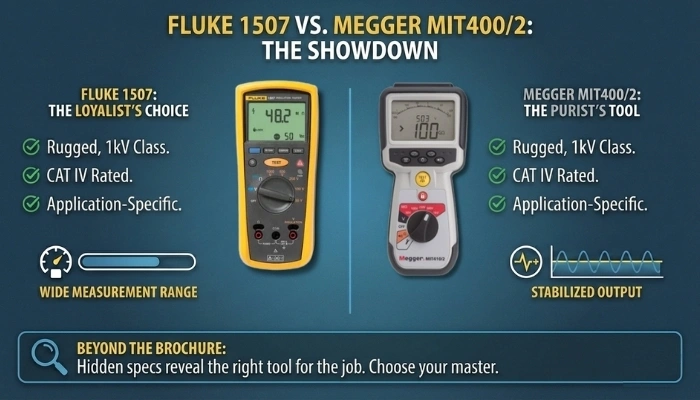
When it comes to preventative maintenance and troubleshooting, the choice of an insulation tester (megohmmeter) often splits the electrical community into two camps: the Fluke Yellow loyalists and the Megger Grey purists.
Two of the most popular contenders in the 1kV class are the Fluke 1507 and the Megger MIT400/2. On the surface, both are rugged, handheld CAT IV rated tools. However, a deep dive into their datasheets reveals that they are engineered for very different applications.
If you are looking for a definitive comparison that goes beyond the brochures, you are in the right place. We analyze the hidden specs—from stabilized output voltage to measurement range—to help you decide which tool belongs in your tool bag.
Technical Comparison table: 1507 vs MIT400/2
In the table below, pay close attention to the Output Voltage Accuracy and Ingress Protection (IP) rows. These are the hidden specs that determine whether your tool survives a wet industrial site—and whether your sensitive electronics survive the test.
| Feature / Spec | Megger MIT400/2 (Industrial Choice) | Fluke 1507 |
|---|---|---|
| Max Insulation Range | 200 GΩ 20x Wider Range |
10 GΩ Standard Range |
| Output Voltage Accuracy | Stabilized (-0% +2%) Safe for Electronics |
Standard (-0% +20%) Potential Over-voltage |
| Ingress Protection (IP) | IP54 Rated Dust & Splash Proof |
IP40 Rated Indoor Use Only |
| Display Type | Digital + Analog Arc Visualizes Fluctuation |
Large Digital Backlit LCD |
| Continuity Range | 0.01Ω to 1000 kΩ Auto-ranging |
200 mA Standard Continuity |
| PI / DAR Calculation | Manual Calculation Available on MIT410 |
Automatic One-button test |
| Test Voltages | 250V, 500V, 1000V Industrial Standard |
50V, 100V, 250V, 500V, 1000V Includes Telecom Voltages |
1. Safety First: The Stabilized Voltage Revolution
The most critical difference between these two units lies in how they manage their output voltage. This is a massive SEO factor for engineers concerned about component safety.
-
The Industry Standard (Fluke 1507): Like most traditional testers, the Fluke 1507 allows the test voltage to rise up to 20% above the selected range. If you select 1000V, the output could legally be 1200V. For cabling, this is fine. For sensitive control boards, it is a risk.
-
The Megger Innovation (MIT400/2): Megger employs Feedback Controlled Test Voltage. This technology locks the output voltage within a tight tolerance of -0% to +2%.
-
Why it matters: If you are testing a circuit that contains sensitive solid-state devices, this megger insulation tester 1000v guarantees that a 500V test is actually 500V (max 510V), eliminating the risk of over-voltage damage.
-
2. Measurement Range: 10 GΩ vs. 200 GΩ
In predictive maintenance, trending is everything. You need to see insulation values dropping over months, not just a Pass/Fail result.
-
Fluke 1507: Caps out at 10 GΩ. If your insulation is excellent, the screen simply reads >10 GΩ. You are blind to the actual value.
-
Megger MIT400/2: Measures up to 200 GΩ.
-
The Advantage: This 20x wider range allows you to track the degradation of high-quality insulation (e.g., in new transformers or HV cabling) years before it drops to a level that the Fluke would even begin to register.
-
3. Durability & Design: IP40 vs. IP54
Fieldwork is dirty, wet, and unpredictable. The ingress protection (IP) rating tells you how well the tool survives.
-
Fluke 1507 (IP40): The standard casing is rated IP40. It is protected against solid objects (like wires) but offers no protection against water. It relies on a separate yellow rubber holster for impact protection.
-
Megger MIT400/2 (IP54): This unit features a dual-case design with rubber over-moulding permanently bonded to the body. It is rated IP54, making it dust-proof and splash-proof.
-
Field Note: The Megger’s battery and fuse compartments are electrically isolated. Even if a battery leaks inside, the main PCB remains safe.
-
4. Display: Digital Precision vs. Analog Insight
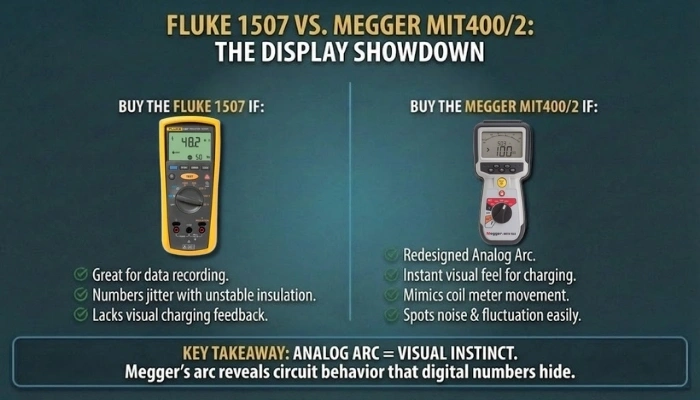
Digital numbers are great for recording data, but they “jitter” when insulation is unstable or capacitive charging is occurring.
-
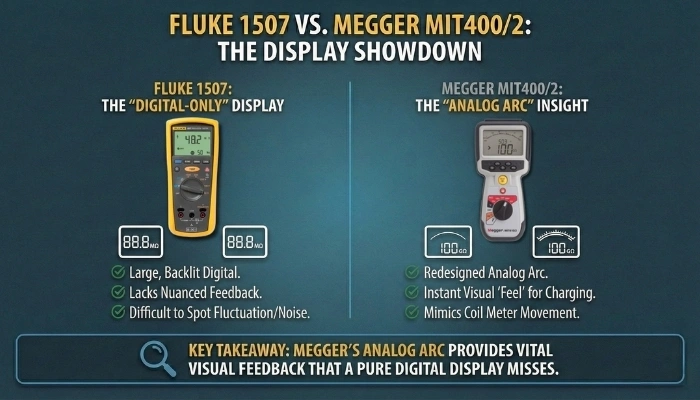
Megger’s Analog Arc: The MIT400/2 features a redesigned Analog Arc that spans the full top of the display. It mimics the needle movement of a coil meter, giving the operator an instant visual “feel” for the circuit’s charging characteristics.
-
Fluke’s Display: The 1507 has a large, backlit digital display. While clear, it lacks the nuanced visual feedback of the Megger’s dedicated arc for spotting noise or fluctuation.
Conclusion: Which One Should You Buy?
The Best insulation tester depends entirely on what you are testing.

Buy the Fluke 1507 if:
-
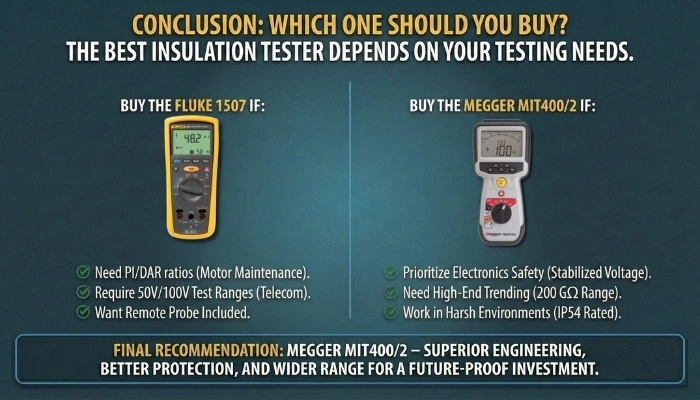
You need PI/DAR ratios at the push of a button for motor maintenance.
-
You require 50V/100V test ranges for telecom work.
-
You want a remote probe included in the box.
Buy the Megger MIT400/2 if:
-
You prioritize Electronics Safety: The stabilized voltage prevents accidental damage to PCBs.
-
You need High-End Trending: The 200 GΩ range allows for early detection of insulation issues.
-
You work in Harsh Environments: The IP54 rating ensures the tool survives rain and dust.
For general industrial and electrical contracting, the Megger MIT400/2 offers superior engineering, better protection, and a wider measurement range, making it the more “future-proof” investment for 2026.






د.إ0.00 (excl.VAT)
(5 reviews)

د.إ0.00 (excl.VAT)
(4 reviews)





 Bench Multimeters