

Finding the right thermal camera isn’t just about picking the highest resolution; it’s about matching the tool to the job. Whether you are inspecting high-voltage lines, checking HVAC systems, or conducting R&D, having the right imager is critical for safety and accuracy.
In this 2026 comprehensive guide, MME experts have tested and ranked the top 10 thermal cameras available in the market. We cover everything from heavy-duty industrial giants like Fluke and Testo to versatile portable options from FLIR and Marmonix.
Why Trust MME? As a leading supplier of T&M equipment in the Middle East, we don’t just read spec sheets—we know which cameras survive the harsh industrial environments and provide accurate data when it matters most.
The Top 10 List
| Rank | Model | Best For… | Key Feature |
|---|---|---|---|
| 1 | Fluke Ti480 PRO | Industrial Pros | MultiSharp™ Focus |
| 2 | FLIR E96 | Long Range | Interchangeable Lenses |
| 3 | Fluke TiX580 | Ergonomics | 240° Rotating Lens |
| 4 | Testo 890 | R&D / Experts | Camcorder Design |
| 5 | Marmonix HTV 340 LPRO | High-Res Value | 384×288 Pixels (Budget) |
| 6 | Fluke TiS75+ | Asset Management | Rugged & Reliable |
| 7 | Testo 868s | Connectivity | Smart App Integration |
| 8 | FLIR C3-X | Pocket Carry | Cloud Upload (Ignite™) |
| 9 | FLIR One Pro | Smartphone Use | Mobile Attachment |
| 10 | FLIR E6-XT | Point-and-Shoot | Simple & Effective |
Introduction to the best thermal imaging camera
Next, we will compare the 10 best thermal cameras in the market from different brands.
1. Fluke Ti480 PRO Infrared Camera
The No-Nonsense Choice for Critical Assets
If your job involves inspecting high-voltage lines or critical turbines where a mistake costs millions, the Fluke Ti480 PRO is your insurance policy. The standout feature here isn’t just the 640×480 resolution; it’s the MultiSharp™ Focus. Most cameras struggle to focus on a fence in the foreground and the transformer behind it. The Ti480 PRO takes multiple shots and blends them, so everything is crisp.
MME Expert Take: “It feels solid in the hand. The pistol grip is balanced, and the screen is bright enough to read under the Dubai sun. It’s expensive, but can you afford not to see a fault?”
-
Pros: Top-tier focus system, rugged build, SuperResolution up to 1280×960.
-
Cons: Heavy to carry all day.
2. FLIR E96 Advanced Thermal Imaging Camera
The Sharpshooter with Interchangeable Lenses
Think of the FLIR E96 as the Swiss Army Knife for professional thermographers. It’s the top dog of the Exx-Series. The real game-changer is the ability to swap lenses. Need to inspect a roof? Put on the wide-angle. Need to check a power line 50 meters up? Snap on the telephoto lens. The camera auto-calibrates instantly.
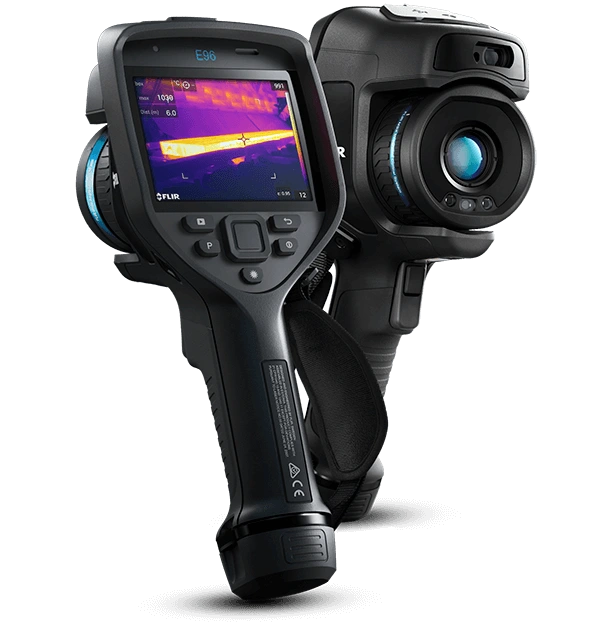
MME Expert Take: “The user interface is slick—it feels like using a high-end smartphone. FLIR’s UltraMax® processing makes the images pop.”
-
Pros: Laser-assisted autofocus, smart lenses, extremely detailed 640×480 images.
-
Cons: Lenses are pricey add-ons.
3. Fluke TiX580 Thermal Camera
The Back-Saver
Ever tried to inspect a motor underneath a conveyor belt? It’s a pain. The Fluke TiX580 solves this with a 240-degree rotating lens. You can hold the screen comfortably at chest level while aiming the lens straight up or down. Plus, that massive 5.7-inch screen is a luxury when you’re trying to analyze data on-site. (Note: Available in standard 60Hz or 9Hz versions).
MME Expert Take: “Ergonomics matter. If you are scanning for 4 hours straight, this form factor is a lifesaver. The screen size is the biggest in its class.”
-
Pros: Articulating lens, huge touchscreen, excellent thermal sensitivity.
-
Cons: It’s bulky; you’ll need a big case.
4. Testo 890 Thermal Camera
For When Precision is Everything
The Testo 890 looks like a camcorder, and it performs like a scientific instrument. It’s designed for R&D labs and high-end consultants. With thermal sensitivity under 40 mK, it detects temperature differences so slight that other cameras miss them entirely. It also records fully radiometric video (video where every pixel has temperature data).
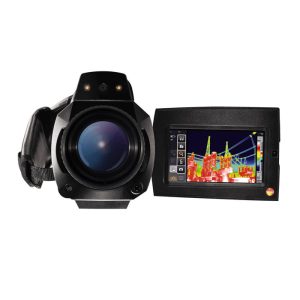
MME Expert Take: “This isn’t for a quick fuse check. This is for analyzing heat dissipation on a PCB board or detailed building envelope audits.”
-
Pros: Camcorder design reduces wrist strain, radiometric video, panoramic image stitching.
-
Cons: Overkill for basic maintenance.
5. Marmonix HTV 340 LPRO
The Budget King with Pro Specs
Let’s be real: not everyone has the budget for a Fluke or FLIR. Enter the Marmonix HTV 340 LPRO. It offers a 384×288 resolution—which is usually found in cameras costing twice as much. The touch screen is responsive, and it handles temperatures up to 600°C.

MME Expert Take: “We sell a lot of these to contractors who need to submit high-res reports to clients but don’t want to break the bank. It gets the job done reliably.”
-
Pros: Incredible value for money, high resolution, durable.
-
Cons: Interface isn’t as polished as FLIR’s.
6. Fluke TiS75+ Thermal Camera
The Organizer
If you manage a facility with thousands of machines, your biggest headache isn’t taking the photo—it’s sorting them later. The Fluke TiS75+ fixes this with Asset Tagging. Stick a QR code on your motor, scan it, and the camera automatically files the image under that asset ID.
MME Expert Take: “It turns a chaotic folder of 500 images into a neat, organized report. It saves hours of admin work back at the office.”
-
Pros: Asset Tagging, dew-point calculation (great for mold), rugged.
-
Cons: Manual focus only (requires a steady hand).
7. Testo 868s Thermal Imaging Camera
Smart, Connected, and Fast
The Testo 868s is built for the modern technician. It connects wirelessly to your phone and to other Testo tools (like clamp meters). This means when you snap a thermal photo of a breaker, the voltage reading from your clamp meter appears right on the image.

MME Expert Take: “Connectivity is the future. Being able to email a report to a client before you even leave their parking lot is a huge competitive advantage.”
-
Pros: Great App, ScaleAssist (prevents interpretation errors), fair price.
-
Cons: Native resolution (160×120) is entry-level.
8. FLIR C3-X
The Everyday Carry
The best camera is the one you actually have with you. The FLIR C3-X is the size of a smartphone and slides right into your pocket. It’s rugged, simple, and features FLIR Ignite™, which backs up your images to the cloud instantly.

MME Expert Take: “Every maintenance supervisor should have one. It’s perfect for that moment when you smell burning plastic and need to find the source fast.”
-
Pros: Ultra-portable, cloud backup, MSX technology (blends visual details).
-
Cons: Battery life is short (approx. 4 hours).
9. FLIR One Pro
Your Phone, Supercharged
For home inspectors, DIY enthusiasts, or occasional use, the FLIR One Pro is brilliant. It plugs into your phone’s charging port. Thanks to VividIR™ processing, the images look surprisingly sharp for such a small device.

MME Expert Take: “It’s a great gadget to keep in the truck glovebox. Just be aware—it draws power from your phone battery.”
-
Pros: Cheapest entry point, uses your phone’s high-res screen.
-
Cons: Not rugged, drains phone battery.
10. FLIR E6-XT
Point. Shoot. Done.
If you need to hand a camera to a junior technician with zero training, give them the FLIR E6-XT. It’s focus-free—meaning everything from 0.5 meters to infinity is in focus. It replaces the legacy i-Series with better resolution and Wi-Fi.
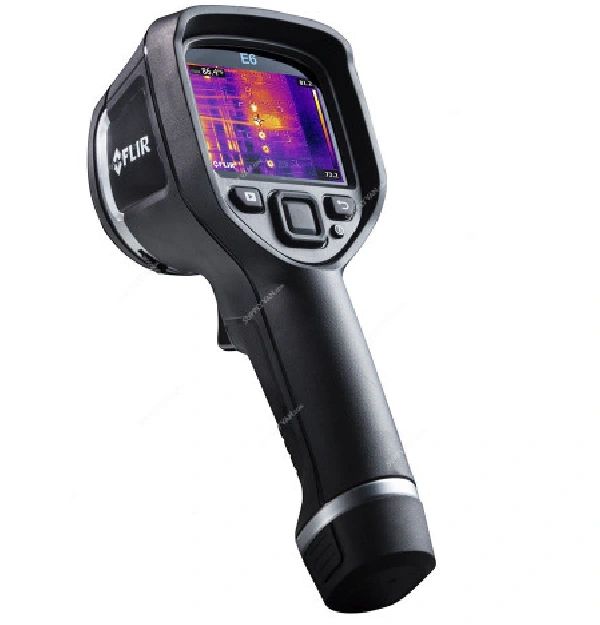
MME Expert Take: Simple is often better. It’s tough, it’s accurate enough for 90% of general troubleshooting, and it just works.
-
Pros: Foolproof operation, extended temp range (550°C), MSX included.
-
Cons: You can’t focus manually on close-up circuit boards.
How Thermal Tech Works & Applications
Need a quick recap on the technology? Here is the breakdown.
Understanding the Magic (How it Works)
Thermal cameras don’t see light; they see heat.
-
Detection: All objects warmer than absolute zero emit infrared energy. The camera lens captures this.
-
Conversion: A sensor (microbolometer) turns that energy into an electrical signal.
-
Visualization: The processor assigns colors to those signals (e.g., White for hot, Blue for cold), creating the image you see.

Where Can You Use Them? (Applications)
It’s not just about finding hot fuses.
-
Electrical: Finding loose connections before they spark a fire.
-
Mechanical: Spotting a bearing that’s grinding and heating up before the motor seizes.
-
Buildings: Tracing water leaks under floors or missing insulation in walls.
-
HVAC: Checking if radiators are blocked or AC compressors are overheating.
-
Medical/Vet: Yes, even doctors use them to find inflammation or infection sites in patients and animals.
-
Safety: Firefighters use them to see through smoke and find trapped victims.
Final Thoughts: Which One is For You?
If you are running a massive plant, invest in the Fluke Ti480 PRO or FLIR E96. If you are a contractor watching your budget, the Marmonix HTV 340 or Testo 868s will serve you well. And for everyone else? Keep a FLIR C3-X in your pocket—you’ll use it more than you think.
Mohammad Mahdi Electronics Trading Llc
Mohammad Mahdi Electronics Trading LLC is a leading player in the thermal imaging camera market, providing top-of-the-line thermal vision cameras and related products to a diverse range of industries. Established with a commitment to quality and customer satisfaction, the company has earned a reputation for supplying some of the best infrared camera solutions available.
Understand the functionality and essential uses of thermal cameras by reading How Thermal Cameras Work and Their Key Applications.
Can’t decide between models? Get a free consultation with our experts. Click here to open popup







د.إ0.00 (excl.VAT)
(5 reviews)

د.إ0.00 (excl.VAT)
(4 reviews)





 Bench Multimeters
One thought on “Top 10 Best Thermal Cameras In The Market”
it was useful thank you for your post